
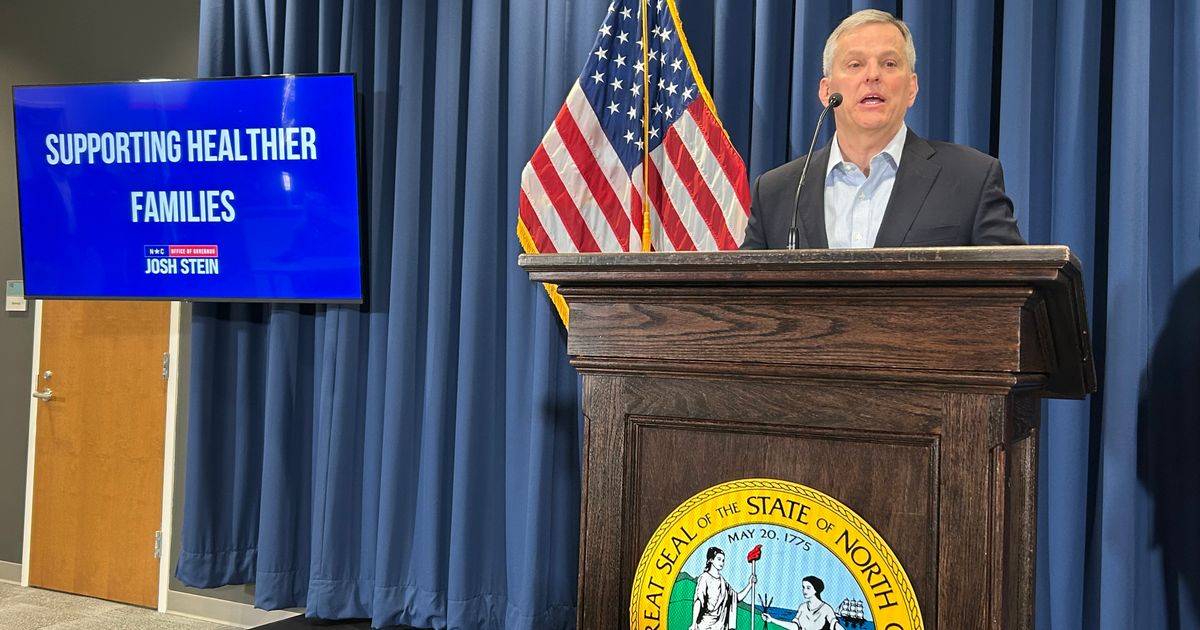
North Carolina Gov. Josh Stein plans to announce new action Thursday on the state’s behavioral health and criminal justice systems.
Stein is expected to lay out details of the actions he plans to take during a morning news conference, his office said in a news release.
Stein’s release didn’t provide specifics, but the announcement comes in the wake of killings in Charlotte, Raleigh and Southport that police say were committed by people with histories of mental illness.
The victim in the Charlotte case was Iryna Zarutska, a Ukrainian immigrant whose stabbing death on a commuter train led to new laws related to mental health and the criminal justice justice system. The victim in the Raleigh case was Zoe Welsh, a teacher who was beaten to death in her home.
Their accused killers, Decarlos Brown in Charlotte and Ryan Camacho in Raleigh, were homeless at the time of the killings, authorities say, and have long criminal histories. Media interviews with family members and public records indicate that each had severe mental illnesses — and that family members spent years trying to get them help as they bounced back and forth between jail, prison and society.
Republican state lawmakers have responded to the killings by accusing Democrats — who control Raleigh and Charlotte city governments — of being “soft on crime.” After Zarutska’s 2025 killing, the legislature passed what sponsors titled “Iryna’s Law,” a set of changes attempting to bring back the death penalty and end cashless bail.
Stein and other Democrats criticized GOP leaders for doing nothing to address the root problems of crime and mental illness to try stopping similar crimes. The new law contained no additional funding for mental health services or law enforcement. Last month, Stein called on the state’s prison system to continue boosting efforts to help ex-inmates become productive members of society, noting that nearly everyone who goes to prison will one day be released.
Stein has cross-crossed the state in recent months to hear recommendations from mental-health professionals and law enforcement officials and community leaders. “We’ve got to do more to get people the health care they need before something bad happens,” Stein said in a statement last week after visiting a behavioral health center in Alamance County.
State lawmakers haven’t passed a new state budget, which has left state-run mental hospitals running on outdated spending plans.
Stein has urged Republican legislative leaders to approve a $195 million proposal that would allocate funding to address law enforcement staffing shortages. He also is pressing lawmakers to provide more funding for Medicaid and mental health care.
Mental hospitals have long suffered from staffing shortages, due in part to low state employee pay, which has meant that many people seeking help — or committed against their will — have been turned away, or sent to stay in jails or emergency rooms for weeks or months at a time.
Another part of Iryna’s Law, seeking to increase the rate at which accused criminals are evaluated for mental illness, has been put on hold as hospital executives and county sheriffs fight over who should oversee those evaluations.
The new law requires that certain defendants — those who have undergone an involuntary commitment within three years of their arrest for a violent crime, or who judicial officials believe to be a danger to themselves or others — must be transported “to a hospital emergency department or other crisis facility” for a psychiatric evaluation.
The mandated location of those evaluations is at the center of the debate between the hospitals and sheriffs.
Hospital leaders say they don’t want the suspects evaluated in emergency departments because they could endanger patients and hospital staff. Instead, hospital leaders suggest conducting the evaluations in jails. Sheriffs oppose that idea, saying hospitals are more appropriate settings for evaluating someone’s health.