
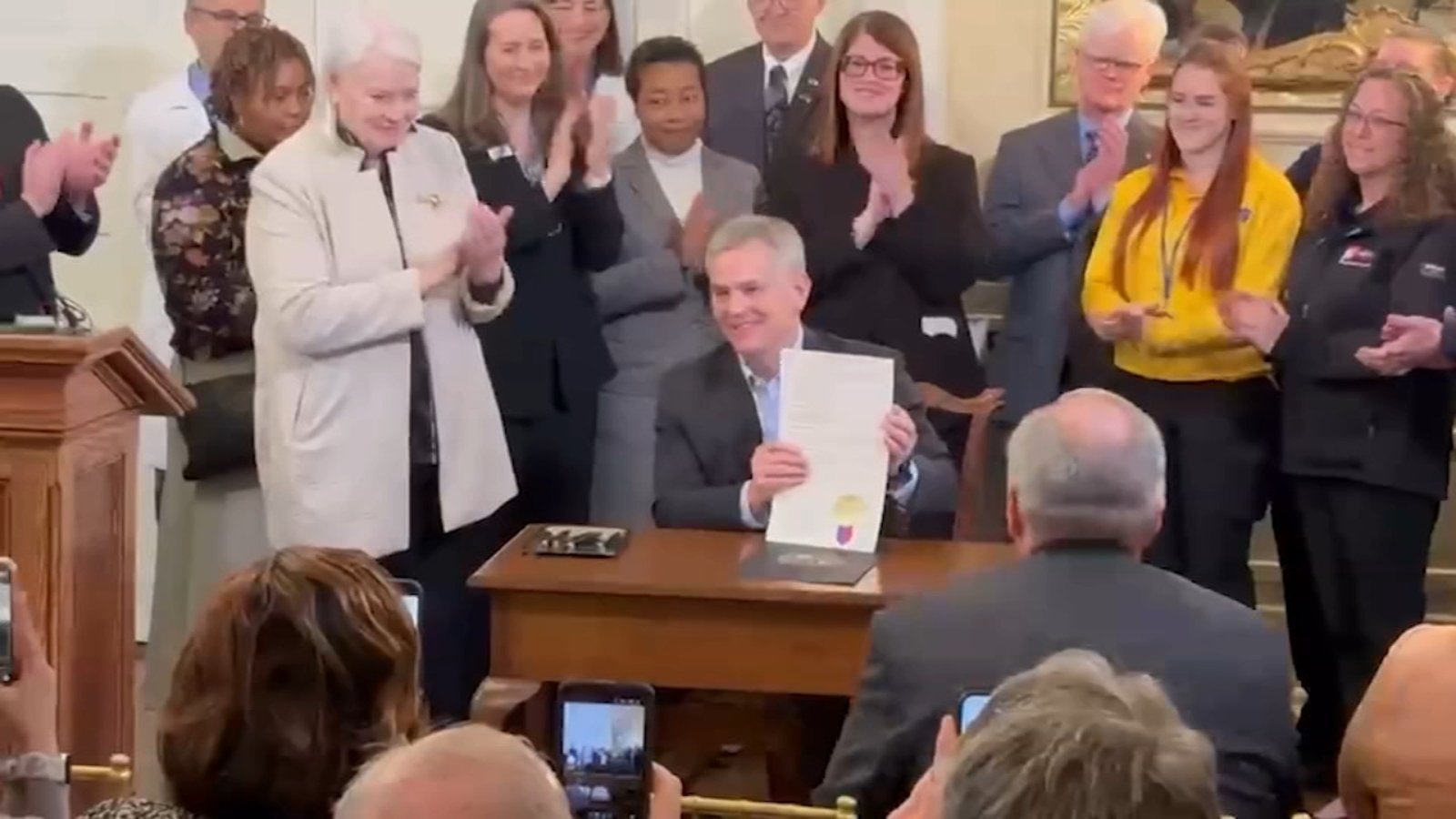
RALEIGH, N.C. (WTVD) — At an event inside the Executive Mansion Thursday, Governor Josh Stein signed an executive order focused on enhancing behavioral health access and public safety.
“We must expand the co-responder model here in North Carolina. That’s when you join law enforcement in coordination with social workers and mental health professionals to respond to service calls. Whether it’s embedding a social worker at the 911 dispatch to identify which person should be responding to which call or strengthening the relationship between 911 calls and 988 calls,” said Stein, referring to the National Suicide and Crisis Lifeline.
The Executive Order focuses on:
Supporting the behavioral health and public safety workforce Strengthening the behavioral health crisis system Improving the involuntary commitment process Strengthening behavioral health treatment for incarcerated people Supporting young people in the juvenile justice system with behavioral health needs Improving reentry supports for people with mental health needs
Deylanis Henderson says she’s faced mental health challenges, and supported the Executive Order.
“Everyone that has mental health (issues) is not necessarily a criminal. Calling the right people to intervene to make sure that people aren’t just going straight to jail or prison and making sure that they get the help that they need so that they can stay on the right path (is important),” Henderson shared.
Henderson says her brother Jacques Clary, suffered from schizophrenia and substance use prior to his death in 2024.
“It takes a toll on my family and we just want to make sure that people know that there are resources out here and don’t be afraid to reach out to them,” Henderson said.
She believes better integration between social services and law enforcement can make an impact in crisis situations.
“It really does make a difference when you’re talking to a counselor and they can calm you down versus seeing a police officer with police cars,” Henderson shared.
Stein supports further work in addressing involuntary commitments, which were part of Iryna’s Law signed into law last year.
“Those petitions are increasing, but we don’t have enough beds to treat all of the people who need them. So I’m directing the Department of Health and Human Services to consult broadly and to recommend (involuntary commitment) reforms for the state. I applaud the efforts by the House (Select Committee on Involuntary Commitment and Public Safety) and the North Carolina Collaboratory for also tackling this critical issue,” said Stein.
Staffing challenges have impacted both access to mental health services and corrections staff. Stein notes that the vacancy rate at the Department of Adult Correction is nearly 50%, while a quarter of inpatient units are not in use due to a lack of of workers.
“I think it’s critical for us to be able to attract new talent by raising the pay for people. But also we have to retain our good staff that we have right now. We have got a large number, almost 14,000 folks, working in our agency every day to see public safety success. Being able to have these step plans and increase their salaries, along with the new starting salaries for correctional officers is going to be critical to our agency’s success moving forward,” said Department of Adult Correction Secretary Leslie Cooley Dismukes.
Stein notes North Carolina ranks 49th in starting pay for corrections officers.
“I’m also directing (Office of State Human Resources) to help (Department of Adult Correction), (Department of Health and Human Services), and (Department of Public Safety) to identify and expand promising recruitment efforts, implement retention programs, address staffing shortages, and make policy recommendations,” Stein shared.
While some work can already start as a result of the Executive Order, Stein acknowledged further funding is needed to address other portions.
“There are things that we can do to enhance coordination, but when it comes to hiring enough nursing assistants to reopen all the units and our mental health hospitals, we need a (state) budget,” Stein said.
Copyright © 2026 WTVD-TV. All Rights Reserved.