
Elizabeth Warren says Kevin Warsh is ‘so much more dangerous’ than previous Federal Reserve chair nominees.An Easton mother filed a lawsuit in the death of her son, who was fatally burned while trapped inside a Tesla that crashed.The chairman of prominent law firm Paul Weiss resigned after the release of emails linking him to Jeffrey Epstein.
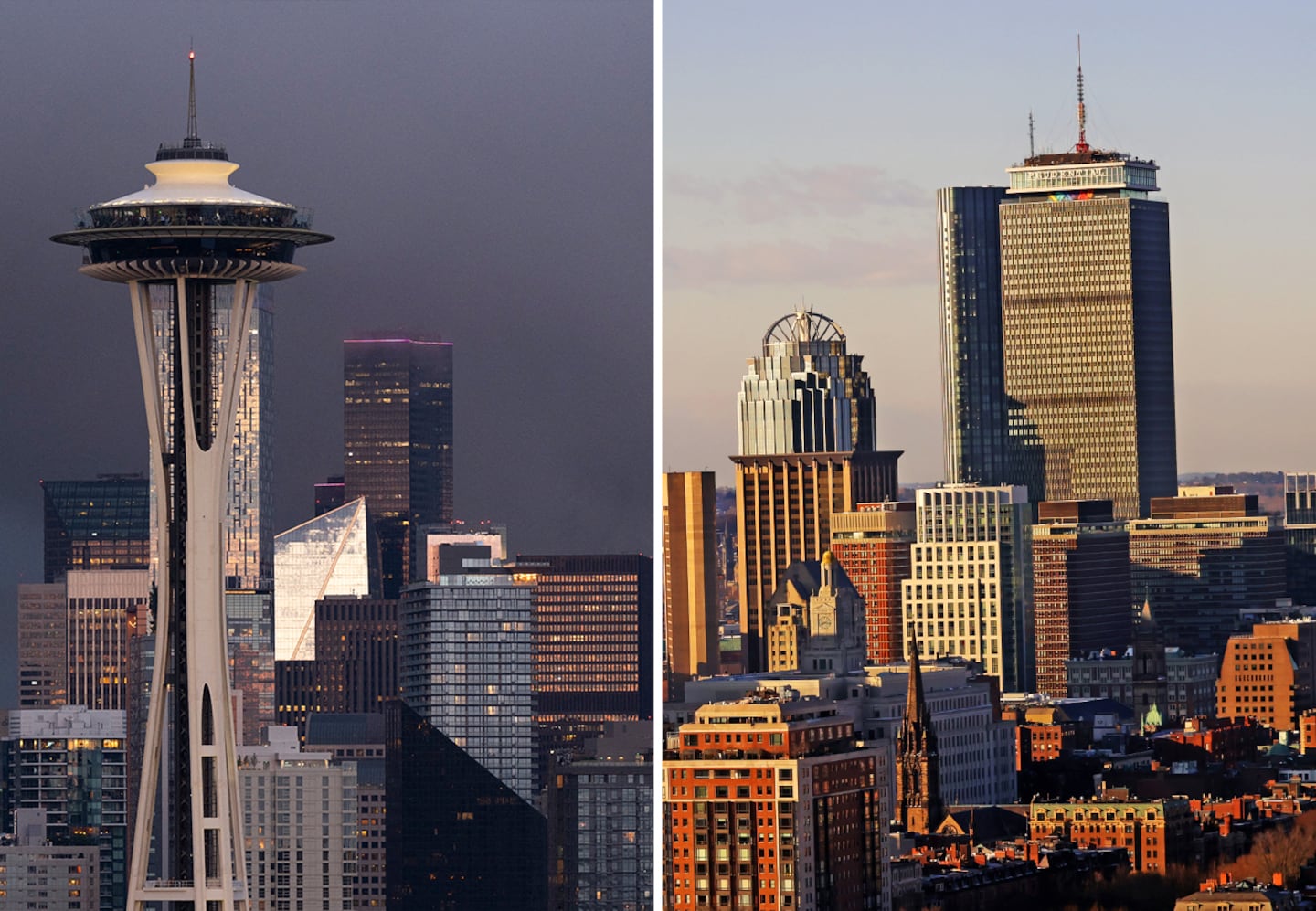
Seattle is about as far from Boston as you can get in the Lower 48, but the two Super Bowl LX cities have traced remarkably similar economic trajectories for decades.
The last time the Patriots faced the Seahawks in the big game, in 2015, each region was a standout economic performer. Today, after a string of forgettable seasons, the teams have their mojo back. But the same can’t be said for their hometowns. Both are on a losing streak.
Telling stats
Unemployment. The jobless rate in the Boston metro area rose to 4.4 percent in November — the most recent month available for the metro area — from 3.7 percent a year earlier. The metro Seattle rate jumped to 5.1 percent from 4 percent amid a spike in layoffs at Amazon and other tech companies.
Commercial real estate. More than 35 percent of office space in Seattle’s central business district was vacant in the fourth quarter, according to Cushman & Wakefield. Boston looked good by comparison at 20 percent. But in our much larger life sciences lab market, vacancies rose to 34 percent.
Outmigration. Both states are seeing more people moving to other states than moving in. In Massachusetts, net domestic outmigration topped 182,000 from April 2020 to July 2024, according to new Census Bureau data. The loss in Washington state was much more modest: 13,000.
Common problems
Key employers under pressure. We know the story in Boston. Biotech payrolls barely budged last year. Hiring in the core health care and education sector slowed dramatically amid federal funding disruptions. Professional and business services firms have shed jobs as their clients struggle.
In Seattle, the story is tech. As companies such as Amazon, Microsoft, and Meta spend huge sums on artificial intelligence, they are cutting jobs in other parts of their businesses. King County, where Seattle is the largest city, is heavily reliant on the information sector, which accounted for 8.4 percent of all jobs last year. Sector employment dropped 3.6 percent in 2025.
High cost of doing business. Washington is one of the few states with no individual or corporate income tax, but it leans heavily on businesses through other levies. The state’s business and occupation tax hits gross revenue, and Seattle adds a JumpStart payroll tax for firms with payrolls over $8 million.
The state enacted a 7 percent capital gains tax in 2022 — the comparable rate in Massachusetts is 5 percent — and is considering an increase to 9.9 percent. Legislators are also weighing a tax on incomes above $1 million, similar to the millionaires tax in Massachusetts.
High cost of living. We gripe continually about inflation in Boston. But consumer prices rose faster in metro Seattle (29 percent) than here (21 percent) from 2021 through 2025.
Housing is as big a problem out there as it is here.
The median sales price for a single-family home in the Seattle metro area was nearly $907,000 in December, according to Zillow. The price in Boston seems like a bargain at $811,300.
But apartment rents here are much more expensive: an average of $3,500 for a 2-bedroom compared with $2,500 in Seattle.
All of which means that the two cities cater to the affluent. The median household incomes in the two metros exceed $115,000 a year.
The big picture
Seattle and Boston traveled parallel routes to get where they are.
Both entered the 1980s dominated by single industries: Seattle depended on aerospace (Boeing and its suppliers), Boston on minicomputers (Digital Equipment, Data General, Wang).
Boeing gradually shifted some production to lower-cost states, and moved its headquarters to Chicago in 2001. The Massachusetts minicomputer industry was a casualty of the personal computer revolution.
Each region leveraged existing strengths into new industries. Seattle built its technology sector on Boeing’s engineering culture; Boston transformed its academic medical complex into a biotechnology cluster. Tech is more volatile than life sciences, but its potential for growth with AI is substantial.
Final thought
Boston and Seattle are at economic inflection points.
They face cyclical challenges from the slowing national economy. They must also contend with structural challenges: dramatic technological shifts, the changing role of urban centers in the remote-work world, and high costs at a time when many families are being squeezed financially.
Only one team will walk off the football field as the winner on Sunday. But in the fight for economic relevance, Boston and Seattle could both be winners or losers. It all depends on the plays they call.
“This ranks among the darkest days in the history of one of the world’s greatest news organizations.”
— Marty Baron, former executive editor of The Washington Post, on the paper’s decision lay off one-third of its newsroom staff.
Slow zone: The rollout of Boston-based Vertex’s treatment for sickle cell disease has hit unexpected an roadblock: specialists can’t collect enough cells to create the infusion product.
Cascade effect: Black and Latino college enrollment has shifted since the Supreme Court’s ruling on affirmative action.
Pain point: President Trump said Harvard University should have to pay $1 billion to settle a litany of allegations, including allowing antisemitism to fester on campus, up from an early demand of $500 million.
Rejected: About one in five claims submitted by providers to commercial health insurers in Massachusetts in 2024 were denied, the vast majority for administrative reasons, according to a new report.
Aiming high: Elon Musk’s SpaceX filed a plan with the Federal Communications Commission to create a network of AI data centers in space, with up to 1 million satellites circling the globe in low Earth orbits.
Busted: Six weeks after it abruptly closed, Circle Furniture filed for bankruptcy, saying it had hundreds of customers who paid for purchases that haven’t been delivered.
$175 billion-$185 billion
— Google parent Alphabet’s forecast for capital expenditures in 2026, up to double last year’s spending, mostly on an increase in AI spending.
 Bradley Cooper (left) and Matthew McConaughey in a scene from an Uber Eats ad set to run during Super Bowl LX.Uncredited/Associated Press
If you believe the Uber Eats TV ads, the NFL was created solely to sell food. It will be hard to debunk that comedic conspiracy theory at Levi’s Stadium in Santa Clara, Calif., home to Super Bowl LX on Sunday. Per Axios:
Fans can expect classic concession fare with regional twists — from Gilroy steak frites ($35), an homage to the self-proclaimed “Garlic Capital of the World,” and Dungeness crab “potachos” ($40), potato chips topped with heaps of crab and white cheddar cream.
Other notables include the super-hot Chinatown-style “dawg” and an over-the-top $180 LX Burger.
The fare for those of us watching on TV might not be as fancy, but it will be a lot cheaper.
Go Pats!
📆 On this date in 1993, President Clinton signed the Family and Medical Leave Act, granting workers up to 12 weeks of unpaid leave for family emergencies.
👋 Thanks for reading. Trendlines will be back on Monday.
✍🏼 If someone sent you this newsletter, you can sign up for your own copy.
Larry Edelman can be reached at larry.edelman@globe.com.