
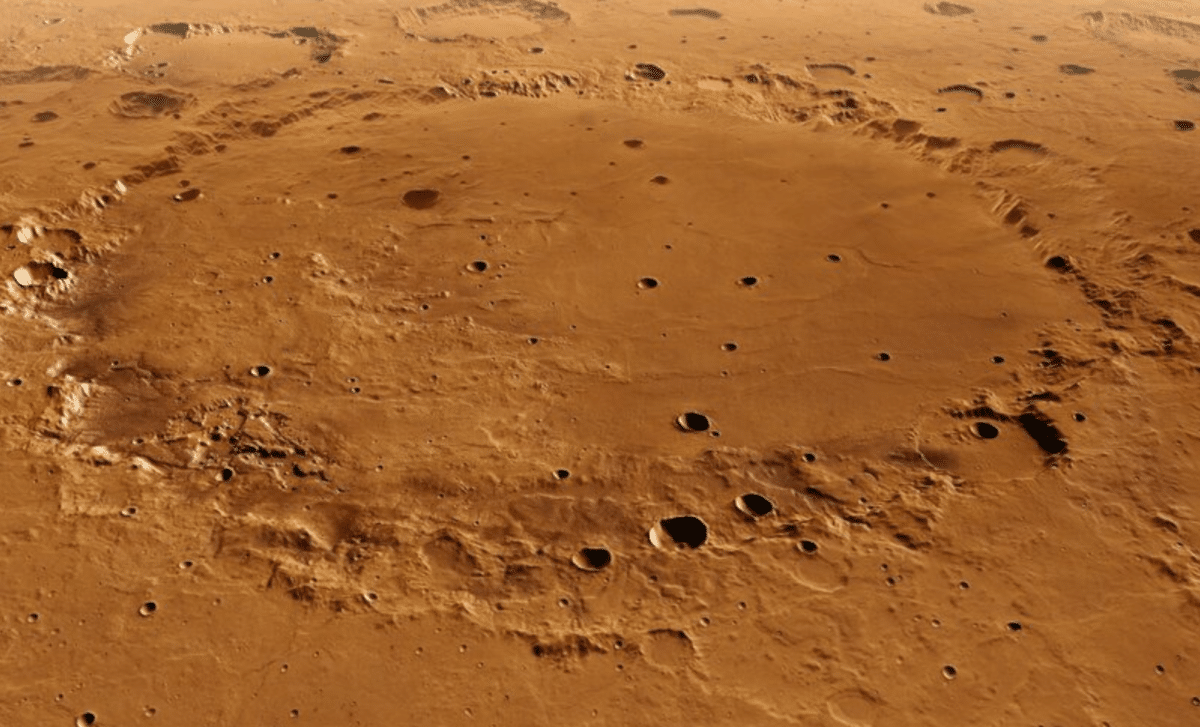
In a breathtaking new view from the Mars Express mission, ESA has released an image of Flaugergues Crater, captured in a flyover video that provides a bird’s-eye perspective of the Martian landscape. The flyover begins by tracking a stretch of ground bordered by two large cliffs, showcasing the rugged terrain of Mars. This stunning imagery, which includes a large impact crater and sweeping ridges, gives us a glimpse into the ancient, scarred Martian surface, revealing both familiar features and hidden wonders. As we venture into this article, we will dive deeper into the story behind this remarkable image, exploring its scientific significance and the technology that made it possible.
The Majestic Martian Landscape: What Makes Flaugergues Crater So Special?
Flaugergues Crater, like many Martian craters, is a remnant of the planet’s violent past. Impact craters on Mars reveal crucial insights into the planet’s geological history, and Flaugergues is no exception. The crater sits among a collection of other similarly ancient formations, creating a rich, detailed map of Mars’ evolution. The terrain surrounding it is jagged, with steep escarpments and ridges, showcasing the impact of eons of natural forces like erosion and meteorite strikes.
The scene captured in this flyover video gives us a bird’s-eye view, offering a rare perspective that helps scientists study the planet’s surface in ways that were previously not possible. The image presents not just the main crater but also the smaller features surrounding it, each of which adds a layer of information about Mars’ history.
Science Behind the Stunning Flyover Video: How ESA Captured Mars Like Never Before
The video of Flaugergues Crater was made possible thanks to data collected by the Mars Express mission’s High Resolution Stereo Camera (HRSC), which uses a combination of high-definition images and topographical data to create detailed, three-dimensional models of the Martian surface. These models allow scientists to study Mars in great detail, analyzing everything from the size and shape of craters to the subtle texture of the planet’s surface.
What makes this flyover particularly special is the atmospheric effects that have been added to the video. The haze seen in the distance, which begins to obscure the view at about 250 km from the camera, mimics the dusty Martian atmosphere and gives the scene a soft, almost dreamlike quality. This is not just for aesthetic purposes; it also helps conceal the boundaries of the terrain model, making the overall representation more realistic.
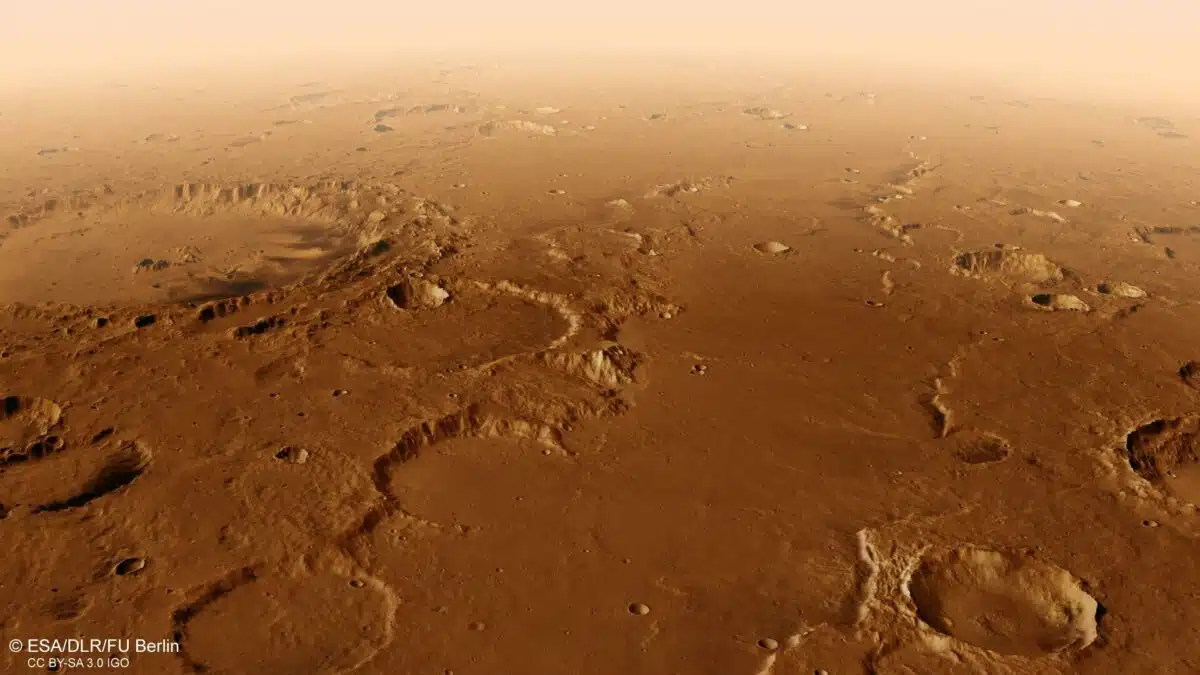 Approaching Flaugergues Crater (bird’s-eye view) Credit: ESA
ESA’s Mars Express Mission: Unveiling the Red Planet’s Hidden Secrets
ESA’s Mars Express mission has been one of the most significant efforts to explore the Red Planet, providing us with detailed images and data since its launch in 2003. The mission’s High Resolution Stereo Camera has captured numerous landscapes, helping to map out the planet’s surface with unprecedented precision. This camera is one of the most advanced instruments used for studying Mars and has allowed researchers to gain a deeper understanding of the planet’s geology.
The flyover video featuring Flaugergues Crater is just one of many incredible discoveries made by Mars Express. By continuing to study the surface of Mars in this way, ESA scientists are uncovering more about the planet’s history, its potential for past habitability, and what it might look like in the future.
What Can We Learn from the Craters on Mars?
Impact craters are more than just scars on the Martian surface; they are windows into the planet’s past. By studying these features, scientists can learn about Mars’ ancient climate, its atmosphere, and the types of events that shaped its surface. Craters like Flaugergues are particularly valuable because they can offer clues about the age of the surrounding terrain and whether there was ever any liquid water present.
In fact, many scientists believe that craters could have once been sites for ancient lakes or even oceans, providing the perfect environment for microbial life to thrive. As Mars Express continues to send back high-quality images, each new discovery brings us one step closer to understanding whether Mars ever supported life.
The Role of Mars Express in the Search for Life on Mars
ESA’s Mars Express mission is not only about mapping the Martian surface but also about understanding whether Mars could have supported life in the past. The presence of ancient impact craters, like the one seen in this flyover, raises the possibility that Mars might have once had conditions conducive to life. By analyzing the composition of Martian soil, rocks, and atmosphere, scientists are piecing together evidence of the planet’s past and its potential to host life.
The HRSC camera, which captures both high-resolution images and topographic data, is a key tool in this effort. By mapping out the surface in three dimensions, it allows scientists to detect subtle changes in the terrain that could indicate the presence of water or other life-sustaining factors. This image of Flaugergues Crater is just one example of how Mars Express is helping to answer some of the most profound questions about the planet’s history.
ESA’s Cutting-Edge Technology: Paving the Way for Future Mars Exploration
The technology behind Mars Express and its High Resolution Stereo Camera has evolved over the years, pushing the boundaries of space exploration. In addition to providing detailed images, these tools allow scientists to build sophisticated 3D models of the Martian surface, which can be used for everything from landing site selection to mission planning for future Mars exploration.
The data provided by Mars Express has been crucial in planning subsequent missions, including the ExoMars rover. This rover, set to launch in the coming years, will explore Mars’ surface in even more detail, searching for signs of past or present life. The work being done by ESA and Mars Express is not only advancing our understanding of Mars but also laying the groundwork for the future of human exploration on the Red Planet.
Why Flaugergues Crater Is a Key Destination for Mars Exploration
As scientists continue to explore Mars, Flaugergues Crater is emerging as an essential area of study. Its unique characteristics, including its size and the way it interacts with the surrounding terrain, make it a key focus for future missions. Understanding craters like Flaugergues can provide important clues about the history of Mars, particularly when it comes to the planet’s ability to sustain life.
This crater, along with others in the region, could offer valuable data on the planet’s past climate, its atmosphere, and how the Martian landscape evolved over time. For future missions to Mars, especially those that aim to look for signs of past life, Flaugergues Crater could be a prime location to study.