
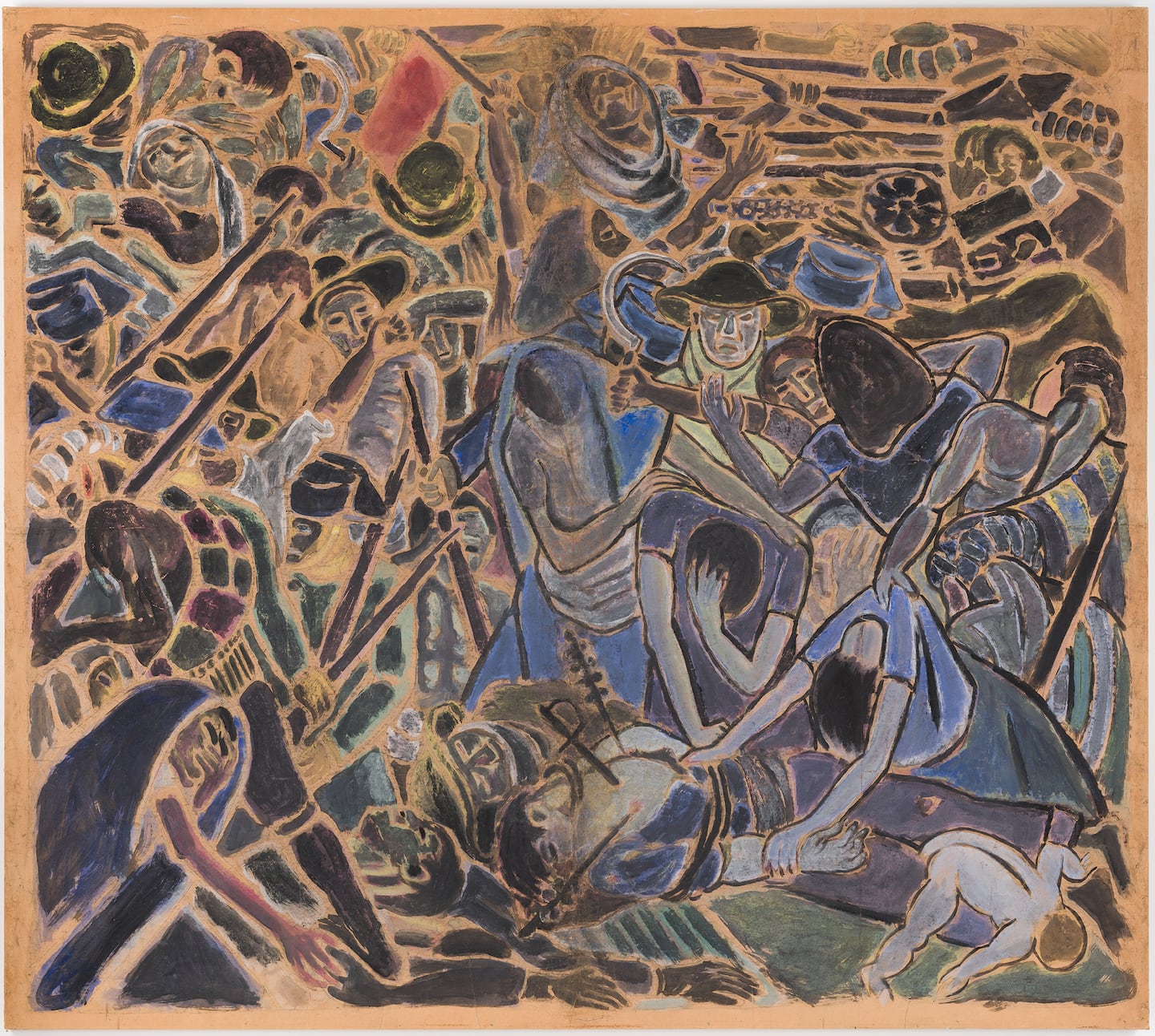
 Wifredo Lam. “La Guerra Civil (The Spanish Civil War),” 1937. © Succession Wifredo Lam, ADAGP, Paris / ARS, New York 2025 Silvia Ros
Lam left Havana, where he was born, in 1923 to study painting at Madrid’s Real Academia de Belles Artes de San Fernando. His early promise at home in Cuba blossomed into intuitive Modernism in his newfound milieu. Picasso’s early foray into Cubism had left its mark across the continent, his homeland among them: An untitled 1937 Lam double-portrait bears the hallmarks of the Spanish giant’s flattened perspective and disconnected forms.
As a young man, Lam thrived in Madrid. But then came civil war. In 1936, he joined the Republican army to protect the city from Franco’s fascist forces, and worked in a munitions factory where chemicals made him sick. Recovering in a hospital near Barcelona, he would make his largest and most charged work to date: “La Guerra Civil,” 1937, a gruesome tangle of bodies — soldiers, civilians, infants — rendered in bleak ash-gray. Lam’s awakening as an artist of charged political ferocity had come.
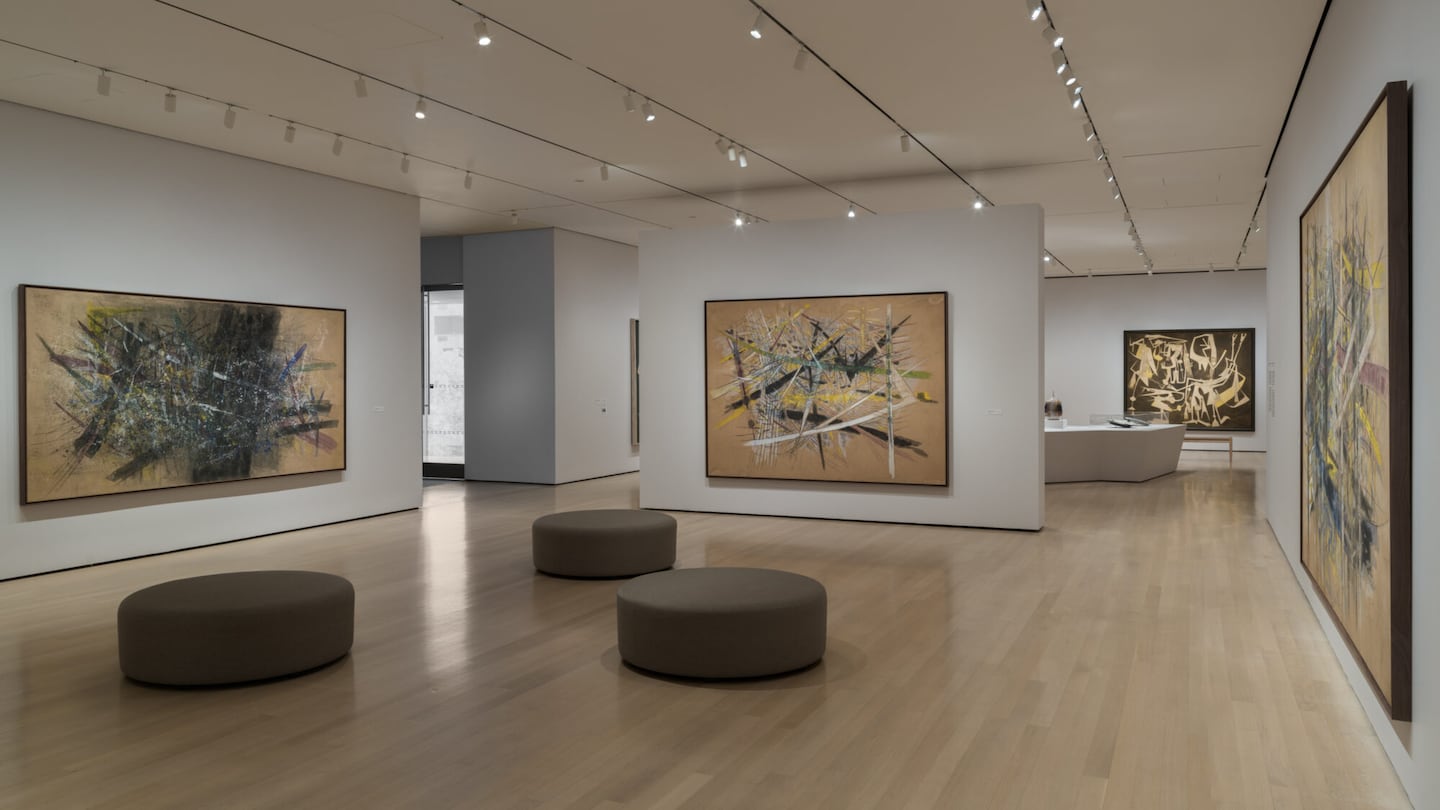 Installation view of “Wifredo Lam: When I Don’t Sleep, I Dream,” on view at the Museum of Modern Art in New York through April 11.Jonathan Dorado
In an exhibition that spans decades of his work, this departure point feels like exactly that: charged, but impersonal, a black-and-white, good-and-evil response to uncomplicated horror. But the strength of the exhibition is the fullness of its story, its attention to the long, slow burn of an artist left perpetually outside the main of broader cultural history in a perpetual state of becoming.
Lam would come to fully embrace his complexity of self, but it took time. In 1938, when Franco declared victory, Lam fled to Paris, where he found a community of remarkable difference. His awakening continued: The flattened figures that the current wave of Modernism embraced transformed in his work into faces that evoked African masks and totemic forms, a latent acknowledgment of his own heritage.
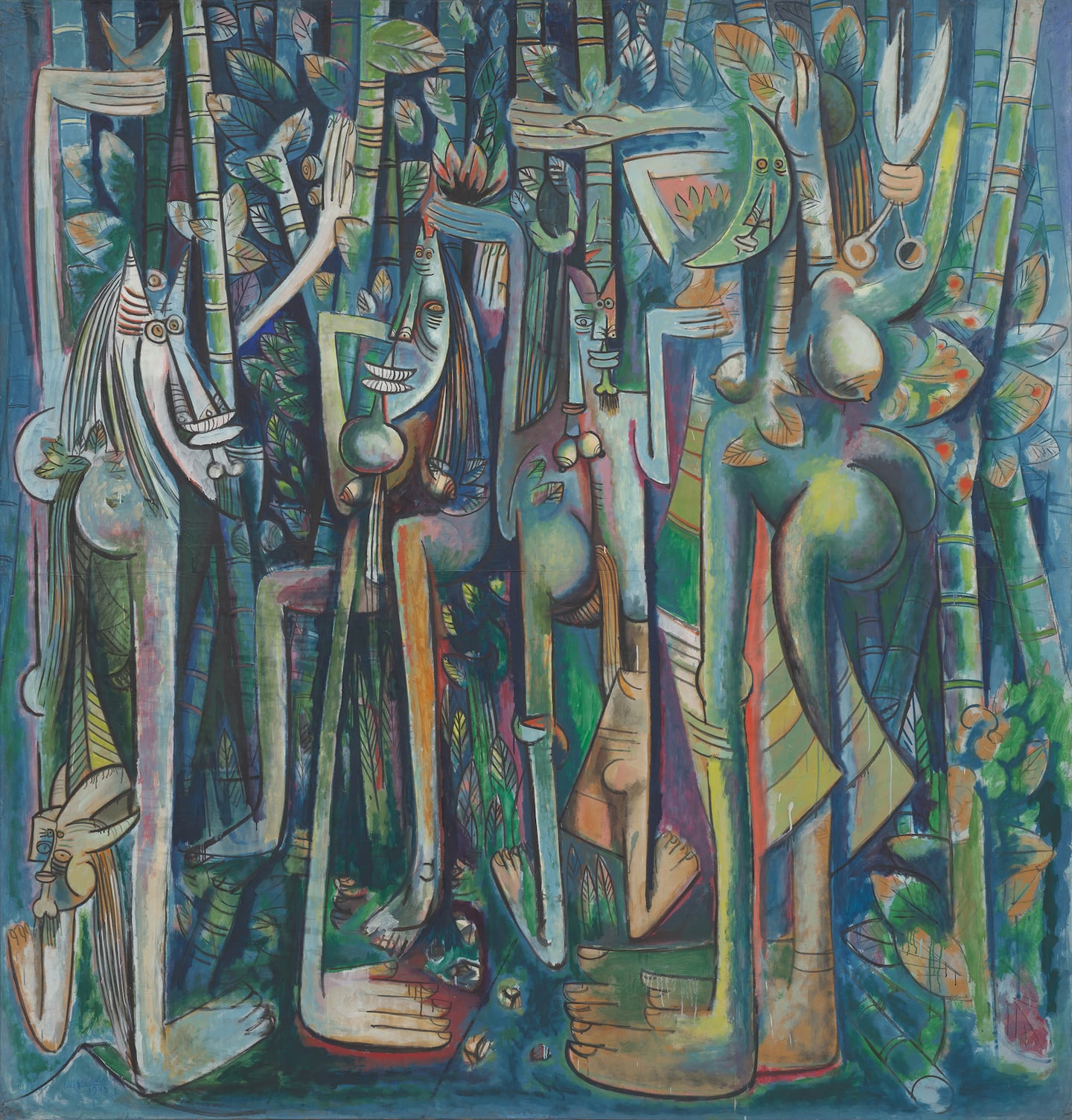 Wifredo Lam. “La jungla (The Jungle),” 1942-43. The Museum of Modern Art, New York © Succession Wifredo Lam, ADAGP, Paris/ARS, New York 2025 Emile Askey
One, “Madame Lumumba,” 1938, is a mournful effigy of a woman with the sharply-cleaved features of a mask-like face. It was titled in hindsight more than two decades later by Lam’s close friend, Aimé Césaire, in honor of Pauline Opango, whose husband, Patrice Lumumba, the first elected leader of the newly-independent Democratic Republic of Congo, was assassinated in a coup in 1961. Built of angular forms piece by piece, the despair is visceral and acute, a presence that separates mere painting from art. Lam had that gift in abundance, and he had barely begun.
It feels like a leap, then, into the next gallery, where what had been intense emotional vignettes explode into painterly epics on par with anything hung on MoMA’s storied walls. “La Jungla,” 1942-43, is a vast, astonishing tableau bristling with dark energy, gutsy and vicious. This is Lam fully in his powers for maybe the first time, with a work that lives up to its epic scale. Nearly 8 feet square, its every inch is charged with electric force — shadows bristlng with a blue-black sheen, toothy creatures shimmering with menace from within its electric green depths.
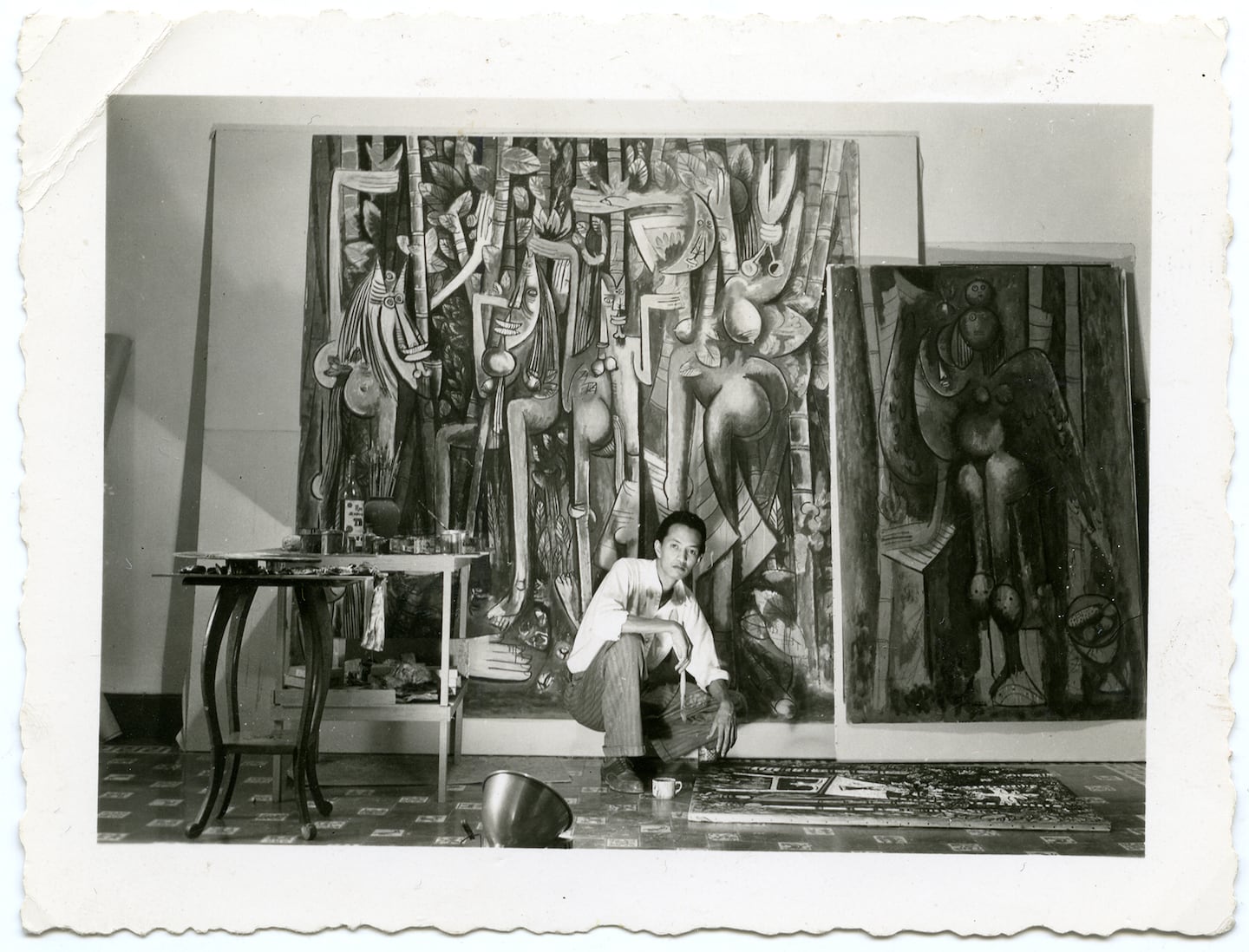 Wifredo Lam with “La Jungla” in his Havana studio, 1943. Archives SDO Wifredo Lam, Paris.Archives SDO Wilfredo Lam, Paris
The piece was made back in Cuba, after his harried escape from advancing fascism in Europe. Lam’s time in Paris had been fruitful, but brief. As the Nazis slashed through the continent en route to the invasion of France in 1940, Lam decamped for Marseille, slipping away by boat to Martinique in early 1941. From there, a short trip across the Carribbean Sea would bring him home, but transformed.
His time in Europe had given him a profound sense of both his own roots and the colonial underpinnings of his homeland itself. He would come to call his painting an “act of decolonization,” an artist more at home in our era than his own, which explains a lot. “La Jungla” is the real departure point — that declaration of self, bundled up with the violent incursions of European invaders over centuries that had made Cuba what it was, and him along with it.
This might be where Lam starts to get lost in the bigger picture. After the war, the art world was shifting into abstraction, led by Americans like Jackson Pollock who believed that pictures of things fell short of conveying the violent spasms of a world remade by millions of war dead. He was wrong, of course, and Lam’s is as good a rebuttal as any.
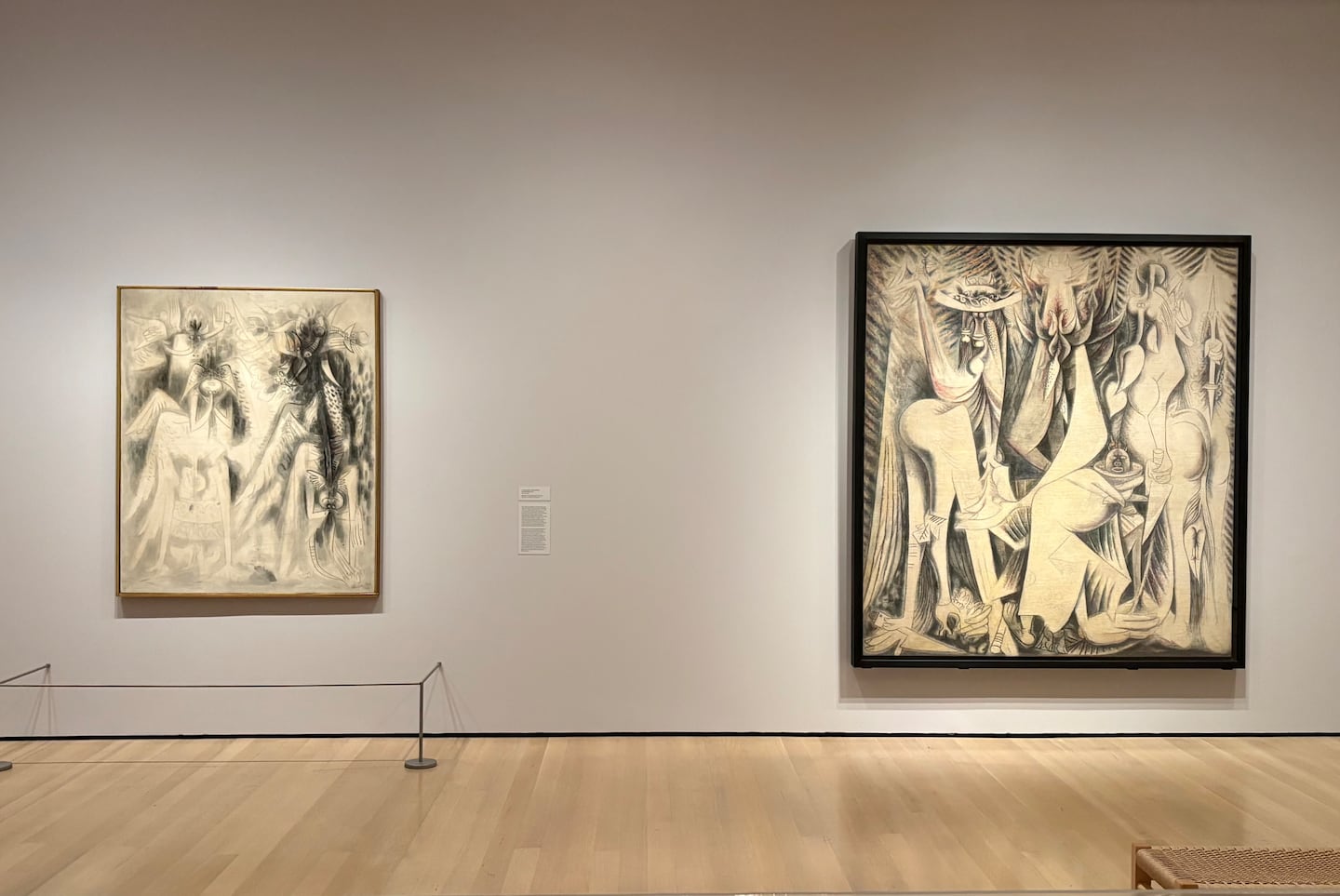 Wifredo Lam, “Annunciation,” 1944 (left), and “The Eternal Present (An Homage to Alejandro García Caturla),” 1944. At the Museum of Modern Art’s “Wilfedo Lam: When I Don’t Sleep, I Dream.”Murray Whyte/Globe Staff
As the Abstract Expressionists looked away from the physical world, choosing to dwell in a realm of pure emotion as they imagined it, Lam was looking deeper into what made that world what it was. He studied Afro-Cuban religion, like Lucumi, and observed Vodou ceremonies in Haiti, where he absorbed its history as the first breakaway independent republic from colonial grasp. Angry spirits accumulated in his work: In animist figures in dynamic struggle, and in scenes of preternatural violence.
“Song of osmoses,” 1945, is a tangle of horned creatures and skulls in a hurricane of rough action, limned in blood red and icy blue. “Omi Obini,” 1943, is a dense thicket of fronds concealing vaguely human form behind a wash of deep sea blue-green. The title, meaning “water woman,” likely referred to a Lucumi water deity. A pair of pale canvases, vast and haunting, feel apparition-like amid the storms of color: “The Anunciation,” 1944, is his version of the collision of faiths in the colonial world — the horned demons of animist religion intermeshed with winged angels in an ashen fog of gray. The other is more pointed. Made in 1944, it’s an homage to the Cuban composer Alejandro Garcia Caturla, an originator of Afro-Cubanismo music who, like Lam, dedicated his work to a culture only Cuba, with its complex, often violent origins, could claim; Lam honored Caturla’s memory with a ghostly palette of sleek, bone-like forms that have the air of animist ritual. It’s as haunting a piece as you’ll find.
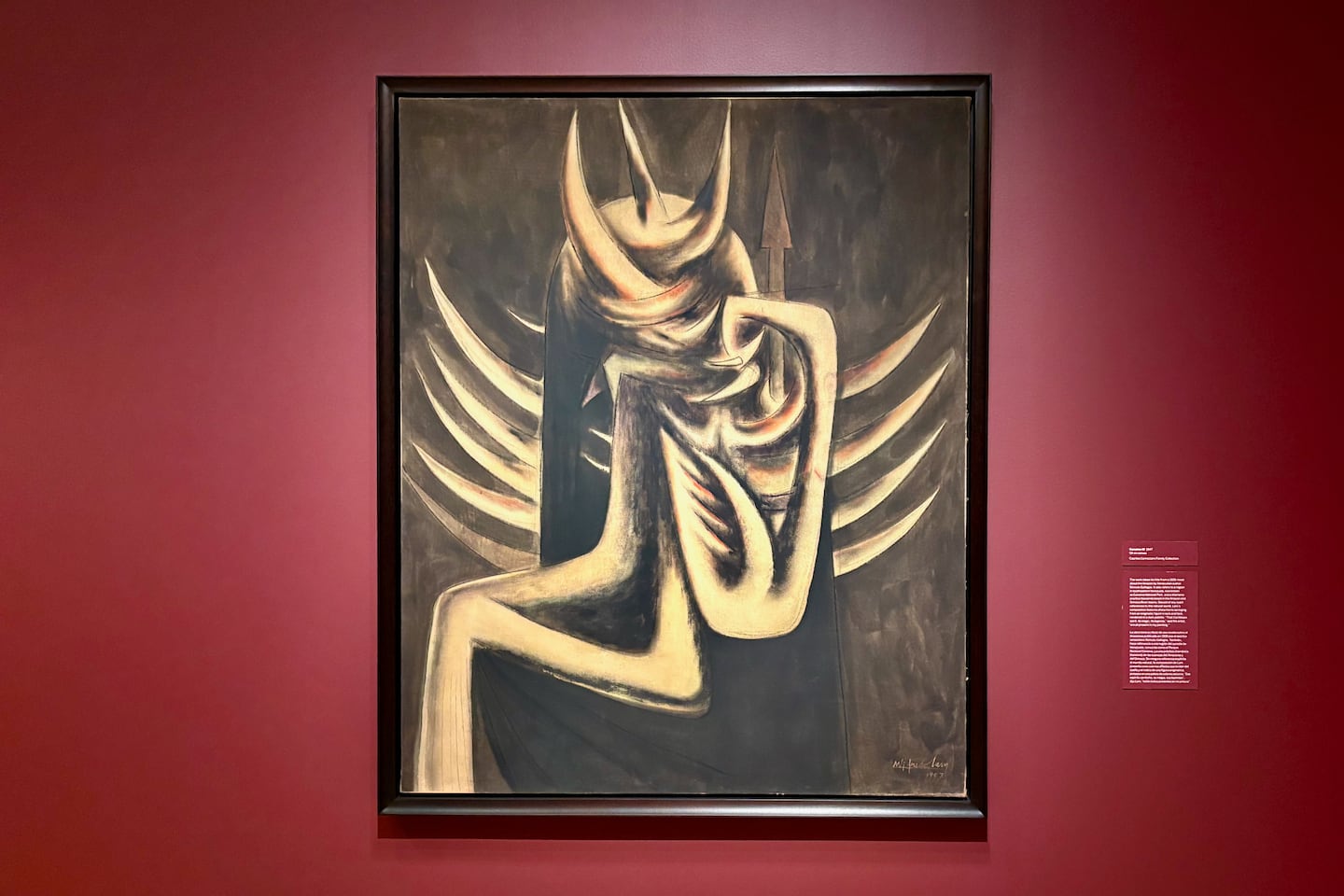 Wifredo Lam, “Cananaima III,” 1947. Installed at the Museum of Modern Art’s “Wifredo Lam: When I Don’t Sleep, I Dream,” on view through April 11.Murray Whyte/Globe Staff
After the war, Lam returned to Paris in 1946 to find it in ruins. It was not the city he had left six years earlier, but he was just as transformed. Now deeply connected to the ravages of colonial history, Lam’s work would turn from light to dark; he returned home quickly, where his work became darker, in every sense. Lam’s distance from European Modernism continued to grow. A small gallery with deep crimson walls marks the turn, most plain in “Canaima III,” 1947, a shoulders-up portrait obscured by shadow and sprouting horns from the face and neck, invoking South American shamanism.
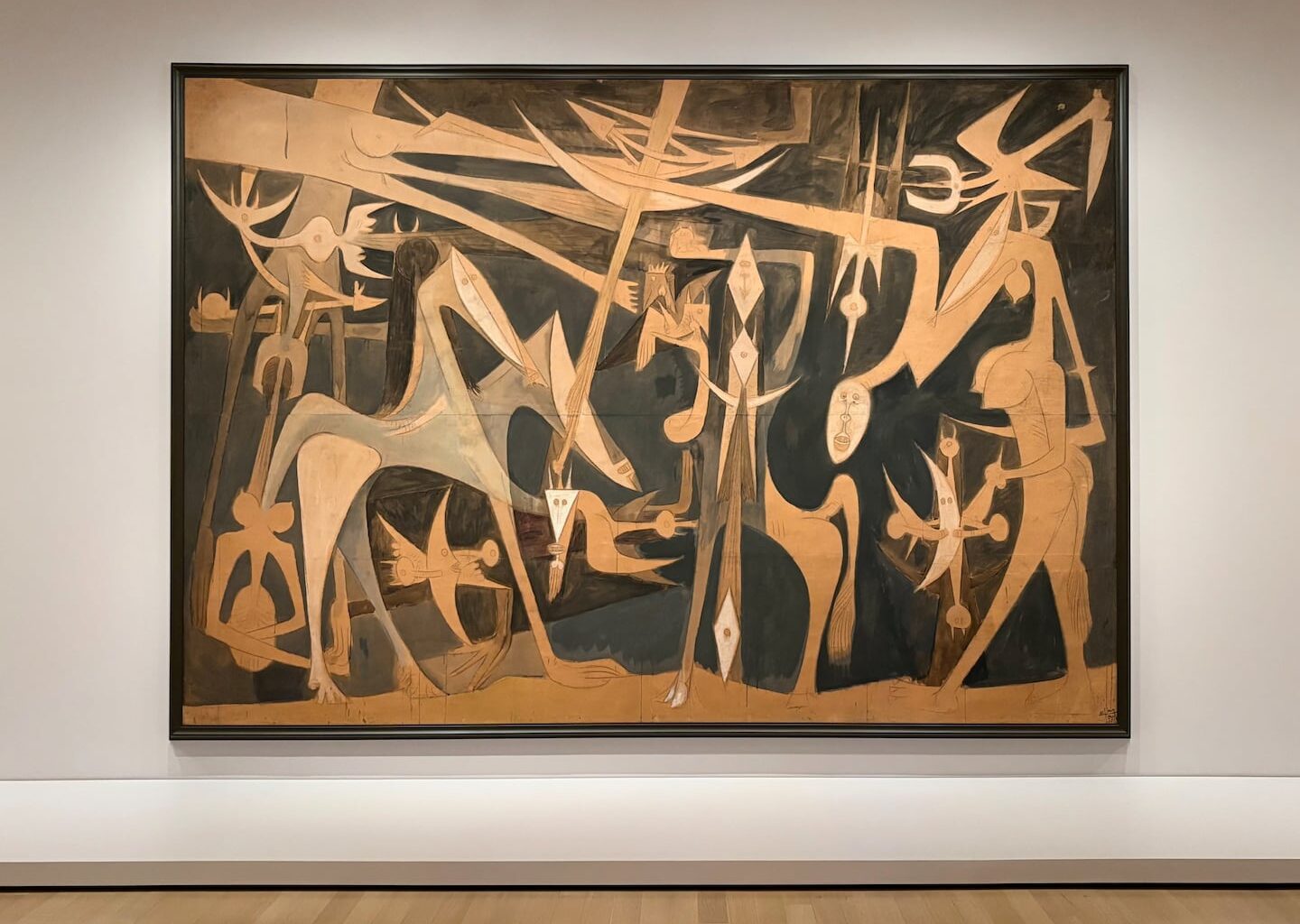
“That Caribbean spirit, its magic, its legends,” he once said, “are all present in my paintings.” Back home in Cuba in 1949, he made what might be his most powerful work: “Grand Composition,” a heaving scene of furious action and collision in a murky pallor of chilly blue-gray. It’s impossible not to think of Picasso’s magnum opus “Guernica,” a brutal scene of Nazi bombing on Franco’s behalf, a prelude to World War II. The conflict for Lam, though, was broader, more epic, and crossed centuries. Within the frame are references to African, Oceanic, and Native American art, all churned under in colonialism’s wake. With Lam, they found passage back to the surface.
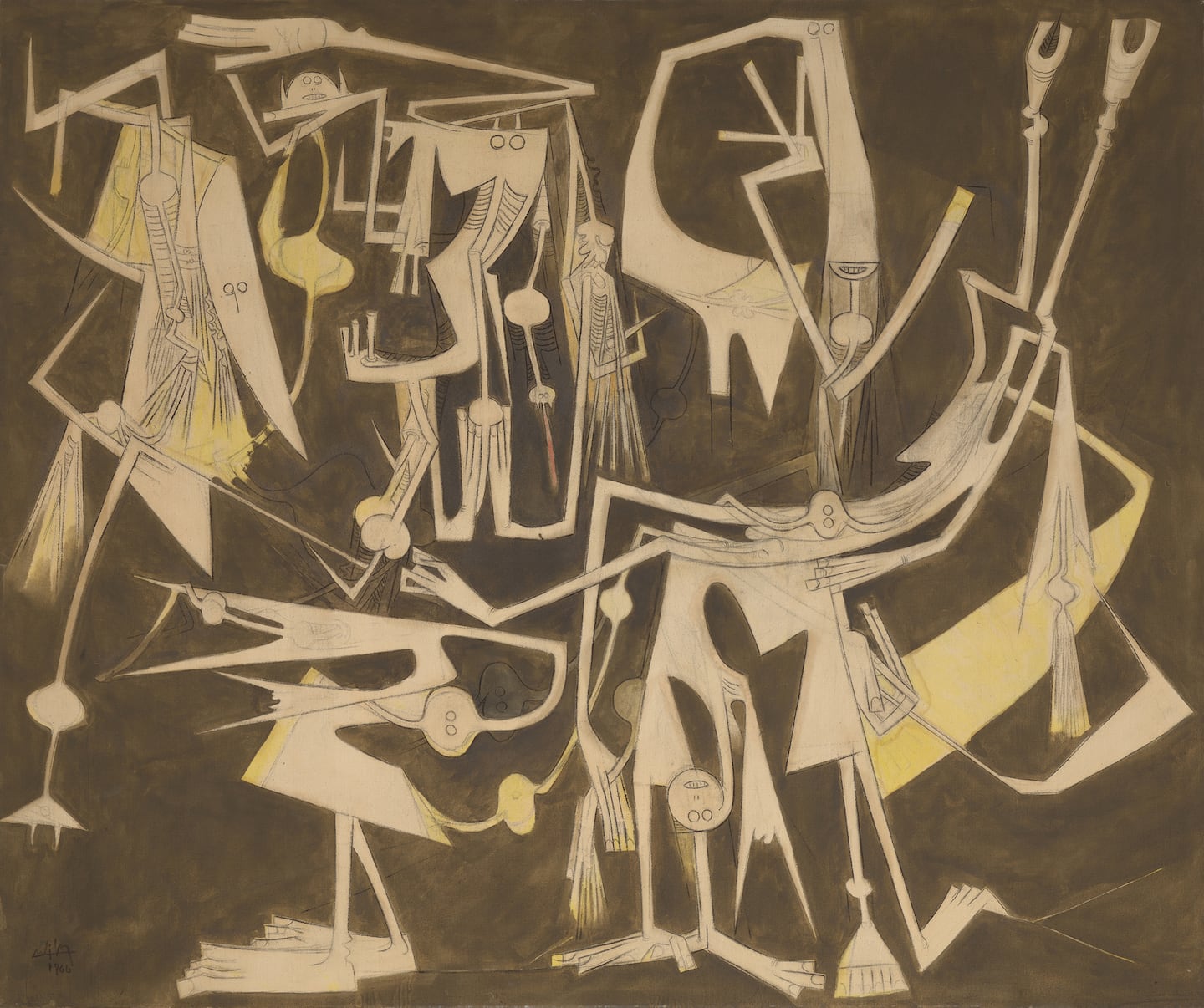 Wifredo Lam. “The Guests,” 1966. © Succession Wifredo Lam, ADAGP, Paris / ARS, New York 2025 Emile Askey
But he would have to carry it inside him. In 1952, the Cuban revolution drove him from home again, and back to Paris. There, distanced from the roots he had come to feel so fully, Lam’s work feels like a grasp at something out of reach. Massive canvases with the violent feel of gestural, abstract action painting reveal, on close looking, heavy thatches of sugar cane and bamboo forest. One untitled canvas from 1958, nearly 12 feet wide, heaves with the glorious fury of his dislocation.
He would visit Cuba again in 1963, four years after the Cuban Revolution, but it was no longer a home he recognized. By then, Lam had decamped for Italy, where he had returned to the ragged, spectral creatures that crowded his imagination — a world of ghosts, locked up for generations, just waiting for him to set them free.
WIFREDO LAM: WHEN I DON’T SLEEP, I DREAM
Through April 11. Museum of Modern Art, 11 West 53 Street, New York, N.Y. 212-708-9400,www.moma.org
Murray Whyte can be reached at murray.whyte@globe.com. Follow him @TheMurrayWhyte.