
An unexpected encounter off Langlade
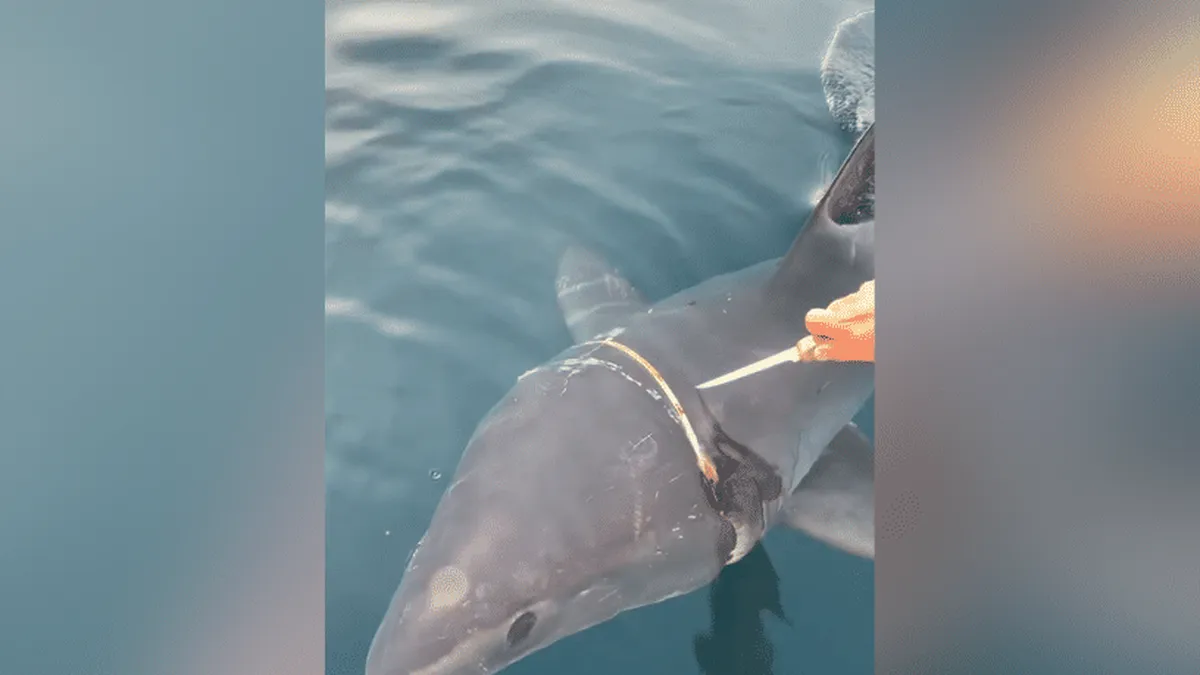
What began as a routine morning to check a bottom line near Anse à la Gazelle turned into a startling confrontation with the cost of plastic pollution. Two French fishermen, Corto and Kahee, found themselves face-to-face with a porbeagle, known locally as a requin-taupe, struggling under the bite of a tight plastic band. The shark kept brushing against their hull, as if drawn by the hope of relief, circling and pressing its wounded flank against the boat.
The pair are no strangers to wildlife offshore. On other days they’ve seen sunfish, orcas, whales, and playful dolphins. But this time the visitor was injured, the plastic loop gnawing into flesh, its edges buried deep beneath skin. In those tense minutes, the ocean felt small, the vessel an improvised clinic, and the crew determined to try.
A rescue attempt under pressure
They used a live bait to keep the shark close, trying to coax it alongside the gunwale while they positioned themselves to cut the strap. More than once, the animal lunged, seized the fish, and wheeled away in a trembling arc. When it returned, they reached for whatever tools they had: slim, flexible fish knives—sharp, but too pliant to sever a band wedged deep into muscle.
The water was dark, the hull rolling, and the risk of a misstep was painfully real. Every pass of the shark offered a brief chance, every retreat reset the fragile trust. They worked methodically, but the band had already infiltrated the wound, turning a quick cut into a dangerous proposition, both for them and for the animal.
“We tried to keep him close without causing more harm, but our knives were too soft. The strap was embedded in the flesh, and we couldn’t cut it with the tools we had,” Corto later explained.
The quiet urgency of an injured shark
Porbeagles are strong, fast predators, built for cold, clear waters. Seeing one move slowly at the surface, nudging a boat, is a sign of unusual distress. The plastic ring had carved a groove, constricting tissue as the shark grew, and every twist of its body deepened the wound. Entanglement injuries are often a slow sentence: they chafe, restrict feeding, and leave animals vulnerable to infection.
A fisherman’s deck is not a clinic, and the crew had to weigh compassion against safety in an uncertain, moving environment. Still, they managed to document the encounter, hoping the images would underscore a message larger than any single day at sea.
A snapshot of a far wider crisis
Every minute, an estimated 15 tonnes of plastic enters the ocean, filtering through gulfs, estuaries, and coastal currents. Some items drift for decades; others fragment into microplastics that pass invisibly through marine food webs. Rings, straps, and loops—seemingly minor items—are especially dangerous because they cinch, catch, and tighten as animals grow or struggle.
Initiatives such as Plastic Odyssey and countless grassroots projects work to curb waste at its source, redesign packaging, and build infrastructure that keeps plastics out of waterways. Yet for every program that scales, there are thousands of everyday decisions that determine whether plastics are properly managed or lost to the sea.
What mariners wish everyone would do
Cut every loop, ring, and strap before disposal, so no animal can be snared.
Secure trash on deck and onshore; wind and spray make light plastics vanish quickly.
Choose durable, reusable gear over single-use items whenever possible.
Support ports and communities with better waste reception and recycling capacity.
Report entangled wildlife to local networks trained for marine animal rescue.
Voices from the water
“He was clearly looking for help, swimming calmly and staying close to the boat,” Corto said. “We tried to keep him within reach with a live fish, but he tore it away and slipped back into the swells.”
That mix of proximity and helplessness etched itself into their memory—a powerful moment that turns statistics into something visceral. On social media, their video struck a nerve, not because of heroics, but because their limits were visible: a small crew, a knife, and a problem too big to solve alone.
The road ahead
The fishermen ended the day without the victory they wanted. The shark swam off with the band still embedded, its fate uncertain, its story now part of a larger chorus urging action. The ocean is a shared home, and pollution is a shared responsibility. What washes off a street or slips from a pier does not simply disappear—it drifts until it ensnares a throat, a fin, or a future.
Moments like this make the stakes plain. They ask us to cut the loops, mind the waste, back the solutions, and remember that the sea connects every shore. If a wounded shark can find a boat and seek relief, then surely we can find one another and act with the urgency that the ocean, and its creatures, deserve.