
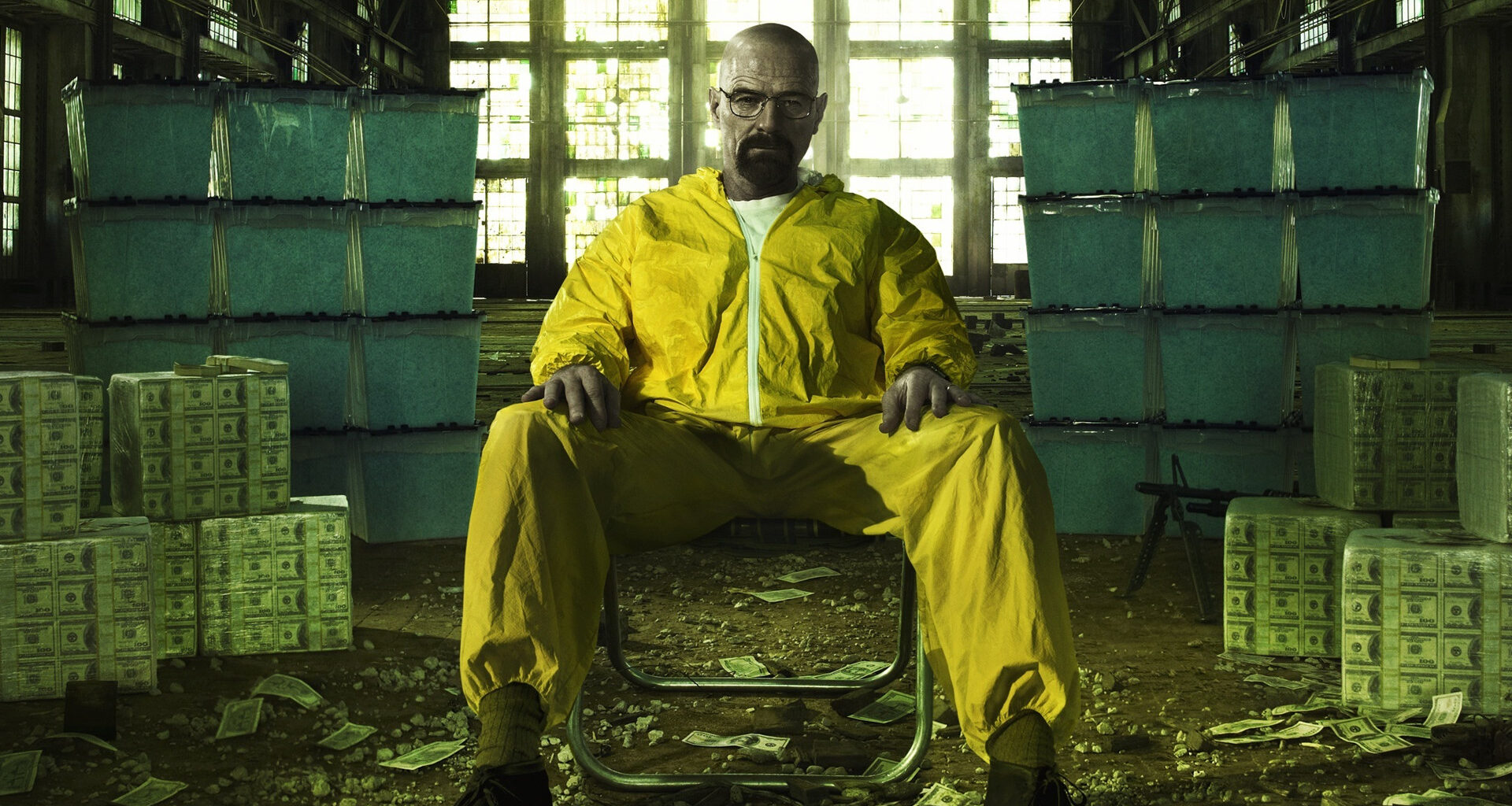
 Credit: AMC/Breaking Bad.
We all know the story of Walter White from the hit TV series Breaking Bad. Faced with a terminal lung cancer diagnosis and a financially precarious future for his family, the mild-mannered high school chemistry teacher transforms into a drug kingpin. It is one of television’s most compelling stories ever, exploring how a sudden health shock can strip away moral guardrails and unleash pure chaos.
But is the “Breaking Bad” effect real? Do some law-abiding citizens actually turn to crime when their bodies turn against them?
According to a fascinating new study by economists Steffen Andersen, Elin Colmsjö, Gianpaolo Parise, and Kim Peijnenburg, the answer is a resounding — and quantified — yes.
Using a massive dataset from Denmark, the researchers have uncovered a startling correlation: a cancer diagnosis increases the probability of committing a crime by approximately 14%. This phenomenon suggests just how fragile our adherence to the social contract can be when we are faced with imminent death from disease and the often-inadequate healthcare we think we’re entitled to.
Breaking Bad Crosses Fiction
The researchers analyzed administrative data covering the entire Danish population, focusing on 368,317 individuals diagnosed with cancer between 1980 and 2018. By linking health records with criminal registries, they tracked the behavior of these patients against a control group of similar individuals who had not yet been diagnosed.
In the year immediately following a diagnosis, crime rates among patients actually dip slightly. This makes intuitive sense; chemotherapy and radiation are grueling physical processes. As the authors note, “undergoing cancer treatment is physically strenuous and forces a cancer patient to visit or remain at the hospital for long periods”. When you are fighting for your life in a hospital bed, you aren’t out robbing convenience stores or cooking meth in a trailer.
But as the immediate physical shock wears off, roughly two years after diagnosis, the probability of violating the law surges past the baseline. This effect intensifies over the next few years and persists for more than a decade.
Crucially, this isn’t just career criminals returning to old habits. The study found that cancer drives individuals with clean records to break the law for the first time. The diagnosis acts as a “negative” turning point that derails a prosocial life trajectory.
×
Thank you! One more thing…
Please check your inbox and confirm your subscription.
The Rational Criminal
 Credit: Andersen et al. (2025).
To understand why this happens, we have to look at crime through the lens of the “rational criminal,” a theory popularized by economists Gary Becker and Isaac Ehrlich in the 1960s and 70s. This theory posits that criminals aren’t necessarily “bad” people, but rational actors who weigh the potential rewards of a crime against the probability of getting caught and the severity of the punishment.
A severe health shock alters every variable in this equation.
First, there is the economic motive. Cancer decimates human capital. The study found that a diagnosis leads to a negative impact on income, employment likelihood, and hours worked. Patients lose their ability to earn legal income, making illegal revenue streams suddenly more attractive. The researchers found that the urge to break the law was stronger among those who lacked financial buffers, such as home equity or a spouse’s income.
This study centers on Danish people who all have access to free, universal health care. Now imagine what might happen in the United States. The grim arithmetic of American healthcare means that even privately insured patients face an average of nearly $600 a month in out-of-pocket costs, a figure that spikes for those with advanced-stage disease. Researchers have found that 42% of patients deplete their entire life’s assets within two years of diagnosis, and cancer survivors are more than twice as likely to file for bankruptcy
as people without a cancer history. With total treatment costs frequently exceeding $150,000, the American experience of cancer is uniquely cruel.
Survival and Rationality
However, desperation for money doesn’t explain the whole picture. If it did, we would expect to see a spike only in economic crimes like theft or fraud. Instead, the data showed a 38% relative increase in non-economic crimes — including violent offenses — compared to a 14% rise in economic crimes.
This points to a darker psychological mechanism: survival probability.
The justice system relies on the threat of future punishment to deter crime. But if you don’t expect to have a future, that threat loses its teeth. The researchers found evidence that “cancer patients face lower expected cost of punishment through a lower survival probability”. When they broke the data down by cancer type, they found that individuals facing the steepest declines in survival odds showed the strongest increase in criminal activity.
Essentially, a terminal prognosis lowers the “discount rate” for future punishment. If you might not be alive to serve a prison sentence five years from now, the perceived risk of committing a crime today drops mathematically to near zero.
Who Breaks Bad?
The increase in criminal activity following a diagnosis is driven primarily by men. This aligns with broader criminological trends where men are generally more likely to respond to life stressors — like job loss or divorce — with criminal behavior.
Interestingly, while low-income individuals showed a larger absolute increase in crime, high-income households actually showed a larger relative increase. This counterintuitive finding highlights the structure of the local safety net: in Denmark, social benefits are capped. High earners who get sick experience a much sharper drop in income relative to their lifestyle than low earners do, potentially creating a greater sense of relative deprivation.
Perhaps most curiously, patients who sought psychological help after their diagnosis were 2.5 times more likely to commit crimes than those who didn’t. This may seem to defy logic, but the researchers argue this variable acts as a distress signal rather than a cause.
Seeking therapy serves as a proxy for the severity of a patient’s mental anguish. Those who go out of their way to find professional help are likely the ones reeling from the most profound psychological shocks. Therefore, the correlation doesn’t suggest that counseling triggers criminality, but rather that the specific subset of patients who are most emotionally devastated are also the ones most prone to the “lashing out” behavior the study identifies.
The Safety Net as Crime Prevention
If economic desperation is a key driver of this behavior, then financial support should function as a crime-prevention tool.
The authors tested this by looking at a natural experiment: the 2007 Danish municipal reform. This administrative shake-up consolidated municipalities, causing some areas to become “stingier” with social support while others remained generous.
In municipalities that cut welfare support, the sensitivity of crime to health shocks increased. The study estimates that the effect of cancer on crime was significantly larger for individuals living in areas that reduced their social safety net.
This reframes welfare programs not just as charity for the sick, but as a mechanism for public safety. “Welfare programs that alleviate the economic repercussions of health shocks are effective at mitigating the ensuing negative externality on society,” the authors conclude.
In economics, an “externality” is a side effect of an activity that affects other parties without this being reflected in the cost. Pollution is the classic example. This study suggests that severe illness carries a “crime externality”. A health shock is usually viewed as a private tragedy, affecting only the patient and their loved ones. But the data shows it ripples outward, creating victims in the broader community through increased theft, violence, and disorder.
By failing to adequately support those struck by biological tragedy, society may be inadvertently paying a higher price in the form of increased crime. The story of the desperate, dying man turning to the wrong side of the law isn’t just a TV trope.
The findings appeared this week in the American Economic Journal: Applied Economics.