
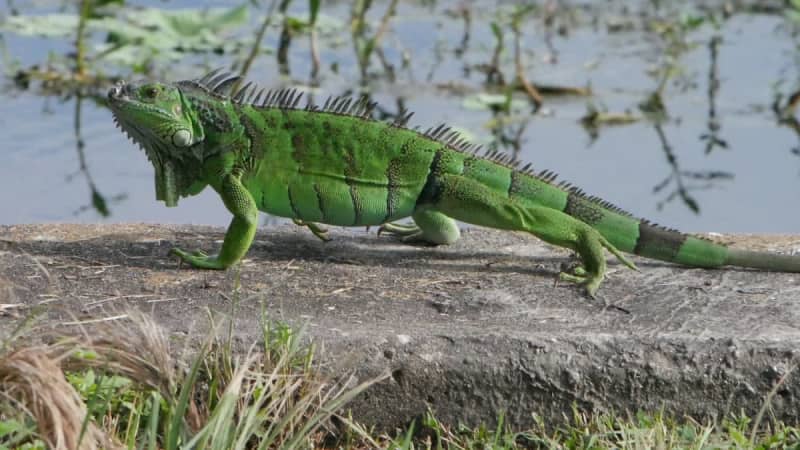
When we heard that a pizza place in North Palm Beach topped a pie this week with iguana, we had some questions.
Bucks Coal Fired Pizza owner and proprietor Frankie Cecere and Ryan Izquierdo, a South Florida fishing content creator, made an Instagram video showing Cecere making what they called the Everglades: a pizza topped with iguana, bacon, venison and cheese, then finished with ranch dressing. Izquierdo takes a few bites; Cecere does not indulge.
In a different post, Izquierdo dresses the tail and leg meat from a few of the thousands of invasive iguanas that have been falling from trees around the state due to the recent cold snap.
State wildlife officials collected 5,195 cold-stunned invasive green iguanas over two days earlier this week, urging the public to collect them from the wild and bring them to designated drop-off sites.
Cecere had other plans. But don’t expect to walk in and order an Everglades pie just yet. The pizza wasn’t served to customers for public consumption.
“We are currently looking for an approved vendor to purchase it through, if we can find that then we’ll offer it,” Cecere said by phone Thursday. “We are having a hard time finding that at the moment.”
We bet.
The stunt left us with some questions.
Green iguanas are an invasive species in Florida and have no protections under state law, outside of anti-cruelty laws. The state allows landowners and residents with landowner permission to humanely kill green iguanas found on their property year-round, according to the Florida Fish and Wildlife Conservation Commission.
A representative at the United States Department of Agriculture’s Meat and Poultry Hotline advised that iguana meat would need to be processed safely, and dubbed it a “personal preference” whether to consume green iguana.
In their native habitat, like Central and South America and the Caribbean, green iguana adults and their eggs are eaten, according to a 2018 article from the Entomology and Nematology Department at the University of Florida Institute for Food and Agricultural Sciences Extension.
You’ll want to cook your iguana like you should cook most meat at home. Like chickens, pigs and produce, reptiles can carry salmonella. Another UF article called “Considering Iguana Meat as Protein: Consider Food Safety First” suggests proper cleaning, cooking thoroughly to a temperature of 165 degrees Fahrenheit, refrigerating promptly when raw and avoiding cross-contamination.
Izquierdo said the tail meat tasted like frog legs. It was “a little sweet” and “very good.” We wonder how much it resembles another Florida oddity: alligator meat.