
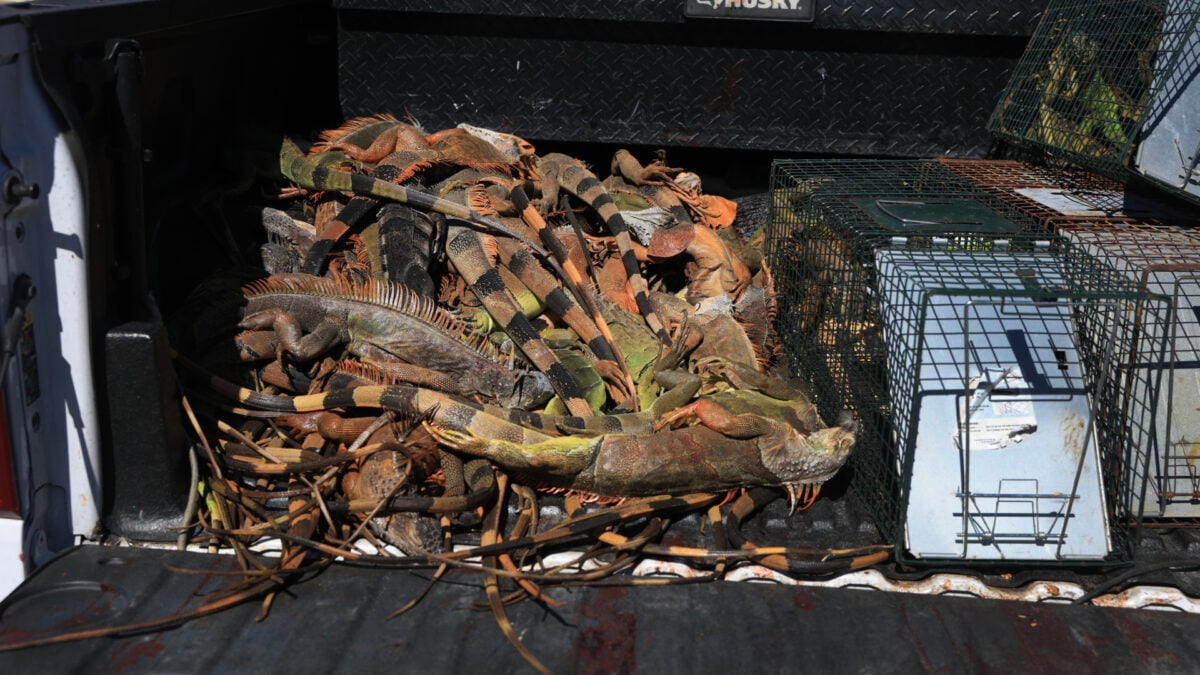
If you didn’t know already, it’s not unheard of for it to rain iguanas in Florida, where colder-than-average winter temperatures make the reptiles drowsy and cold-stunned, causing them to fall from trees. As brutal winter storms ravaged the southeastern U.S. over the past few weeks, Florida saw a spattering of frozen iguana rain like never before.
On Wednesday, Florida’s Fish and Wildlife Conservation Commission (FWC) reported that, in just two days, it had removed 5,195 iguanas with public help. Iggy Trap, a private pest control service, told NBC Miami that it had captured over 1,500 iguanas during the previous weekend. Combined with other private services, the estimated number of frozen iguanas is about 8,000, according to the South Florida Sun Sentinel.
“It’s certainly a significant number,” Ron Magill, a wildlife expert at Zoo Miami, told the South Florida Sun Sentinel. “But I think there are still a lot of iguanas left, and I think it speaks to the number of these animals that are actually in our environment.”
Why is it raining iguanas?
Green iguanas are considered invasive pests by the FWC. This means they are not subject to anti-cruelty laws in Florida and can be captured and killed without a permit. However, the FWC has recommended contacting professional removal services to safely and humanely remove iguanas from private property.
To Florida residents, these iguanas are a serious menace. They chew on power lines, damage gardens and farms, attack native species, and poop in your swimming pool—dishonorable behavior that has led to some even referring to them as the “green plague.”
That’s just during warmer seasons. In winter, iguana threats shift in the strangest way; when temperatures drop to below 45 degrees Fahrenheit (7.2 degrees Celsius), they appear to “drop dead” and spontaneously fall out of trees.
To be clear, these iguanas are still alive—they’re just stiff and unmoving until it gets warmer. But they’re also known to grow over 5 feet (1.5 meters) in length, and such giant creatures suddenly falling from the sky pose clear safety hazards to communities.
A sweeping iguana hunt
In response, this Monday the FWC issued an executive order granting temporary permission for the public to gather cold-stunned iguanas and bring them to FWC collection points.
“As an invasive species, green iguanas have negative impacts on Florida’s environment and economy,” said FWC Executive Director Roger Young in the statement. The removal of over 5,000 of the invasive lizards was “only possible thanks to the coordinated efforts of [FWC staff], our partners, and of course the many residents that took the time to collect and turn in cold-stunned iguanas from their properties,” he added.
FWC officials told NBC Miami that it plans to release statewide removal numbers and that the captured iguanas will be euthanized or transported for live pet sales.