
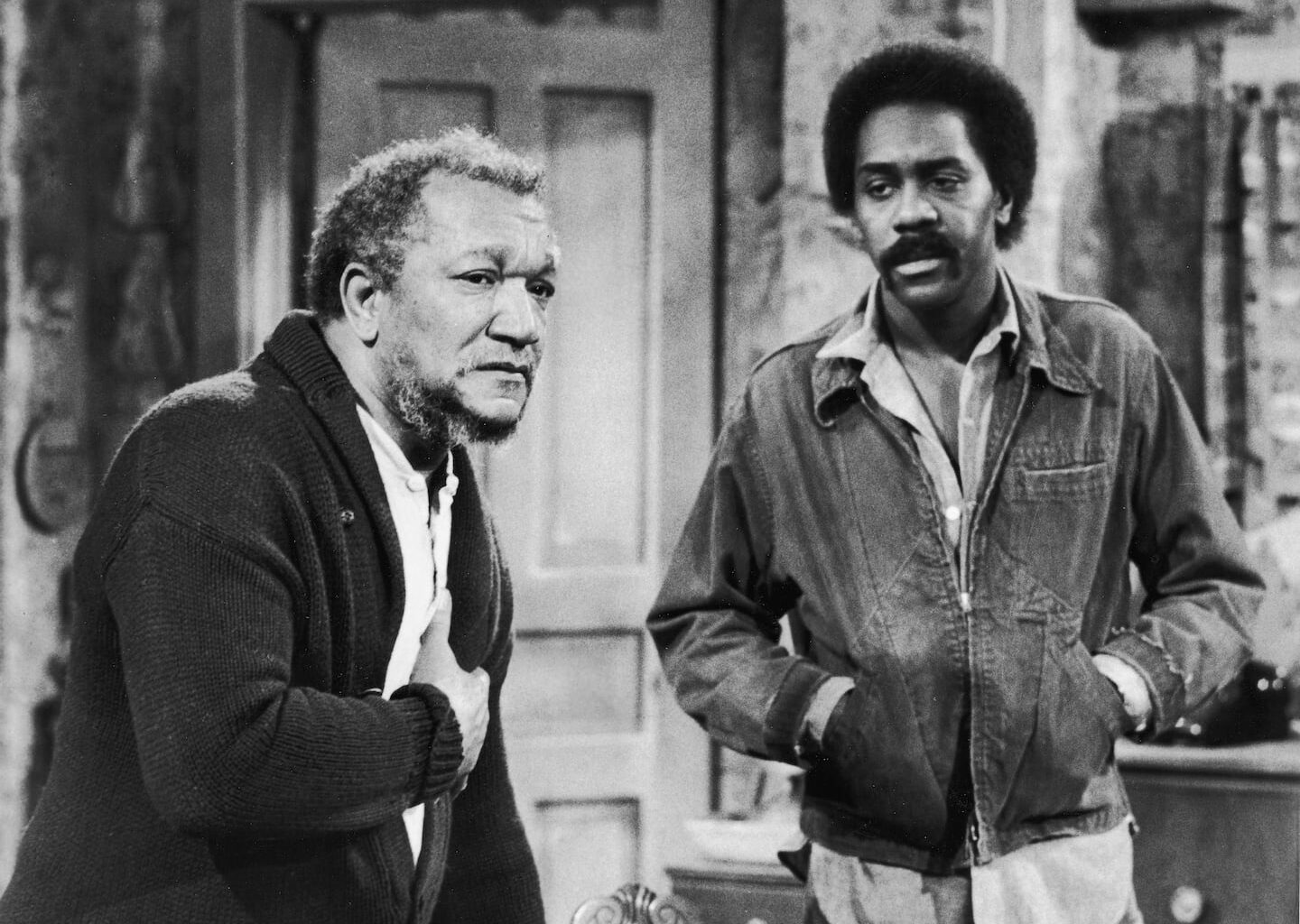
It was also trailblazing, because the sitcom featured a two-man-led Black household. This was during the storied Blaxploitation film era, when Black male actors exploded onto the big screen. But in 1972, outside of the variety show “The Flip Wilson Show,” they were all but absent on television.
“Sanford and Son” was a star vehicle for Foxx (who was born John Elroy Sanford), a pioneering standup comic known for his edgy, raunchy blue style humor. Foxx integrated Las Vegas clubs, made regular appearances on “The Tonight Show with Johnny Carson,” and later starred as a junkyard owner in the 1970 film “Cotton Comes to Harlem.”
The new show was based on a 1960 British comedy series, “Steptoe and Son.” Lear and producer Bud Yorkin transplanted the now-American father and son duo to the South Los Angeles neighborhood of Watts. After making a guest appearance on Lear’s “All in the Family” in 1971 as a charismatic yet culturally aware cat burglar, Wilson won the role of Lamont Sanford. He even bested comic legend Richard Pryor for the part. In 2022, Wilson relayed to the AP his pitch to producers at the time, telling them he argued, “C’mon, you can’t have a comedian with a comedian. You’ve got to have a straight man.”
It was a formula that worked. Premiering in 1972, “Sanford and Son” was a success for its entire six-season run. As Foxx’s “straight man,” Wilson’s depiction was so straightforward he didn’t even have a catch phrase (a mainstay for ’70s sitcoms), unlike Foxx, who had a nonstop litany of them (saying “You big dummy” to Wilson, declaring “It’s the big one Elizabeth, I’m coming to join you,” and always saying “My name is Fred G. Sanford and the G stands for…“).
Instead, Wilson played Lamont with a quiet and comical suaveness, as he tried in vain to stop his TV dad from creating havoc. (When Lamont had moments of mishaps, Fred was always there to lovingly guide and protect his son in return.) Pushing back against the stereotypical images of Black men in pop culture, Wilson depicted a son juggling his role in a family business with trying to live an independent life.
But more interestingly, Lamont was devoted to making sure his widowed dad felt loved, treasured, and never abandoned. For Black men to be portrayed this way on TV — proudly and strongly representing the culture, yet depicting the love and vulnerability between father and son — was groundbreaking television. Wilson didn’t just mirror my father and brother; he represented the experiences of “Sanford and Son’”s wide, culturally diverse audience, which would only grow over the ensuing decades. Plus, the pair and their cast of family and friends Aunt Esther (LaWanda Page), Grady Wilson (played by Whitman Mayo in a role Foxx named after his costar), Bubba (Don Bexley), and Rollo (Nathaniel Taylor) were all funny as hell.
Following the success of “Sanford and Son,” Wilson’s TV career continued into the 2020s with roles in “Baby I’m Back,” “The New Odd Couple,” “Girlfriends,” and “Eleanor’s Beach.” His films included “Me and the Kid,” “Full Moon High,” and “Hammerlock.” While audiences might have wanted to see even more of Wilson, it seems the possibilities of his offscreen life beckoned him more. The Valdosta, Ga., native, raised in Harlem, began to take huge gaps in between jobs — sometimes decades-long stints.
Wilson, a lifetime performer who studied dance as a child and performed on and off Broadway before becoming a TV star, admitted to falling a bit out of love with Hollywood.
“It wasn’t challenging,” Wilson told the Los Angeles Times in 1986 of his acting life. “And it was emotionally exhausting, because I had to make it appear that I was excited about what I was doing.”
Instead, Wilson forged a deeper connection to his spiritual faith and left Hollywood for a time to become a Pentecostal minister in the 1980s. Over the next four decades he juggled careers in acting, preaching, and publishing, writing several books.
Wilson’s death conjured up an immediate outpouring of reactions from generations of fans who grew up watching him. Reading how his most famous role represents a special bond to people’s childhoods, family relationships, and laughter is particularly moving. Especially because Wilson’s timeless, hilarious work also keeps me endlessly connected to my dad. And night after night, it’s a gift I truly treasure.
Stream it on: Pluto TV, Tubi, Peacock and Prime Video.
Ronke Idowu Reeves is the Globe’s SEO Editor. For over 20 years she worked as an entertainment writer and reporter for PEOPLE, BET, VH1, The Sundance Film Festival and Tribeca Festival. She is a contributor to the books “Oprah: A Celebration at 70” and PEOPLE Books: Special Edition Barbie.”