
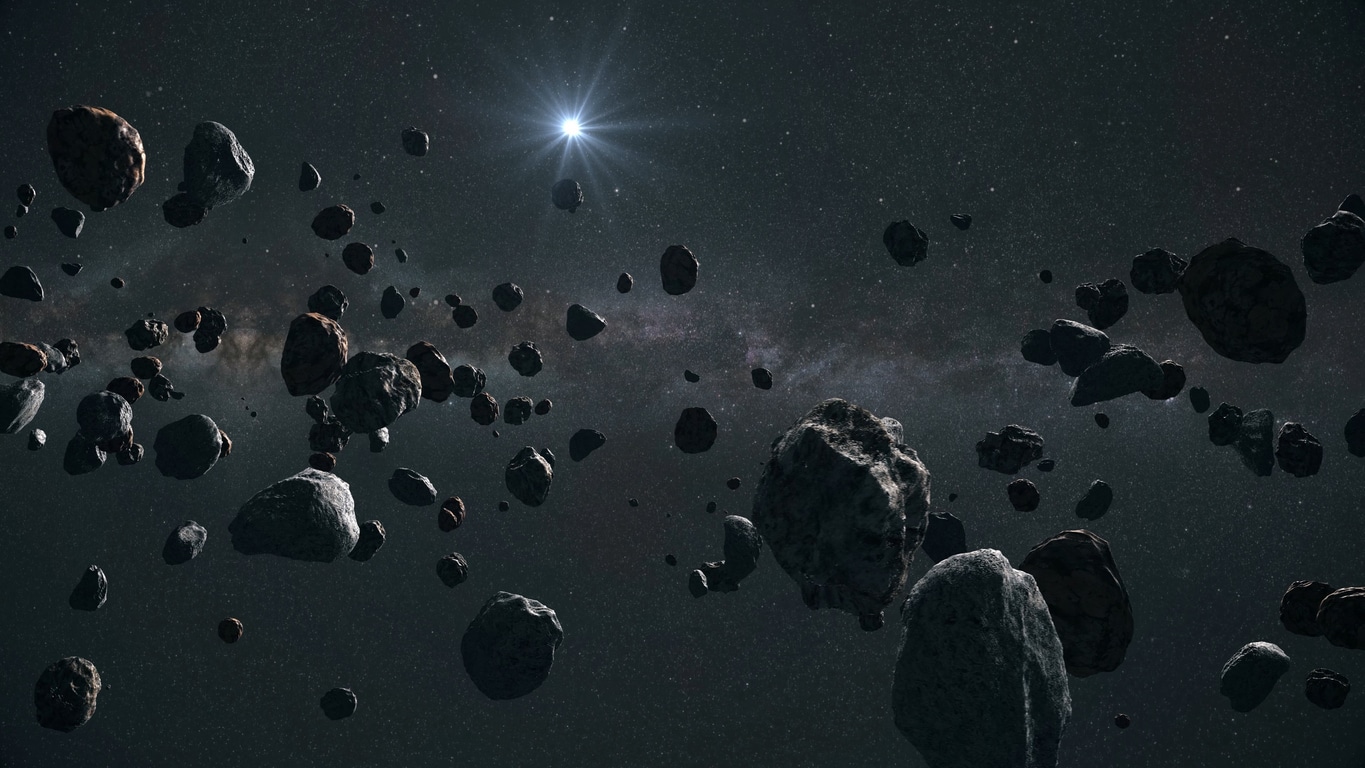
Whispers from the far rim of the Solar System suggest a remarkably ancient and surprisingly intact arrangement of worlds. Beyond the orbit of Neptune, among dim points of ice and rock, researchers report a tightly clustered set of orbits that may have barely budged since the Solar System’s dawn. If confirmed, this quiet architecture could act as a planetary time capsule, preserving the earliest conditions of planetary formation.
A quiet ring beyond Neptune
Far past Neptune lies the Kuiper Belt, a sprawling donut of icy debris stretching from roughly 30 to 50 AU. It hosts Pluto, Makemake, Eris, and the contact binary Arrokoth, each a remnant of early accretion. Unlike the inner asteroid belt, this region forms a thick disk, its structure sculpted by Neptune’s steady gravity. Over billions of years, that gravitational chisel has nudged orbits, sorted inclinations, and carved subtle substructures.
From a 2011 clue to a sharper picture
Back in 2011, astronomers identified a dense “core” of Kuiper Belt objects around 44 AU. These bodies follow nearly circular orbits with low inclinations, implying minimal stirring since their birth. The finding hinted at a fossilized layer within the broader Kuiper population. For years, that core stood as the clearest signature of primordial order beyond Neptune.
An inner core with exceptional calm
A Princeton-led team has now analyzed 1,650 Kuiper Belt objects, using a density-based algorithm known as DBSCAN. In validating the 2011 core, their search revealed a second, slightly closer cluster centered near 43 AU. This “inner core” is striking for its exceptionally low eccentricities, often between 0.01 and 0.06. Orbits this circular, and this coplanar, suggest a population scarcely disturbed by later chaos. As one researcher put it, “It’s a fossilized ring, quietly orbiting where the early Solar System set it.”
What makes this inner core compelling are several traits that together argue for ancient stability:
Very low orbital eccentricity, pointing to minimal heating
Low inclination angles, indicating limited vertical scattering
A compact radial location near 43 AU, distinct from the main core
Apparent resilience to Neptune’s past migration, preserving its shape
Potential to link composition with pristine dynamics, revealing formative conditions
A test for migration models
Such pristine orbits place new constraints on how the giant planets moved. Instead of a slow, smooth drift, Neptune may have migrated in stops and starts, leaving gravitational fingerprints in the belt’s texture. An inner core that remains unruffled would limit how violent those moves could have been. It also touches on the early Sun’s natal environment, including encounters with passing stars and the swaddling gas of the primordial disk.
If the inner core truly formed in situ, it probes the original temperature and density profile of the outer nebula. With so little dynamical mixing, surface ices may retain early chemistry, from volatile balances to radiation-induced hues. Combined with targets like Arrokoth, these bodies provide a multi-point archive of the Solar System’s formative recipes.
Caution, and what comes next
The analysis is preliminary and awaits peer review, so healthy skepticism is warranted. Selection biases, orbit-fitting uncertainties, or survey footprints could mimic a second cluster. The Vera C. Rubin Observatory’s LSST will vastly expand the catalog, improving orbits and sampling depth. With millions of detections, astronomers can map Kuiper Belt substructure with unprecedented clarity.
Follow-up will require careful dynamical modeling, refined orbital solutions, and spectral observations of representative members. If a mission ever revisits the belt, sampling an inner-core body could transform our understanding of primordial material. Until then, the evidence points to a remarkably old and remarkably quiet structure, circling beyond Neptune in patient silence.
In the frigid dusk of the outer Solar System, the inner core stands as a rare constant amid cosmic change. It is both a scientific challenge and an irresistible invitation: read the record written in gentle orbits, and let ancient architecture speak.