
As the number of satellites in low-Earth orbit (LEO) continues to surge, a new study highlights an alarming risk: a solar storm could leave satellites with only five days to avoid catastrophic collisions. The research underscores a growing concern about the overcrowded skies and the limited time available to react when space weather disrupts orbital vehicles operations.
The rapid expansion of satellite constellations, like SpaceX’s Starlink, has transformed the landscape of Earth’s orbit. What began as an effort to provide global internet access is now causing a chain reaction of potential hazards. Scientists are raising the alarm about the crowded conditions, warning that the risk of satellite collisions is higher than ever, especially if a solar storm knocks satellites out of control.
Low-Earth orbit is becoming increasingly congested. As companies like SpaceX plan to launch thousands of space probes over the next decade, the situation is only getting worse. SpaceX has already launched thousands of Starlink satellites, with plans to add another 7,500 by 2031. These space probes are becoming a major contributor to the growing number of objects in space. Currently, Starlink ones are passing within 1 kilometer of each other every 11 minutes.
Is the CRASH Clock Running Out of Time?
The CRASH Clock, developed by astrophysicist Sarah Thiele and her team, offers a stark warning about how little time we have to prevent collisions. The clock tracks how much time remains before a collision becomes almost inevitable, particularly if a solar storm disables the space probes ability to maneuver. According to the study avaliable on arXiv:
“Our calculations show the CRASH Clock is currently 5.5 days, which suggests there is limited time to recover from a wide-spread disruptive event, such as a solar storm,” said the authors.
The clock’s rapid decline reflects the increasing congestion in orbit. As more they are launched and fewer maneuvering opportunities are available, the time window for avoiding a disaster shrinks. The risk is particularly high if a solar storm causes satellites to lose their positioning systems. During such storms, the increased drag on orbital platforms and the loss of communication can lead to a cascade of failures, culminating in a collision.
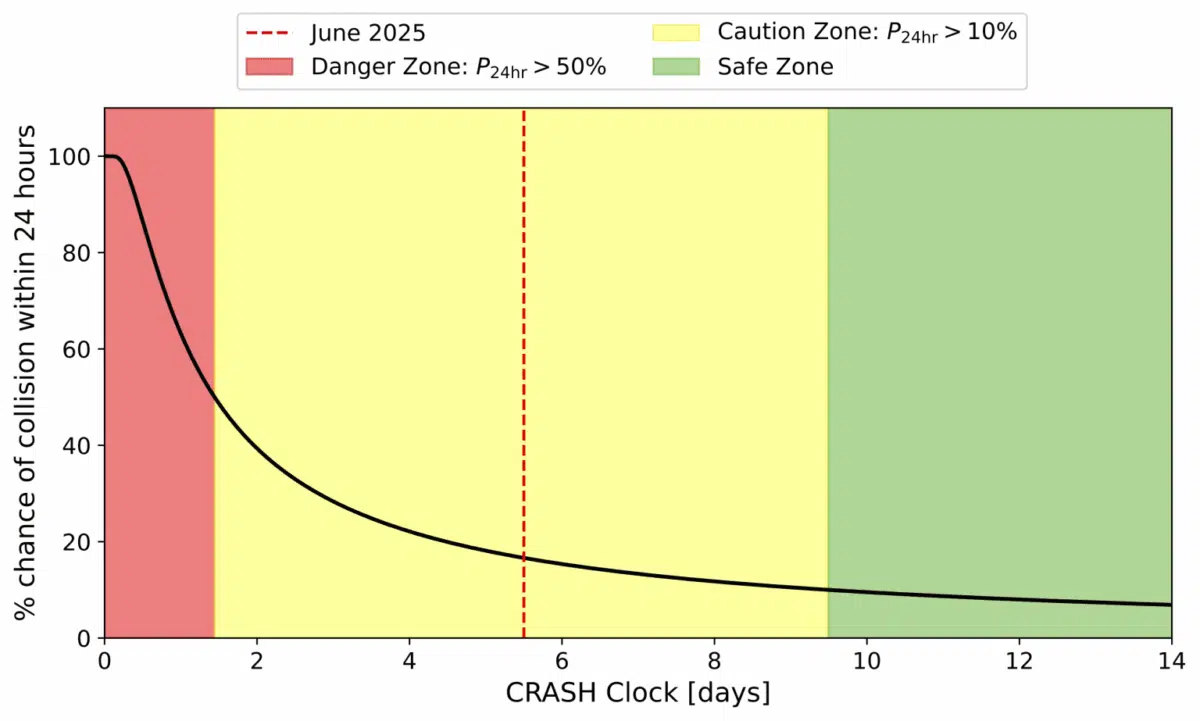 This graph displays the increasing risk of satellite collisions with time, highlighting danger and safe zones. Credit: Crash Clock
Space Weather: The Invisible Menace in Our Skies
Solar storms represent one of the greatest threats to satellite safety. These storms, which release bursts of charged particles from the sun, can cause massive disruptions to satellite systems. During solar flares or coronal mass ejections, they face increased atmospheric drag, causing them to lose altitude and fuel at an accelerated rate. This can force satellites into unpredictable orbits, putting them at greater risk of collision.
The Gannon solar storm of 2024 serves as a recent example of how space weather can impact satellite operations. During this event, nearly half of the satellites in low-Earth orbit had to perform maneuvers to avoid damage. However, even though the storm was intense, it didn’t reach the scale of historical events like the Carrington Event of 1859, which lasted for days and caused widespread disruption.
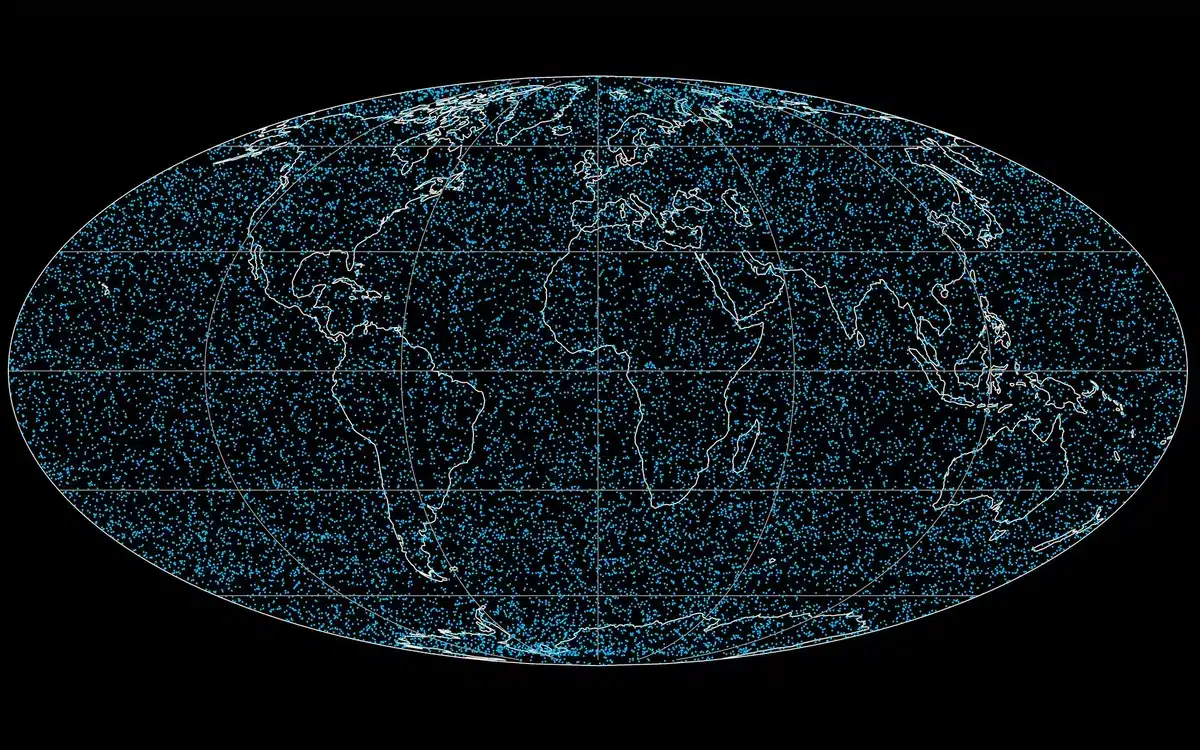 Map showing all tracked objects in low earth orbit. Credit: Sarah Thiele, Skye R. Heiland, & al.
Solar storms also pose another risk: they can disable satellites’ communication and navigation systems, leaving them stranded in orbit. Without the ability to maneuver, they could drift off course, potentially colliding with other objects in space. This would create even more debris, further complicating the already perilous situation in low-Earth orbit.