
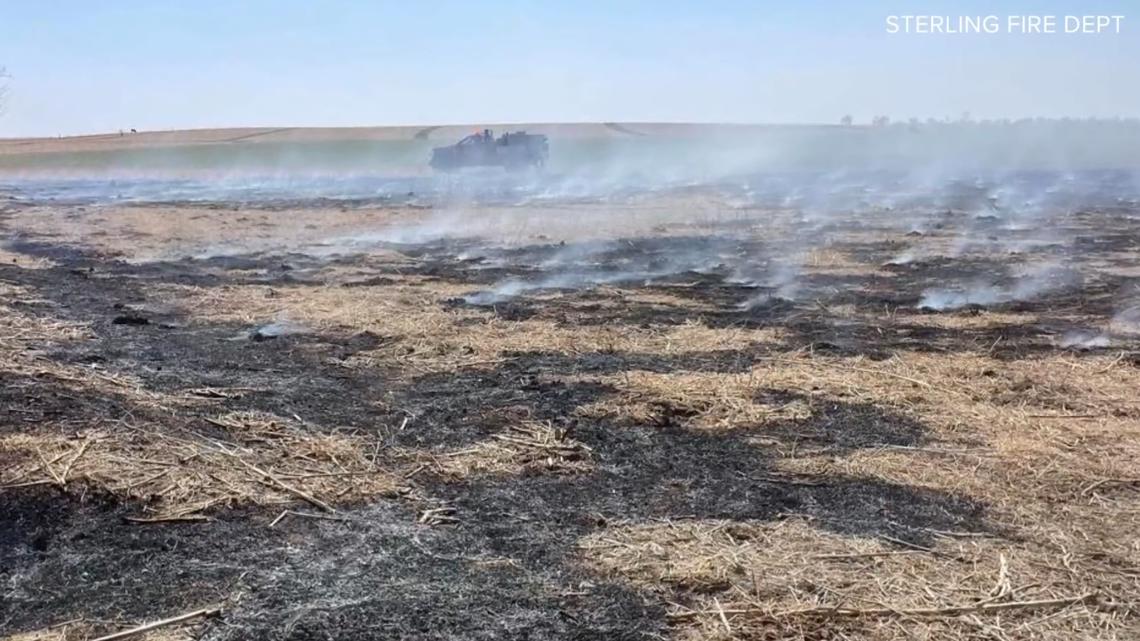
More than half of Colorado is now experiencing drought, raising serious concerns among fire officials as the state faces its worst snowpack in over 40 years.
DENVER — More than half of Colorado is now experiencing drought, raising serious concerns among fire officials as the state faces its worst snowpack in more than four decades and the prospect of an early and intense wildfire season.
According to Colorado’s drought monitor, 54% of the state is currently classified as being in drought. The lack of precipitation has left landscapes across Colorado parched, including Logan County, where fire officials said conditions are ‘unprecedented.’
Sterling Fire Chief Lavon Ritter said local fire departments are already seeing large grass fires — earlier than what would typically be expected this time of year. Ritter said Logan County fire chiefs met recently to coordinate their response strategies as conditions worsen.
“We’re all on the same page. We are going to be calling for mutual aid much sooner,” Ritter said. “Not waiting to see if we can handle it ourselves. And we’re also going to be taking advantage of some aircraft that we have in the area. We have some ag sprayers that can come and make water drops for us.”
Mutual aid, which involves assistance from neighboring fire departments, has become a critical part of firefighting plans in the region. Ritter said Logan County regularly works with departments in Phillips, Weld, Sedgwick and Morgan counties, as well as the state’s Division of Fire Prevention and Control.
“We have a lot of standing dead fuels. Typically, the snowpack will take those fuels down and it’s much easier to fight a fire when the flame lengths aren’t as tall as they will be this year with any fires that we have,” he explained. “And the winds – it’s always windy in northeast Colorado, but the winds this year have been much stronger than anything that we’ve had in the past few years.”
Ritter told 9NEWS, community members have also come forward with offers of assistance, including trucks to haul water and tractors to carve out fire lines.
The National Weather Service said the next two to three months will be critical in determining how severe conditions become. Meteorologist Kenley Bonner said precipitation levels would need to far exceed normal averages to reverse the current trend.
“If we want to get to a normal snowpack, we will need to, from this point forward, we need to be at 180% of normal for precipitation,” Bonner said. “The last 40 years, this is the lowest that we’ve been…looking at our maps of the state, all of our Colorado basins are below normal for this time of year.”
A Red Flag Warning is expected to go into effect Saturday for Logan County and several other areas, signaling heightened fire danger due to dry conditions and wind. Bonner noted that drought is especially severe in Colorado’s central mountains, which typically provide much of the snowmelt that feeds rivers and soil moisture across the state.
Ritter noted that all of their wildland trucks remain stationed and ready — something that is not usually necessary this time of year.
“It’s going to be a crisis out here,” Ritter said. “We’re going to have a very challenging fire season, not to mention the financial impact it’s going to have on farmers and ranchers out here if we don’t get some moisture.”