
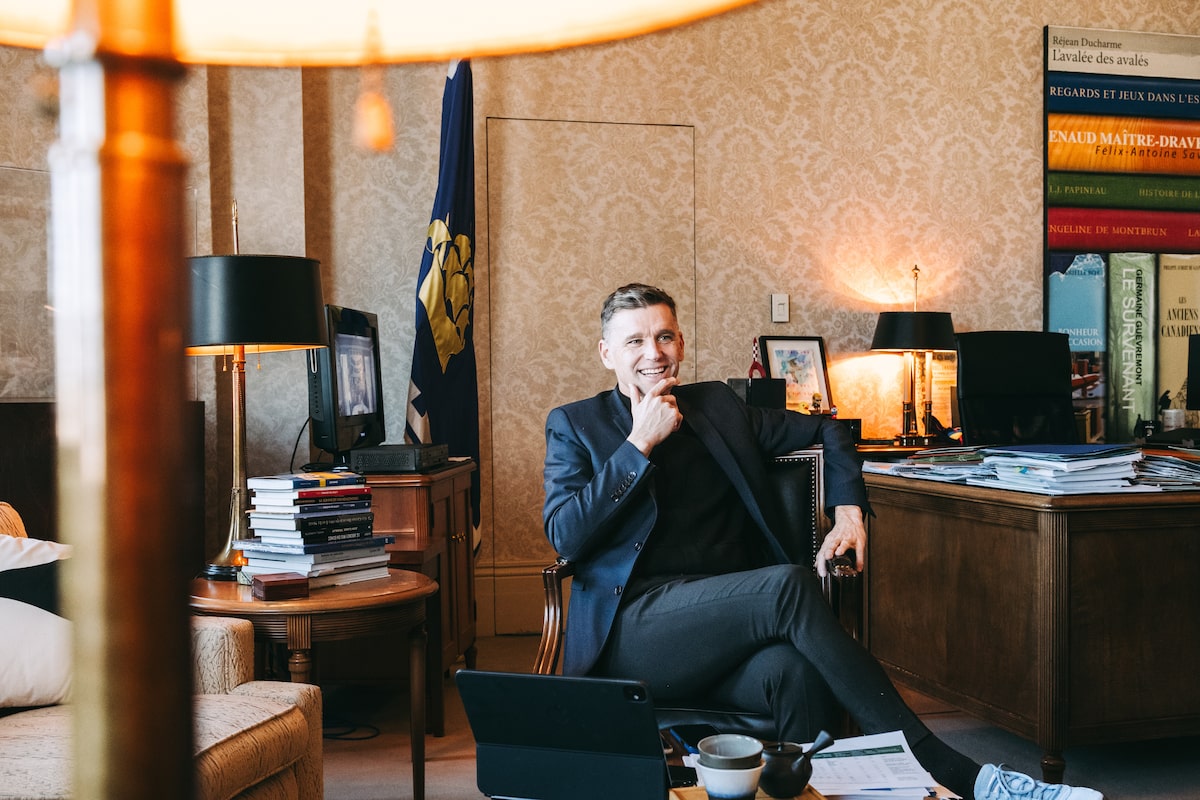
Quebec City Mayor Bruno Marchand in the mayor’s office at Quebec City Hall.Renaud Philippe/The Globe and Mail
Forget ice sculptures, the Château Frontenac and Bonhomme. Set aside the cobblestone streets and antique cannons.
Quebec City has long been seen as a sleepy government town at worst and a tourist destination at best, the latter never more so than during Carnaval, the winter festival that kicked off on Friday.
But quietly, in recent years, the provincial capital has transformed into something more interesting: Canada’s most successful city.
Numbers tell part of the story. Among the country’s eleven biggest urban areas, Quebec City boasts the fastest economic growth, the lowest crime rate, lowest unemployment rate and least income inequality. Only Edmonton and Winnipeg have more affordable homes.
Canada’s 100 Most Livable Cities
Walk the streets of neighbourhoods like Saint-Sauveur and Limoilou, far from the souvenir shops, and you could be in the hippest corners of Brooklyn, with a food scene to match. Quebec City restaurants won twice as many Michelin stars as Montreal’s last year, with about one-quarter of the population.
La capitale nationale has been on a roll, even as other Canadian cities struggle with runaway housing prices, homelessness and gridlock. Bonhomme’s hometown isn’t immune to these challenges, but has weathered them better than most, offering improbable lessons in urban thriving.
Quebec City housing prices grew faster last year than in any other major Canadian market, meanwhile – but homebuilding also increased at a best-in-Canada rate.Renaud Philippe/The Globe and Mail
A new residential neighborhood in the city.Renaud Philippe/The Globe and Mail
The baby-blue Adidas worn by Mayor Bruno Marchand on a recent workday tell another part of the story. Mr. Marchand started wearing brightly coloured running shoes to get recognized while campaigning for his first term in 2021, when the little-known social worker had to wear a mask because of COVID. It has become part of his brand; he never wears formal shoes in public any more, “other than for funerals,” he says, when he settles for black runners.
The shoes seem to express the spring in the city’s step that has transformed a once-dowdy community of bureaucrats and insurance executives into a hive of entrepreneurship. Where about one-quarter of the work force was in the public sector two decades ago – the same level as Ottawa-Gatineau today – that figure is now down to 8 per cent after a generation of rapid private-sector growth.
That makes the city less vulnerable to periodic waves of government belt-tightening than it used to be, Mr. Marchand says. The local economy is far more diverse now, branching beyond traditional strengths in shipbuilding (Davie) and insurance (Beneva and Industrial Alliance) into new-gen fields such as data centres and photonics.
The mayor credits a predecessor, Jean-Paul L’Allier, who served from 1989 to 2005 and laid the groundwork for much of modern Quebec City.
He built world-class green spaces, helped breathe new life into the working-class neighbourhood of Saint-Roch, persuaded the provincial government to create an agency devoted to the capital region and championed a municipal amalgamation that enriched the city’s tax base by adding a number of well-off suburbs. The 2002 merger, in particular, helped give the city direction and attract investment, argues Mr. Marchand.
“A city that speaks with one voice can rally capital,” he says.
Around Promenade St-Charles, a major renaturalization project began in 1996 and was completed in 2008. More than 7 km of concrete walls, dating from the 1970s, were replaced by abundant vegetation, creating a natural ecosystem, wildlife habitats, and the Saint-Charles River Linear Park.Renaud Philippe/The Globe and Mail
Quebec City elected itself another larger-than-life mayor from 2007 to 2021, the pugnacious former mining executive Régis Labeaume, who backed a number of successful megaprojects such as the Centre Vidéotron arena, a waterfront revitalization project, and the city’s spectacular 400th anniversary in 2008 featuring performances by Paul McCartney and Céline Dion on the Plains of Abraham.
He was a “hurricane, a tornado,” says Frédérik Boisvert, president of the local chamber of commerce. “He gave the people of Quebec City their pride back.”
Luck in its leaders isn’t the only reason Quebec City has vaulted up the urban leaderboard. It also benefits from the most educated work force in the country, by some measures, with the highest percentage of postsecondary graduates among working-age adults of Canada’s eleven biggest metro areas, at 83 per cent.
That includes products of Quebec’s CEGEPs, two-year colleges between high school and university that are unique to the province, point out researchers Pierre Fortin and Mario Polèse in a 2024 Policy Options paper. The intermediate category of skilled workers produced by CEGEPs – electricians, IT specialists, high-end mechanics – are a particular strength of the city and contribute to its middle-class character.
We traded a beach resort for an ice slide on our family escape to Quebec City
More intangible qualities have also animated Quebec City’s success. The chauvinism of its residents is something of a running joke in the province, and a fairly one-way rivalry with Montreal has long fuelled civic ambition. But where that fixation with the bigger metropolis was once “neurotic” and limiting, says Louis Bellavance, vice-president and artistic director of the events company BLEUFEU, it has now mellowed into a healthier “sense of belonging.”
His company’s flagship summer music festival, which has played host to everyone from The Rolling Stones to 50 Cent, is under the same scrutiny from local fans as the Canadiens are in Montreal, he says. It has no choice but to be successful.
Residents of Quebec City are fiercely proud of local companies and patronize them accordingly. When the avant-garde farm-to-table restaurant Tanière³ was awarded two Michelin stars last year, the share of local diners actually increased, rather than being displaced by foodie tourists, said co-owner Roxan Bourdelais.
“Quebec City remains a big village,” he says.
With a metro-area population of 850,000 and growing by as much as 20,000 a year recently, it won’t be a big village for long. At this rate, the city’s challenge is to avoid becoming a victim of its own success.
The Port of Quebec will begin a historic ten-year infrastructure modernization plan this year.Renaud Philippe/The Globe and Mail
A much-debated tramway project is expected to come online in the early 2030s after breaking ground this spring, while an even more contentious “third link” highway across the St. Lawrence to neighbouring Lévis would ease growing traffic, advocates say.
Quebec City housing prices grew faster last year than in any other major Canadian market, meanwhile – but homebuilding also increased at a best-in-Canada rate, and Mr. Marchand points out that the affordable-housing budget had tripled during his mayoralty.
Some gentrification in up-and-coming neighbourhoods is inevitable, he says. “The question is how you compensate for it.”
There is less visible homelessness in Quebec City than in places like Montreal and Toronto, in part because Mr. Marchand has continued a municipal policy of refusing to allow encampments of the kind that have proliferated in many North American cities since the height of the pandemic. When such clusters are broken up, their residents are offered shelter beds and community services, says the mayor, who is a former president of the local United Way equivalent, Centraide.
Quebec City is the least ethnically diverse community of its size in Canada. The 2017 mosque shooting, which left six worshippers dead at the hands of a white male gunman, is a bitter reminder that hatred has existed here.
But Mr. Marchand says his hometown’s traditional pure laine image is changing, and it’s a good thing. Quebec City saw a 57-per-cent increase in its immigrant population between 2016 and 2021, and few other politicians in the province have fought as hard as Mr. Marchand to defend the Programme de l’expérience québécoise, an immigration stream controversially shuttered by the nationalist government of Premier François Legault last year.
The 53-year-old mayor is aware that urban growth has its perils – worsening traffic, ballooning house prices. But for now, he insists, Quebec City is caught in a virtuous cycle instead, where success attracts talent and investment rather than headaches. The numbers, and his baby-blue sneakers, seem to bear this out.
“When it’s going well, it goes better and better.”