
A visual diary by Design Editor Wendy Goodman.
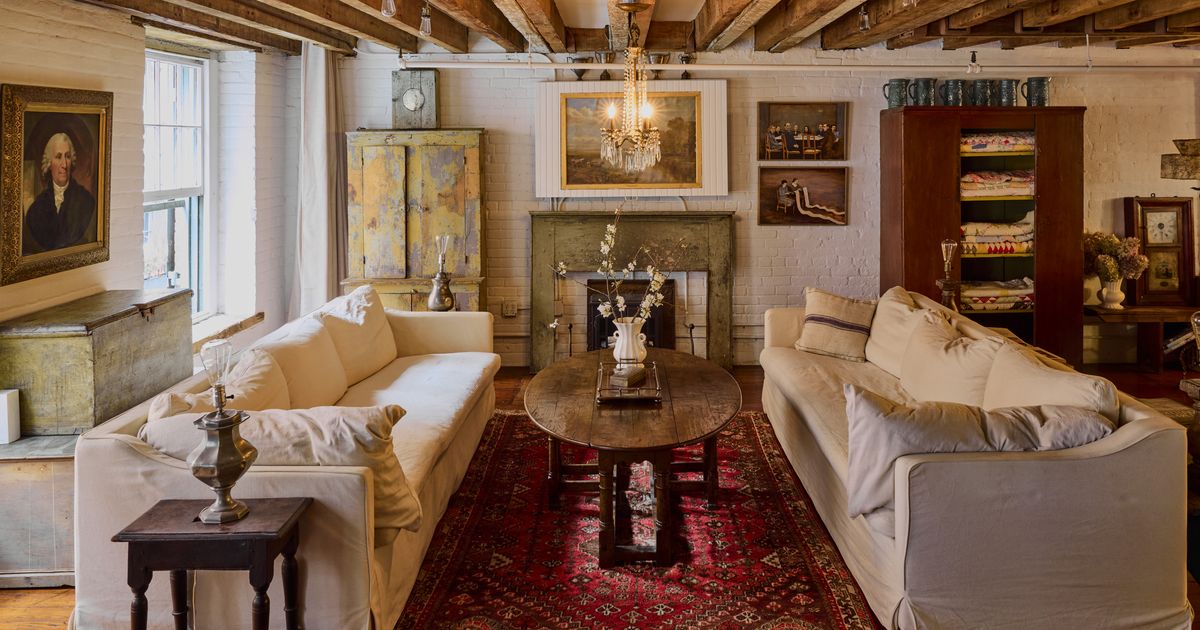
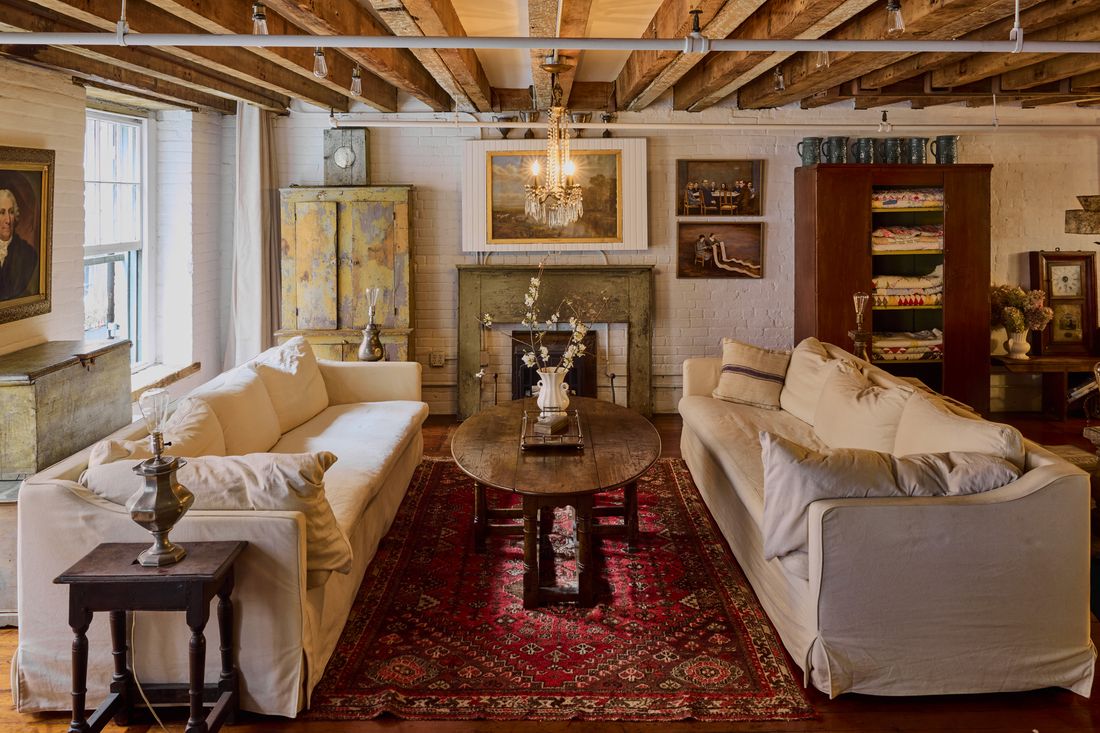
The Living Room The exposed beams are original. “The apartment was primitive and rustic in a way I’d never seen,” says Jean Hanff Korelitz. “The River Near Reading,” the F. Hardy painting above the added mantel and fireplace is a cover devised by contractor Robert Benes to conceal a TV. Korelitz found the couches on Instagram.
Photo: Jeremy Liebman
It was definitely an adventure,” says the novelist Jean Hanff Korelitz of the switch she and her husband, the poet Paul Muldoon, made from the Upper West Side to the Financial District.
For a decade, the couple had lived in a 1910 building that Korelitz tolerated because it was closer to her son’s school. When he graduated, she got on StreetEasy.
“I had a specific thing I wanted: an old and unmodified space. Basically, I wanted to live in the 19th century,” she says. “I wanted to be reminded of Gangs of New York.”
Korelitz, whose fiction is set in the present day, came across the loft of an 1860s sea-biscuit factory near the South Street Seaport. At the open house, the view from the windows facing the street reminded her of an Edward Hopper painting.
“There were about ten other people, and one of them kept measuring his height against the lowest beam. I remember thinking, Get out of my house,” she says. “I have always said, ‘This one is for love.’ This is the final move.”
The couple divvied up the open space into discreet zones and enlisted their daughter, Dorothy, a decorator, to close off the bedroom with library walls.
Muldoon, who was a professor at Princeton for nearly 40 years, turned a narrow nook in the living room into his workstation. “I am a person who has gone to an office throughout my writing life,” he says. “Honestly, what else are you going to do with a spot like this?”
Korelitz often writes on a sofa facing the windows, usually with her mutts Sherlock and Finn on her lap. “The only thing I can’t do is sit at a desk,” she says. For the most part, the couple prefers to salvage secondhand furniture, such as their cannonball rope bed and the 19th-century cupboard and settle bench the previous owners left behind.
“The couches are the first new furniture I’ve purchased since 1997,” Korelitz says. “The exception to the rule of ‘Everything old is better.’ ”
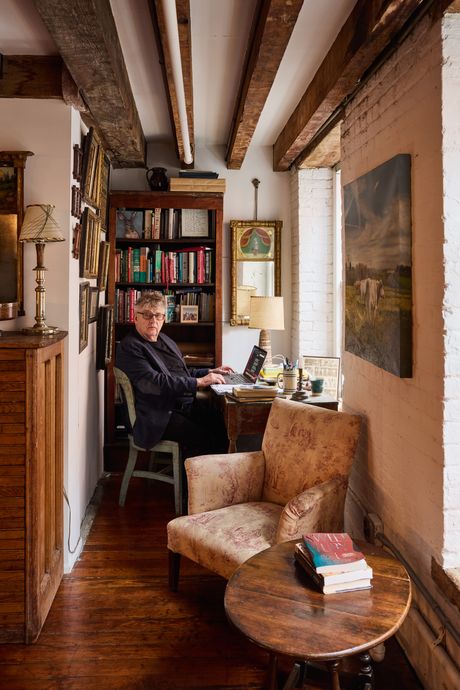
The Writing Nook Paul Muldoon (pictured) fashioned an office in a corner of the living room, where he now does most of his work. “The brown jug on top of the bookcase is a student piece by Edmund de Waal,” says Korelitz. “We were at Cambridge together.”
Photo: Jeremy Liebman
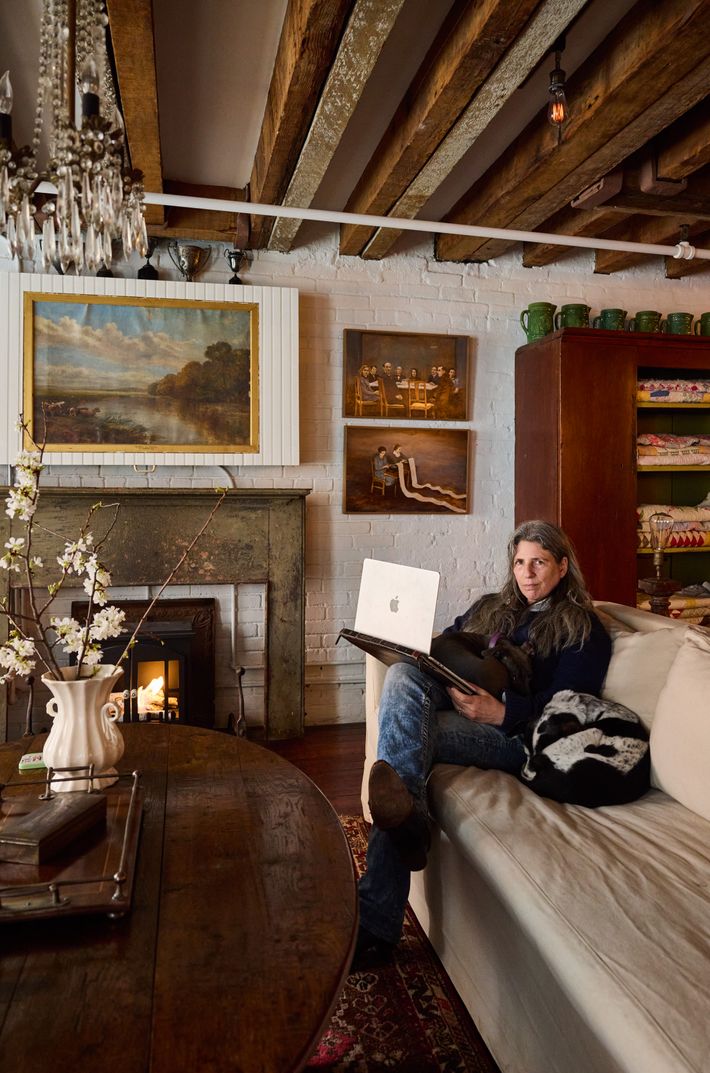
The Sitting Area Korelitz often writes on a sofa facing the windows, the only natural light source in the apartment.
Photo: Jeremy Liebman
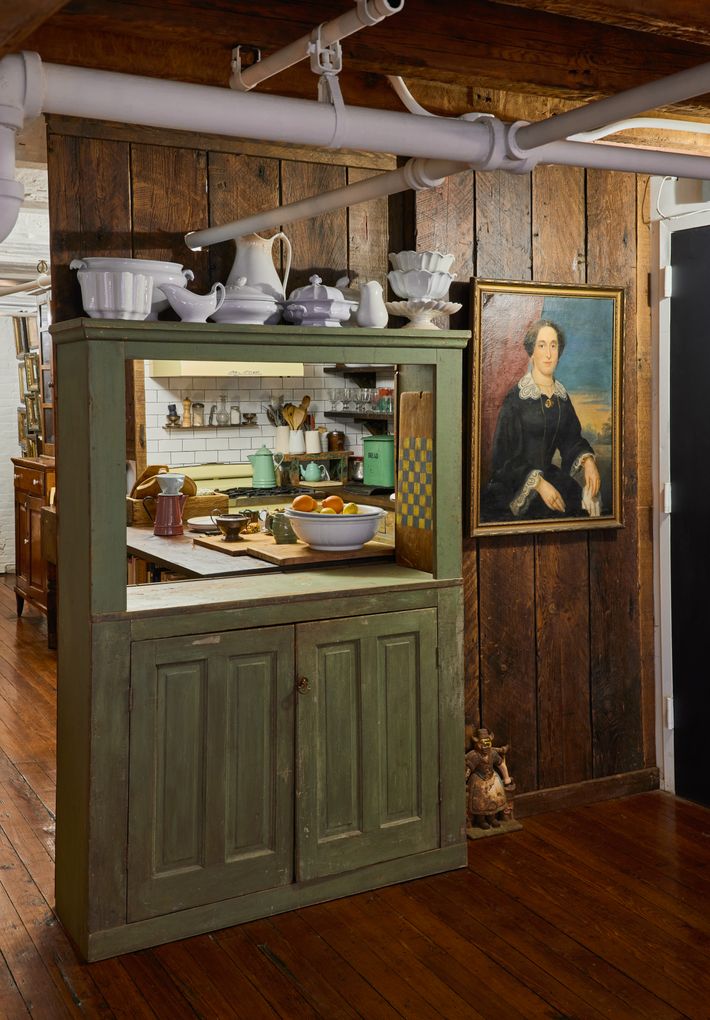
The Sideboard “We couldn’t decide whether to close off the kitchen with a wall or leave it open,” Korelitz says. The cupboard, found at Hyde Park Country Auctions, is a divider that allows for a view into the kitchen from the living room.
Photo: Jeremy Liebman
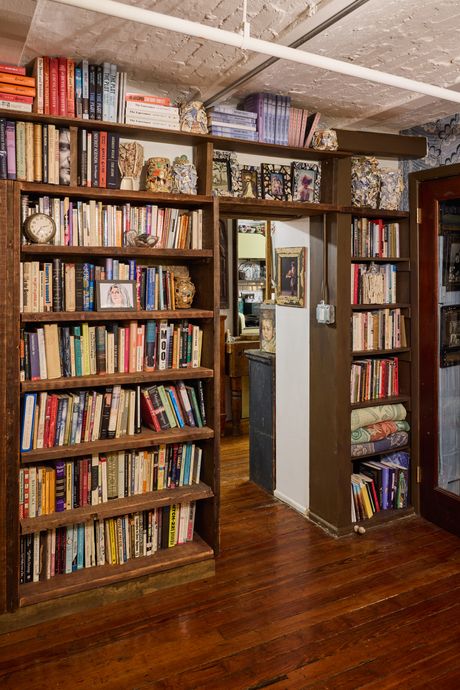
The Library Wall Dorothy Muldoon devised back-to-back bookshelves to close off the bedroom.
Photo: Jeremy Liebman
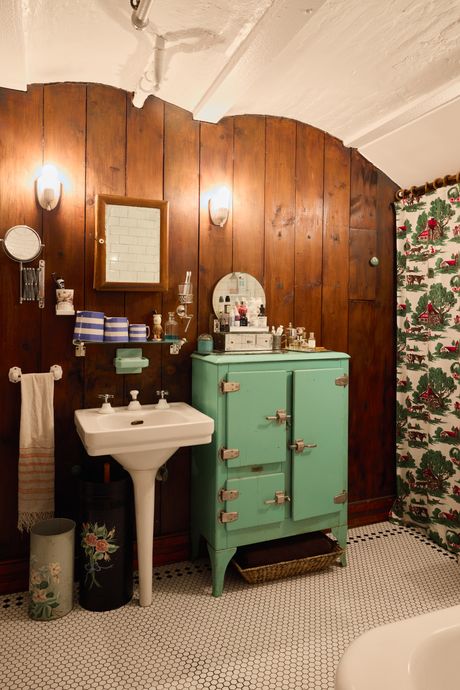
The Bathroom The paneling is original. “The new bathtub is about 100 years old; it was out in a field in Connecticut,” Korelitz says. The old icebox turned vanity is a gift from a friend. “I think she found it on the street,” Korelitz adds.
Photo: Jeremy Liebman
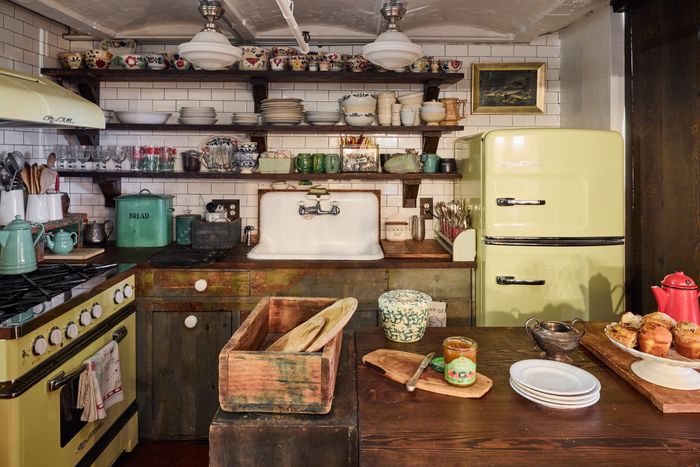
The Kitchen “We don’t like to use the word island, but this dry sink acts as one,” says Korelitz. “It’s not a great refrigerator. But doesn’t it look good?” The Yellow-ware mugs and Victorian cutlery are from U.S. flea markets and British car-boot sales.
Photo: Jeremy Liebman
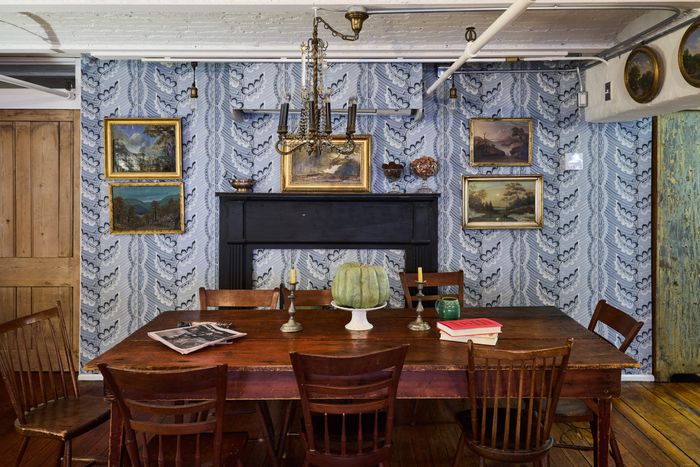
The Dining Area The Bixby Vine & Drapery wallpaper is by Adelphi Paper Hangings. “The table, like a lot of things, came from LiveAuctioneers,” says Korelitz.
Photo: Jeremy Liebman
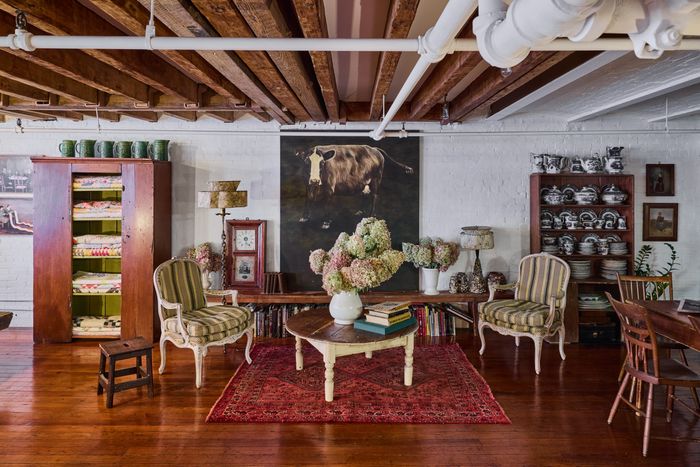
The Central Zone The “Moss Cow” painting is by Dermot Seymour, and it was in the couple’s home in Princeton. The furniture is a work in progress. Muldoon would like to find leather Wingback chairs. “We can’t afford them,” Korelitz tells him. “It’s a running gag,” Muldoon says. “It keeps us going. It gives us something to talk about, right?”
Photo: Jeremy Liebman
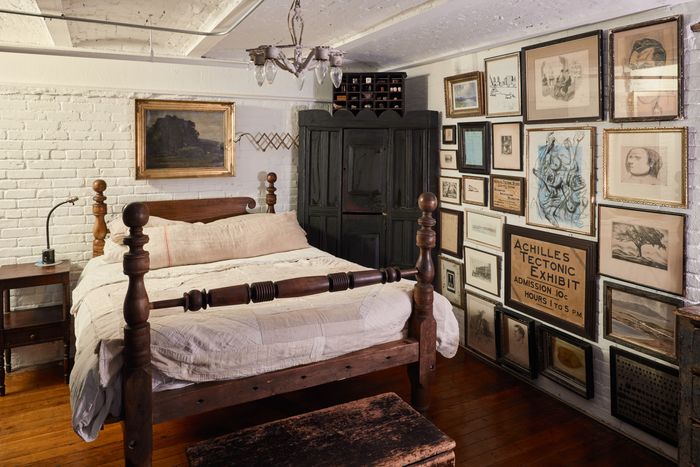
The Bedroom The art includes a drawing by Sylvia Plath, watercolors by Jack B. Yeats and Percy French, a cartoon by Helen E. Hokinson, and a print by Rockwell Kent that belonged to Korelitz’s grandparents; the bookplate was also theirs. “Our very old cannonball rope bed doesn’t fit a regular mattress,” Korelitz says, so she finds vintage heavy linen sheets in European flea markets.
Photo: Jeremy Liebman
Thank you for subscribing and supporting our journalism.
If you prefer to read in print, you can also find this article in the February 9, 2026, issue of
New York Magazine.
Want more stories like this one? Subscribe now
to support our journalism and get unlimited access to our coverage.
If you prefer to read in print, you can also find this article in the February 9, 2026, issue of
New York Magazine.
Sign Up for the Design Hunting Newsletter
Design editor Wendy Goodman takes you inside the city’s most exciting homes and design studios.
Vox Media, LLC Terms and Privacy Notice