
Researchers in New York have reported the first observation of a new type of time crystal with a unique ability: it can levitate on a small cushion made of sound waves.
Intriguingly, the achievement seems to suggest that these novel levitating quantum systems defy Newton’s Third Law of Motion, in that their movements do not appear to be governed by the influence of balanced forces.
The team reported their achievement in the journal Physical Review Letters.
Time Crystals: Novel Quantum Systems
Time crystals are essentially collections of particles that exhibit unique properties, such as regular, repetitive oscillations, which physicists liken to the ticking of a clock. Initially only theorized to exist, over the last decade, studies of these intriguing quantum systems have seen several advancements, although practical uses remain elusive.
Still, scientists recognize that time crystals could have many uses, especially in quantum computation, data storage systems, and a range of other fields that may benefit from the unique properties of different types of time crystals.
Defying Newton’s Third Law of Motion
In their recent research, the New York University physics team says their newly discovered time crystals represent collections of particles like other varieties, but whose unique ability to levitate on sonic waves gives rise to some unique properties, including the apparent defiance of Newtonian laws.
Newton’s Third Law of Motion is arguably one of the famed physicist’s most memorable: that for every action, there is an equal but opposite reaction. In essence, this describes a balancing of forces, although in the case of the new time crystals the New York team has discovered, this does not appear to be the case.
“Time crystals are fascinating not only because of the possibilities, but also because they seem so exotic and complicated,” according to David Grier, a physics professor and director of NYU’s Center for Soft Matter Research.
Grier, who was also the senior author of a new paper that describes these quantum oddities, said that the system he and his colleagues have uncovered “is remarkable because it’s incredibly simple.”
Levitation Through Sound
Unlike some of their quantum cousins, the New York team’s new time crystals can be seen with the naked eye, but are suspended on a device small enough that it can be held in a single hand.
At the heart of the discovery are Styrofoam beads levitated by sound waves, allowing them to be suspended in midair.
“Sound waves exert forces on particles—just like waves on the surface of a pond can exert forces on a floating leaf,” said Mia Morrell, a NYU graduate student who conducted the recent research along with fellow NYU undergraduate Leela Elliott.
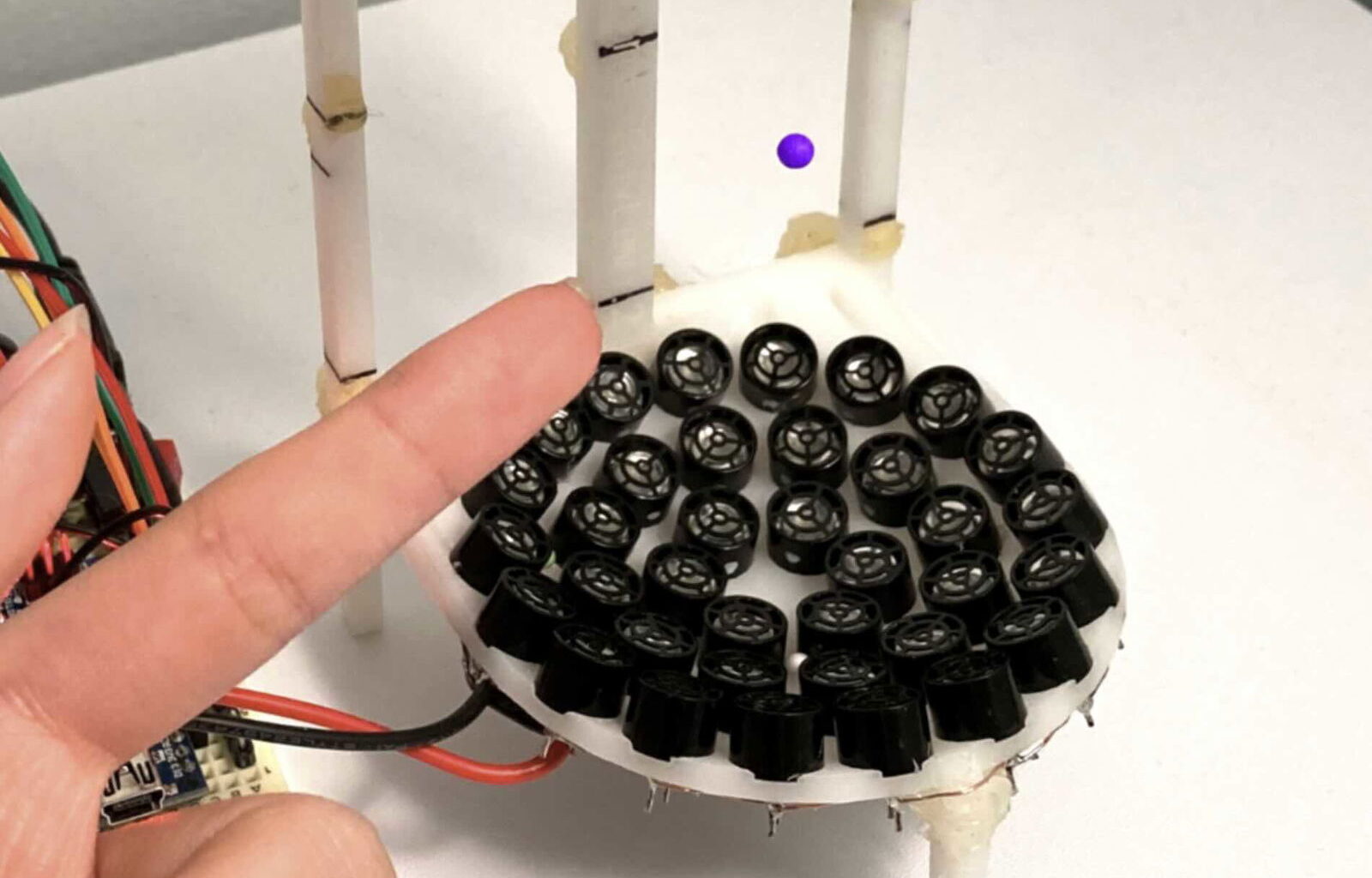
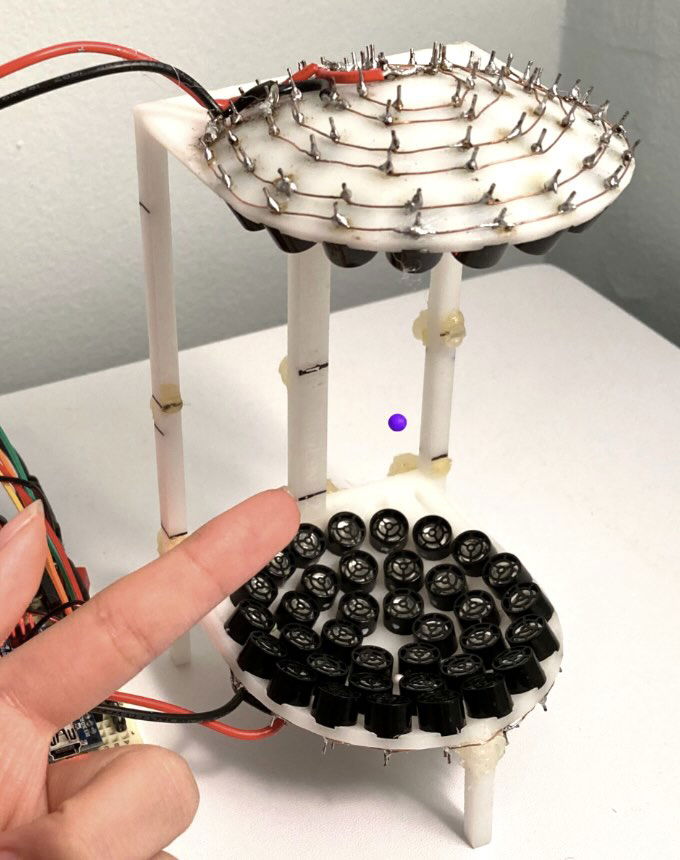 Levitating on a cushion produced by sound waves, a bead (shown in purple above) is suspended in mid-air by sound waves emanating from (black) circular speakers arranged in a six-inch-tall 3D-printed frame (Image Credit: Courtesy of NYU’s Center for Soft Matter Research).
“We can levitate objects against gravity by immersing them in a sound field called a standing wave,” Morrell recently said. With Elliott’s contributions, the team says their achievement provides scientists with deeper insights into circadian rhythms, often referred to as “biological clocks,” by revealing certain biochemical networks that appear to display nonreciprocal interactions seemingly in defiance of Newton’s Third Law of Motion.
Unbalanced Interactions
Additionally, the team reports that the processes through which the new time crystals levitate result in the exchange of scattered sound waves. This is important because more sound is scattered by larger particles, and therefore, they exert a greater influence on their smaller counterparts, leading to an imbalance between particles of different sizes.

Morrell likens this to a pair of ferries, one smaller and one larger, that are each approaching a dock. “Each one makes water waves that push the other one around—but to different degrees, depending on their size,” Morrell explained.
Since wave-governed interactions such as these are not constrained by Newton’s Third Law, the team observed that their beads appear to oscillate spontaneously while they are levitated, which effectively gives rise to a rhythm (i.e., the clock-like “ticking” time crystals produce through their repetitious movements) that helps to perfectly balance the forces to which they are subjected.
Altogether, the team says the new levitating time crystals were capable of achieving four distinct states, which they claim were both experimentally and theoretically demonstrated.
“We show, in theory and experiment, that a minimal system composed of two acoustically levitated particles can access four distinct dynamical states, two of which are emergently active steady states,” the team writes in their recent paper, adding that under some conditions, the resulting active steady states lead to disruptions in space-time symmetry which “therefore constitute a classical time crystal.”
The team’s recent paper, “Nonreciprocal Wave-Mediated Interactions Power a Classical Time Crystal,” was published in Physical Review Letters on February 6, 2026.
Micah Hanks is the Editor-in-Chief and Co-Founder of The Debrief. A longtime reporter on science, defense, and technology with a focus on space and astronomy, he can be reached at micah@thedebrief.org. Follow him on X @MicahHanks, and at micahhanks.com.