
The wild population of Mexican gray wolves in the United States was 286 at last count. That’s well below the number set by federal scientists to take it off the endangered species list.
Congress has never delisted a species that still meets the legal definition of endangered. But with backing from ranchers, an effort to do just that is advancing in Congress.
Conservationists argue that delisting should be based on the population, genetic diversity and long-term viability of the wolves, as required under the Endangered Species Act of 1973.
“There’s nothing science-based” about Congress sidestepping the law and imposing its own judgment, said Michael Robinson, senior conservation advocate at the Center for Biological Diversity.
The gray wolf was reintroduced in the wild in 1998.
Rep. Paul Gosar, R-Bullhead City, and others who back delisting say the animals are no longer on the verge of extinction. And, they say, the wolves threaten livestock, game animals like elk and deer, and people in Arizona and New Mexico.
“There are elderly people in my community who will no longer walk in the woods because of the wolves. Wolves snatch and kill pets off our front porches and from front yards. They kill our kids’ horses,” Tom Paterson, president of the New Mexico Cattle Growers’ Association, told a House Natural Resources subcommittee during a hearing on Gosar’s bill in September.
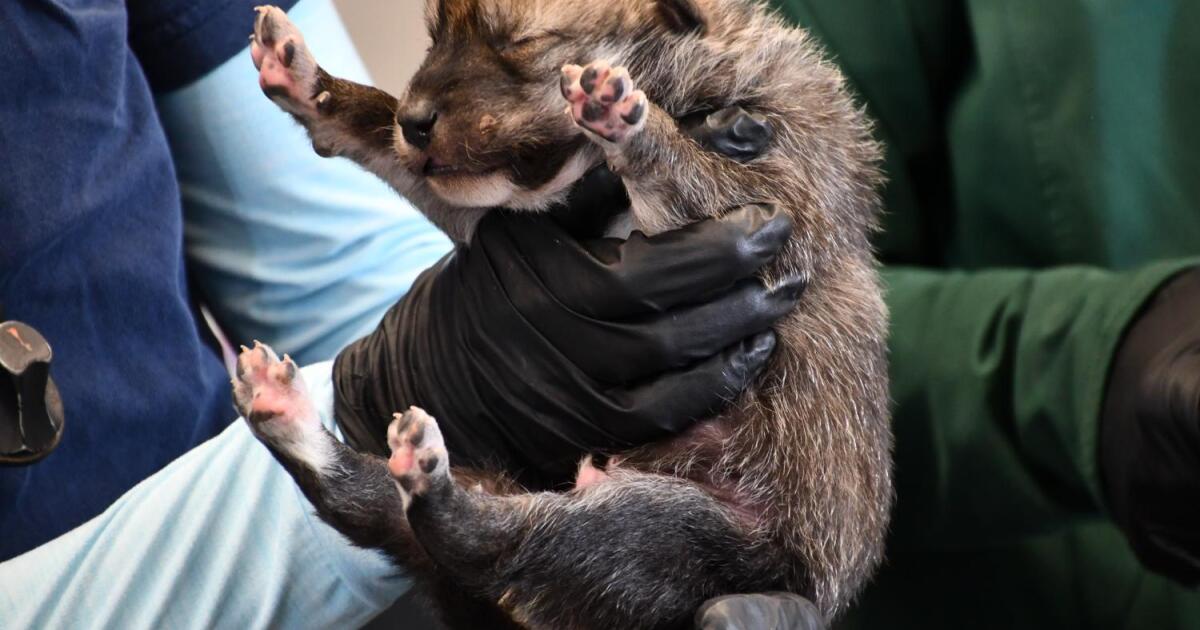
Two piles of Mexican wolf pups huddled together in a den box, taken May 30, 2025. (Photo by U.S. Fish and Wildlife Service) Under the 1973 law, once a species has recovered enough that it’s no longer endangered, it would get a “threatened” designation. That also comes with legal protections.
Gosar’s bill would also forbid listing the wolves as threatened.
For a species deemed to be threatened, recovery efforts continue though the U.S. Fish and Wildlife Service may allow limited hunting and trapping.
Once a species falls off the threatened list, it loses most federal protection. Population management shifts primarily to the states, though monitoring by Fish and Wildlife won’t end for at least five years.
Under the current federal recovery plan, the Mexican gray wolf will stay on the endangered list until the wild population hits a rolling average of 320 for eight years, with a stable or increasing population that tops 320 for the last three years.
This bar graph displays minimum population numbers for Mexican wolves in the United States for the years 1998-2024. It also shows 8-year population average and number of released wolves surviving to breeding age. (U.S. Fish and Wildlife Service) The current population – 124 in Arizona and 162 in New Mexico – is the highest since 1998, when 11 captive-reared wolves were released in eastern Arizona.
The first litter born in the wild to a wild-born parent came in 2002. The population grew in most years since then, including in the last eight.
The Game and Fish Departments of Arizona and New Mexico count the wolves from November through February using remote cameras, scat collection and visual observation. Alpha females are caught and collared. Teams on the ground count the packs multiple times throughout the winter.
Tracks, like this Mexican wolf paw print photographed March 1, 2019, help biologists track wolves during annual ground surveys. (Photo by Mexican Wolf Interagency Field Team/U.S. Fish and Wildlife Service) Jim deVos, the Mexican wolf coordinator for the Arizona Game and Fish Department, said the annual census is considered accurate within 5% to 10%.
Gray wolves were originally listed as subspecies or as regional populations of subspecies, according to the Fish and Wildlife Service. In 1978, the gray wolf was reclassified as endangered at the species level throughout the U.S. and Mexico, except for a population in Minnesota that was classified as threatened.
Congress removed protection from gray wolves in Montana and Idaho and parts of Oregon, Washington and Utah in 2011.
That population had already met federal recovery goals, unlike the Mexican gray wolf. The only hurdle to delisting at the time was a lack of state regulation to protect the wolves from excessive hunting or trapping, another requirement under the Endangered Species Act.
Those were very particular circumstances, and legal scholars say Congress would set a dangerous precedent if Gosar’s bill becomes law.
William Snape, an assistant dean at American University Washington College of Law who directs the environmental law program, called it an instance of “rare legislative overreach to try to overly manage a species without taking into account the actual biological specifics of recovery.”
In Arizona and New Mexico, ranchers say the wolves have become a significant financial burden.
Don McDowell, chair of the wildlife committee for the Arizona Cattle Growers’ Association, said depredations have increased, though that’s often impossible to prove because a cow may not be found for days.
By then, scavengers have often picked at the carcass, destroying the evidence needed to file a claim for reimbursement.
“The cowboys are not out there babysitting their livestock,” he said.
U.S. Department of Agriculture investigators blamed wolves for the deaths of 138 cattle in 2024, plus one horse and two dogs. Owners in Arizona and Mexico collected $171,371 in compensation under a program funded jointly by the federal government and the states.
The federal government also provides funds to help ranchers take non-lethal steps to keep wolves away. The number of recorded depredations has been dropping for several years despite the growing number of wolves.
Gosar has been trying to remove federal protections for the Mexican gray wolf for a decade. A 2015 bill he filed died without a committee vote. His latest effort won committee approval Jan. 22 on a party-line vote, with all but one of the Democrats opposed.
“Ideology has replaced management. Bureaucracy has replaced common sense,” Gosar said during that committee meeting. “U.S. land owners should not be held hostage to decisions made outside of their borders.”
Paterson, the New Mexico rancher, testified that wolves have become “habituated” to people, though there have been no recorded instances of attacks on humans, according to the National Park Service.
The Fish and Wildlife Service says wolf-human interactions are rare. Hardly any involve imminent danger, though in December 2024, a pair of uncollared wolves were spotted near a home near Quemado, N.M., over several days.
In addition to the U.S. population target, the Mexican gray wolf recovery plan also sets a target of 200 wolves in Mexico to ensure genetic diversity.
The current count in Mexico falls far short of that – just nine wild wolves, according to a 2024 recovery report from the U.S. Fish and Wildlife Service.
With the population on the U.S. side growing, though, Gosar and others say the decision on whether they are endangered should not hinge on the population in Mexico, where legal protections and enforcement are weaker.
“The introduction back into Mexico is not working,” McDowell said, but “we have a viable breeding population in the state of Arizona.”
He also asserts that the wolf population is undercounted because game departments can’t collar all of them, and because some are breeding with dogs and coyotes. Ranchers have seen such hybrids, he said, though he acknowledged there is no scientific evidence.
No such hybrids exist, according to deVos. In any case, they would not count toward federal targets set under the Endangered Species Act.
“Every wolf that we capture we pull a DNA sample from,” he said. “There simply are no documented hybrids.”
This article first appeared on Cronkite News and is republished here under a Creative Commons Attribution-NoDerivatives 4.0 International License.