
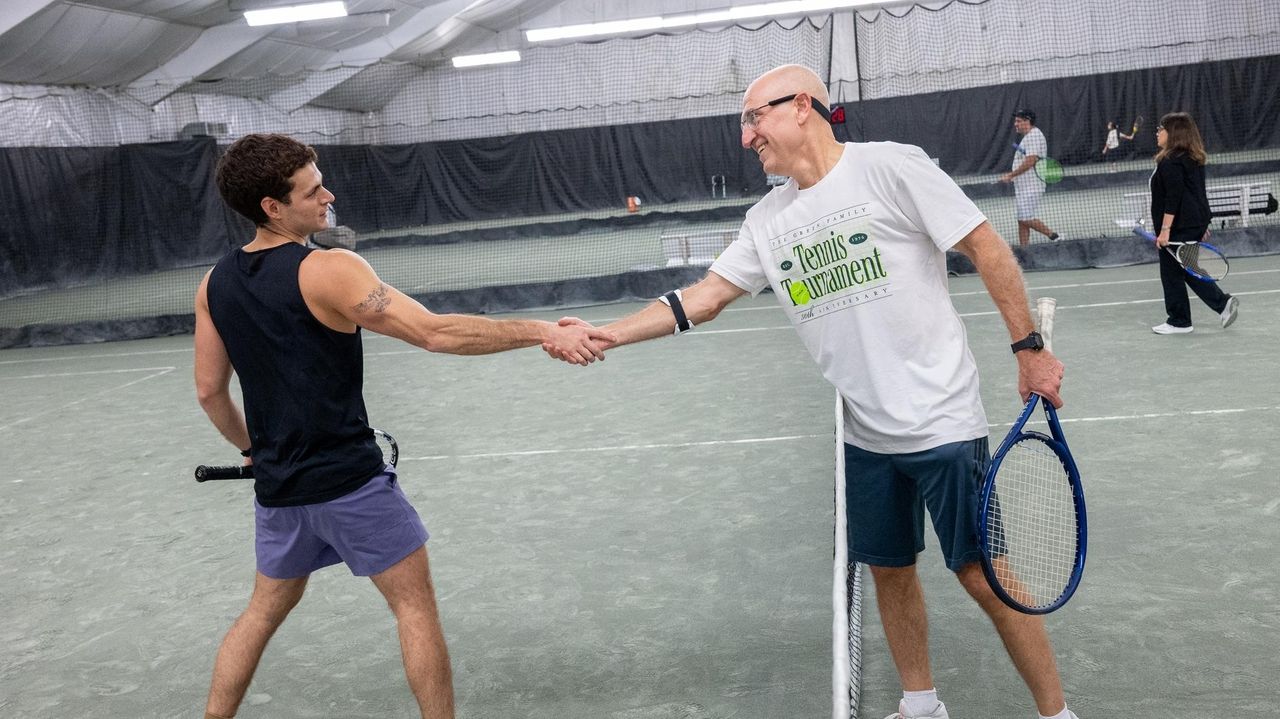
It was parent against child, husband versus wife, cousin creaming cousin. But before things went south with pop, whack and thwap, a poem was read.
“Who would win? Who would lose?” Ellen Rosenzweig, 68, the poem’s author, read to dozens of family members. “You’d think it wouldn’t matter. But not to this competitive family, for the losers would simply be shattered.”
So began the 50th anniversary of the Green Family Tennis Tournament, held at Jericho-Westbury Indoor Tennis on Jan. 24.
Since 1976, the annual tournament has been equal parts competition and reunion. Whether players could swing a racket or not — participation was once mandatory — the score was always love-love. In-laws and distant relatives are simply called cousins, uncles or aunts. Nonplayers catch up with each other in the spectator area, and the day ends with a post-tournament dinner, hosted by a family member with a big dining room.
After dessert, the two winners are announced. Their names are later added to the tournament trophy, which each champion keeps at home for six months.
For the anniversary, players wore commemorative T-shirts of the family tree featuring three Green siblings whose descendants now span four generations — 82 family members so far. Underneath that shirt, several wore the 25th anniversary T-shirt.
“We are a family of traditions and doing things together,” said David Green, 61, of Old Bethpage, a retired commercial real estate broker. “It’s the commitment to the continuity of our family values.”
A SPECIAL MOMENT 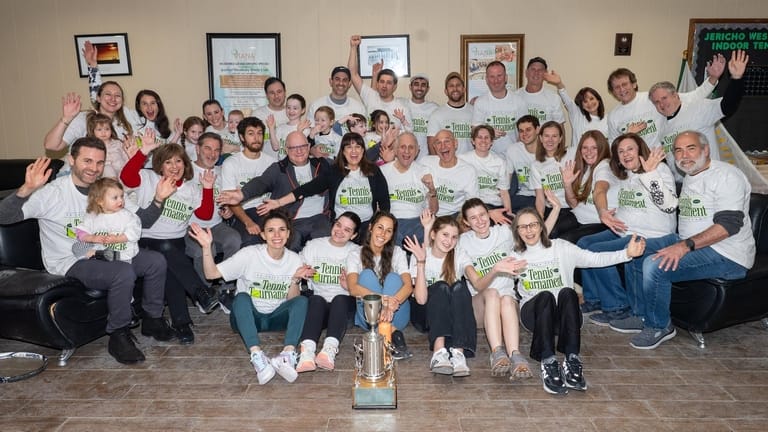
A group photo of the family, who played the doubles tennis tournament at Jericho-Westbury Indoor Tennis on Jan. 24. Winners get their names added to the trophy. Credit: Howard Simmons
During the 50th gathering, there was an almost unnoticed moment worthy of a Wimbledon highlight reel.
As youngsters ran and the adults gabbed around them, Stephen Green, 89, — the tournament’s founder and the last surviving member of his generation — held hands with Avery Bromberg, 14, an eighth grader from Bellmore. She’s the first member of the fourth generation to compete, and, like other Green descendants, had dreamed about finally being old enough to do so.
“I’m so excited to play this year,” Bromberg recalled telling her “Uncle Steve,” who then replied, “I’m so excited for you to carry on this tradition.”
No one ever thought the family would still be playing five decades later, least of all Stephen Green: “That’s like a dream world,” he said.
Perhaps the highlight of the 50th matches was when Adam Green, 61, known for his killer instinct, careened into the next court and onto a bench there as he chased the ball.
His fellow family members didn’t mind the interruption.
“We see friends and neighbors that share stories of animosity and trouble at family get-togethers,” said Adam of Commack, a retired nuts and dried fruit importer. “We don’t have any of that. We enjoy each other’s company. We laugh like crazy together. The fact that we happen to have a love of tennis is just a side note.”
THE MAN BEHIND THE TOURNEY 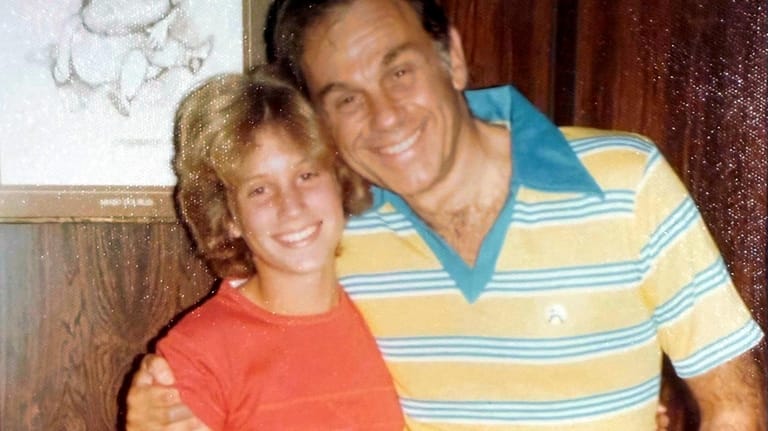
Jennifer Green-Kravitz and her uncle, Stanley Green, during the 1976 tournament Credit: Green Family
A fierce competitor by nature, Stephen Green was known as a lover of many games, from Monopoly contests in high school to bridge tournaments later in life.
After taking over his father’s dress manufacturing company in Manhattan’s Garment District in the early 1960s, which he said he hated, he started thinking of how to combine family time with tennis time.
The tournament was embraced by his siblings and their spouses, Stanley and Arline Green and Bette and Jerry Klaif.
“It really seemed natural because we had a big family that was very close, and we all loved to play tennis,” he said.
Stephen Green, a meticulous planner, drafted the doubles tournament bylaws. He made himself and Stanley lifetime members of the board of directors. Only descendants of his parents, Murray and Dora Green, and their spouses could participate. Players had to be at least 15, unless, like Bromberg, they showed “exceptional ability and maturity.” No one living under the same roof could be paired together.
Green said he wanted everyone in the family to win at some point, so for years, he ranked the players and paired the weak with the strong. Some feigned injury to be paired with a skilled player. Others said they weren’t feeling well.
“People will do anything sometimes to get their names on the trophy because they’d go 20 years and never see their name on the trophy,” Stephen Green said. He then confessed for the first time, without naming names: “I may have bent the rules a little bit to help the people who deserve to be on the trophy, but they didn’t make it legitimately.”
One never did. His sister, Bette, was considered one of the family’s best athletes, but she died of cancer without claiming the title. When she was diagnosed, Green created the Lifetime Achievement Award in 1990 for her and she passed away shortly afterward. “She was probably the best athlete of the whole group,” her brother said.
EVOLVING RULES 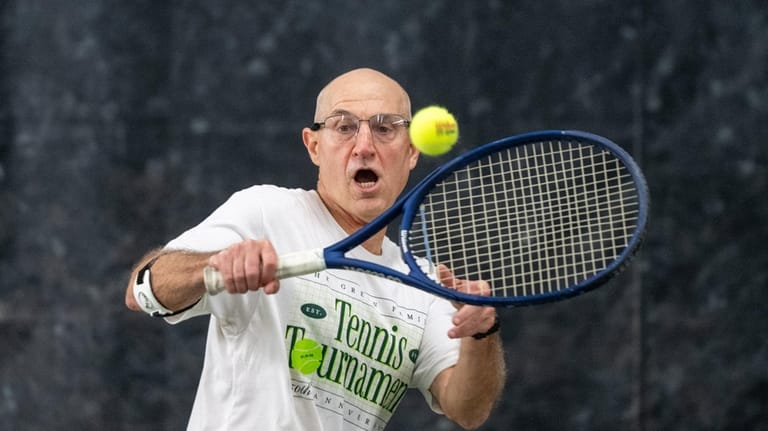
Adam Green, a perennial winner of the tournament, on Jan. 24. Credit: Howard Simmons
Rules have loosened over the years, but one issue remains disputed — whether family members are mandated to play during their teen years.
Katie Sussman, 40, a special education teacher from Great Neck, recalled having a “crying fit” in the ninth grade because she had to play at the tournament and miss a party.
“I was the only one who didn’t like tennis,” she recalled.
In college, Sussman rebelled. “The first year I didn’t do it. I was the only one in my generation who didn’t do it,” she said. “The next year, people started dropping like flies. They said, ‘Oh, if it’s not mandatory, I’m not going to do it.’ ”
When Newsday wrote about the event’s 25th anniversary, with a photo of her father, Larry Rosenzweig, the teenage Katie was mortified about the family tradition: “I thought we were like the ‘Brady Bunch.’ Now I think it’s cute,” she said.
In 2005, the family shifted to a round-robin format to avoid predictable outcomes dominated by perennial winners like Adam Green, known for his powerful shots.
“There are some very exciting matches that are high-level play,” Sussman said. “There’s some exciting matches of much less accomplished players, but just the fact they’re playing together is very nice. There’s a Jewish term called ‘kvelling.’ It means feeling good about something. Everybody is just enjoying the fact that there’s a sweet foursome of kids out there.”
THE PENTATHLON 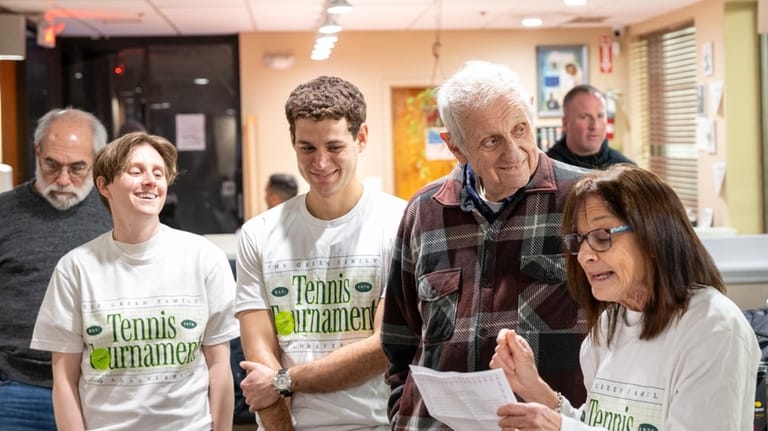
Tournament founder Stephen Green, 89, in plaid shirt, listens with others as Ellen Rosenzweig reads a poem she wrote about the competition at the beginning of festivities. Listening, from left, Stephen’s nephew Steve Sandler, and grandchildren Dana Kravitz and Gabriel Green. Credit: Howard Simmons
The tournament is not the only tradition that’s a family hit.
Stephen Green was batting a thousand when he, with the help of family members, mounted their very own Olympics a few years after starting the tennis tradition.
They called it the Pentathlon.
For a single day every two summers, teams of family members competed in various games at Stanley and Arline’s 2-acre home in Muttontown, complete with tennis court and swimming pool. Croquet on the lawn. Table tennis at the house. Swimming. Relay races. Darts on a bull’s-eye board hung between the house’s cedar shingles. Basketball throws in front of the garage. Badminton at the tennis court. Horseshoes over a sandbox.
Just like the Olympics, they’d have a parade during the opening ceremony. Stephen Green and several other family members would interview players and comment as sportscasters during The Games, with jokes at players’ expense.
The Games ended in 2012, but the stories live on.
Like the time Stephen Green tried to win a kayak race — actually on inflated rafts in the swimming pool — but when he put one foot into the raft, he plunged into the water.
FAMILY LORE 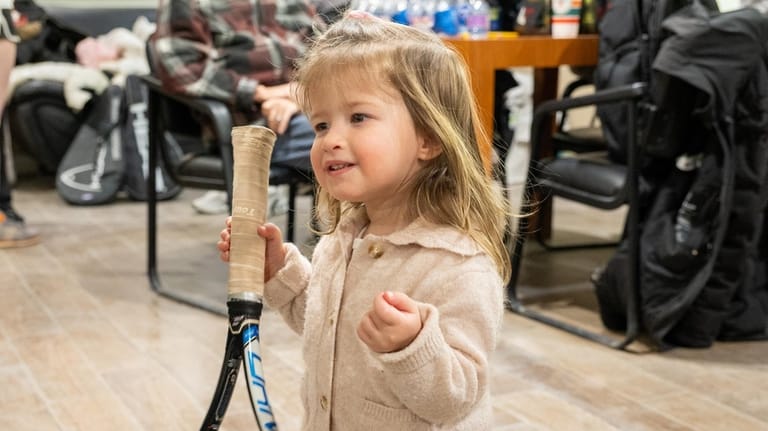
Layne Sussman awaits her tournament. Most family members don’t compete until they are 15. Credit: Howard Simmons
It’s the memories that make the tradition dear, not the tennis or games, which are just a side note for the Green gang as they laugh and reminisce.
In an oft-told story, all-around good athlete Peter Kravitz secretly trained for tennis glory. And one year a nine-month pregnant Linda Sussman won the tournament because under the rules, she got a strong partner.
“Putting these things together takes a lot of time and effort and coordination,” Linda Sussman noted. “It exemplifies how much we love each other and how strongly we feel the bond to keep the family together. Outsiders might think it’s a little wacky and zany. For us, it exemplifies the very best of what a family can be.”
Correction: A previous version of this story misidentified Jerry Klaif and Larry Rosenzweig.