

Health care leaders across the Bay State have spent weeks bracing for a Tuesday deadline ending the special protected status for the thousands of Haitian immigrants who are the industry’s backbone.
And now three Massachusetts politicians are asking those same leaders for in-depth data on the breadth and scope of an expected staffing shortage for an industry that’s already stretched thin.
“At precisely a time when the United States needs more elder care providers for its aging population, and health care facilities report difficulties filling nursing, home care, and other provider vacancies, the Trump Administration is forcing legal, trained care providers out of the workforce,” Democratic U.S. Sens. Elizabeth Warren and Ed Markey., joined by U.S. Rep. Ayanna Pressley, D-7th District, wrote in a Sunday letter to seven industry trade groups and unions.
In all, 52 lawmakers in the U.S. House and Senate signed the letter, Warren’s office said in a statement.
“This trend of de-legalizing legal immigrant workers will not make Americans safer. It will simply leave our communities with fewer options for quality, affordable care,” the lawmakers wrote.
The U.S. government granted temporary legal status to Haitians after the country was devastated by an earthquake in 2010. And since the country’s president was killed in 2021, violent gangs run much of the country, Marketplace reported.
 Sen. Elizabeth Warren, D-Mass., attends a news conference about SNAP benefits, Wednesday, Oct. 29, 2025, on Capitol Hill in Washington.(AP Photo/Jacquelyn Martin)
A spokesperson for the U.S. Department of Homeland Security has defended the move, arguing that it “restores integrity in our immigration system and ensures that Temporary Protective Status is actually temporary.”
“The environmental situation in Haiti has improved enough that it is safe for Haitian citizens to return home,” the spokesperson said.
Bay State elected leaders have spent weeks pleading with the Republican White House to extend temporary protected status, arguing that the economic fallout will be severe.
“Haitian TPS holders are essential contributors to our state’s workforce, filling roles that are vital to our economic stability and growth,” that spans such industries as “health care and long-term care to transportation, hospitality, and construction,” Gov. Maura Healey wrote in a letter last week to U.S. Homeland Security Secretary Kristi Noem.
While immigrants make up around 20% of the U.S. civilian labor force, they account for more than a quarter of the estimated 4 million nursing assistants, home health aides, personal care aides and other direct-care workers, Warren and Pressley noted in their letter to industry and labor leaders.
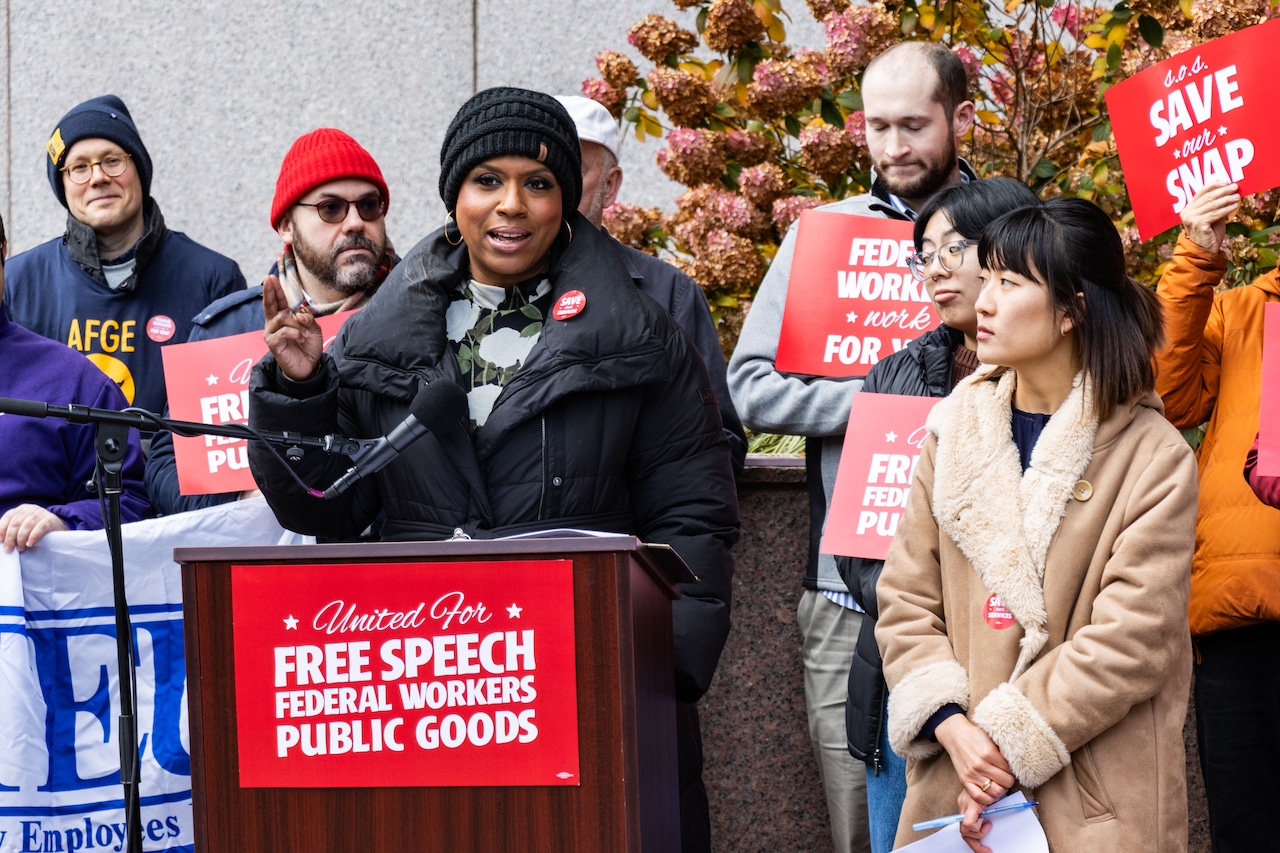 Rep. Ayanna Pressley, D-7th District, left, speaks at a press conference in support of Ellen Mei, right, a federal employee fired for giving a news interview about SNAP during the government shutdown.(Tréa Lavery/MassLive)
In Massachusetts, meanwhile, immigrants account for 22% of the state’s total workforce, but comprise nearly 40% of home health aides, with Haitians making up the broadest share, the two lawmakers wrote.
The Bay State is home to one of the largest Haitian populations in the country, more than 45,000 of whom have temporary protected status, Healey said. Those workers “help keep our economy running. The sudden loss of their legal status and work authorization would be devastating for our state.”
Warren and Pressley said they’re “gravely concerned” that the end of the temporary legal status will “threaten access to health care, elder care, and disability care for American families.”
On Capitol Hill, Pressley is trying to force a vote on a measure that would preserve temporary protected status. The Boston lawmaker’s district has a large Haitian population.
“Extending TPS for Haiti isn’t just the moral, humanitarian thing to do — it is also good policy,” Pressley said.
At a field hearing last month, Pressley, joined by U.S. Sen. Ed Markey, D-Mass., and U.S. Rep. Seth Moulton, D-6th District, heard directly from people who will be impacted by the White House’s decision.
“We are profoundly grateful to the United States for welcoming us during that time of crisis,” one witness, identified only as Bruno, told the lawmakers. “My children have been brought up, been educated here, and become part of the fabric of Massachusetts. This is their home today.”
Franklin Soults of 32BJ SEIU, which represents thousands of health care workers, said one of the misunderstandings about TPS is that it does not provide a direct pathway to citizenship or permanent residency, such as through a green card.
“There is no path for them to normalize their status, to turn it into something permanent,” he said, according to State House News Service.