
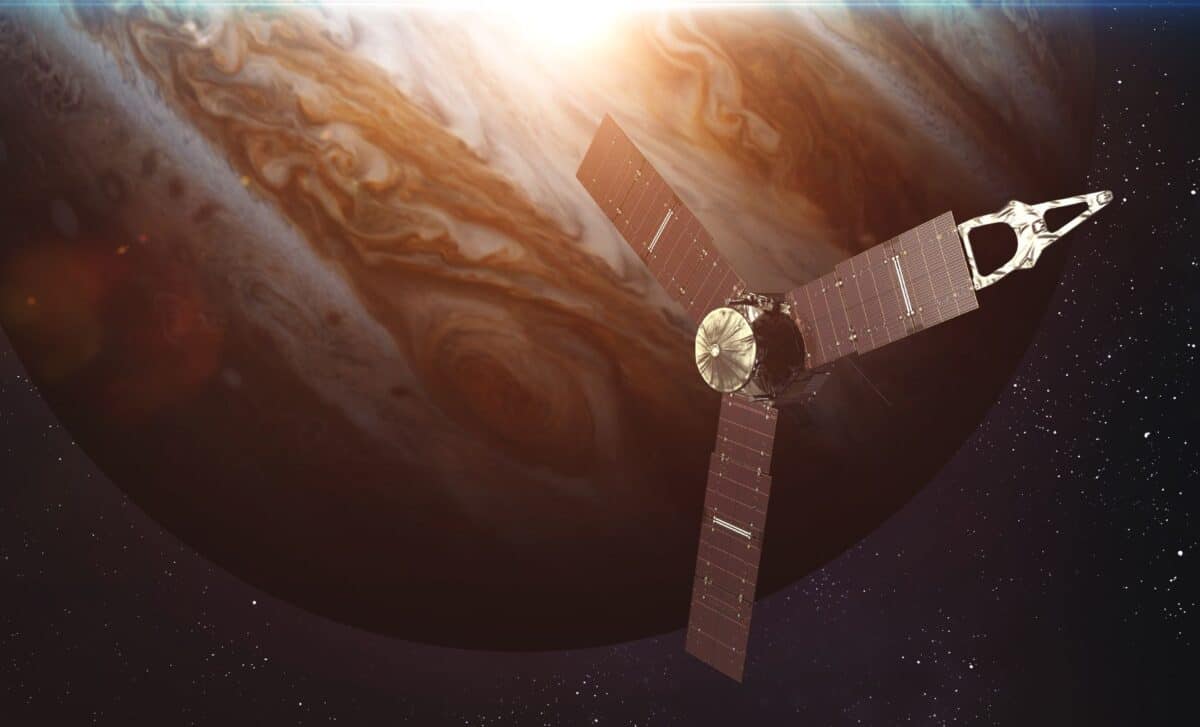
For decades, scientists have been puzzled by the violent eruptions on Jupiter’s moon Io. Now, thanks to Juno’s recent close flybys, we know that Io’s 400 volcanoes are likely powered by individual chambers of magma, not a massive global magma ocean beneath the surface. This finding clears up a mystery that has been around for 44 years.
Io, often described as the most volcanically active body in our solar system, has always been a source of wonder and confusion. From the moment NASA’s Voyager spacecraft first captured images of volcanic plumes on the moon in 1979, scientists have been trying to figure out exactly what’s behind these fiery outbursts. The latest data from Juno’s flybys in 2023 and 2024 might have just cracked the code.
Solving a 44-Year-Old Mystery
When Io’s volcanic activity was first discovered, it was like opening a scientific Pandora’s box. Two competing theories emerged: one suggested that a global ocean of molten rock lay beneath Io’s surface, feeding its volcanoes, while the other proposed that each volcano had its own localized magma source. According to new research, published in Nature, the truth lies somewhere in the middle. Juno’s data, gathered from flybys in late 2023 and early 2024, suggests that Io’s volcanoes are powered by individual chambers of magma.
This finding comes from the spacecraft’s precise measurements of Io’s gravity field, which revealed crucial details about the moon’s internal structure. By tracking how Io’s gravity affected the spacecraft’s motion, scientists could gain a better understanding of the moon’s inner workings.
The discovery is a big deal because it rules out the idea of a global magma ocean and gives us a more accurate picture of how volcanic activity is sustained on Io.
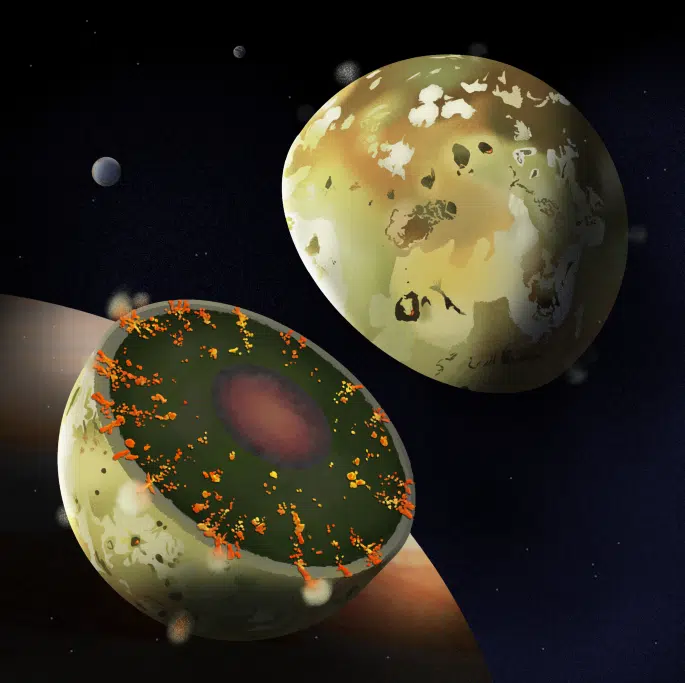 An artistic interpretation of Io’s intense volcanic landscape. Credit: Nature
Tidal Forces: The Hidden Engine of Io’s Volcanism
One of the key reasons Io is so volcanically active is its orbit around Jupiter. Io’s orbit is far from circular; it’s highly elliptical, meaning its distance from the planet changes dramatically over time. This places Io in the grip of intense tidal forces as Jupiter’s gravity pulls on the moon, stretching and squeezing it in a way that generates enormous friction deep inside.
This phenomenon, known as tidal flexing, is responsible for much of the internal heat that drives Io’s eruptions. Scott Bolton, the principal investigator of the Juno mission, explained it like this:
“This constant flexing creates immense energy, which literally melts portions of Io’s interior.”
If Io had a global magma ocean beneath its surface, scientists would have expected to see much larger tidal deformations. Instead, the data showed that Io’s interior is more rigid, with smaller pockets of molten rock, which fits with the idea of individual chambers of magma driving the volcanoes.
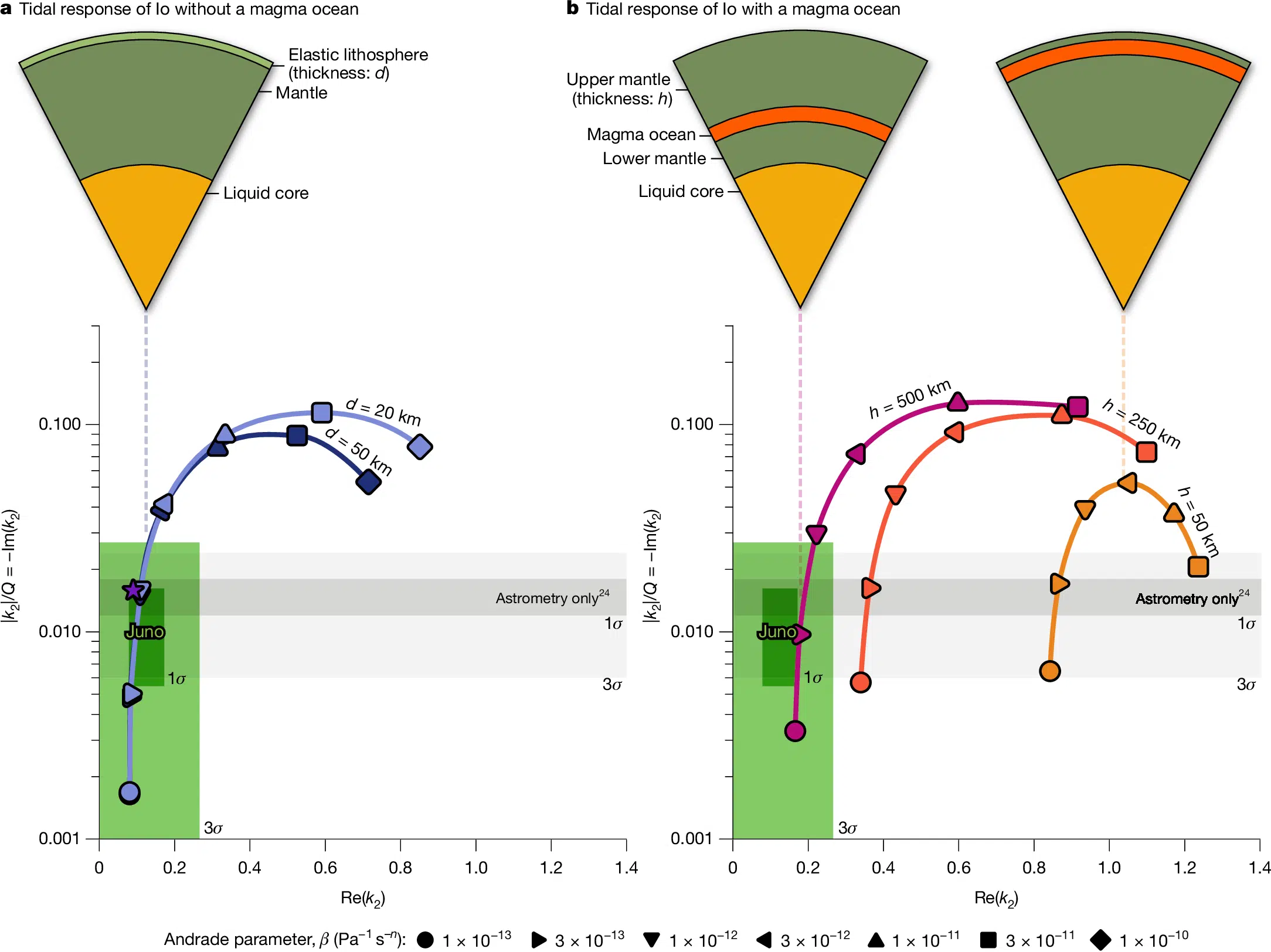 Tidal response of Jupiter’s moon Io with and without a magma ocean. Credit: Nature
What Io’s Volcanic Fury Tells Us About Other Worlds
The findings from NASA’s Juno mission not only enhance our understanding of Io but also have far-reaching implications for planetary science as a whole. Ryan Park, a co-investigator for Juno, pointed out that:
“It has implications for our understanding of other moons, such as Enceladus and Europa, and even exoplanets and super-Earths. Our new findings provide an opportunity to rethink what we know about planetary formation and evolution.”
The discovery also encourages scientists to rethink some of their assumptions about planetary formation and evolution.