
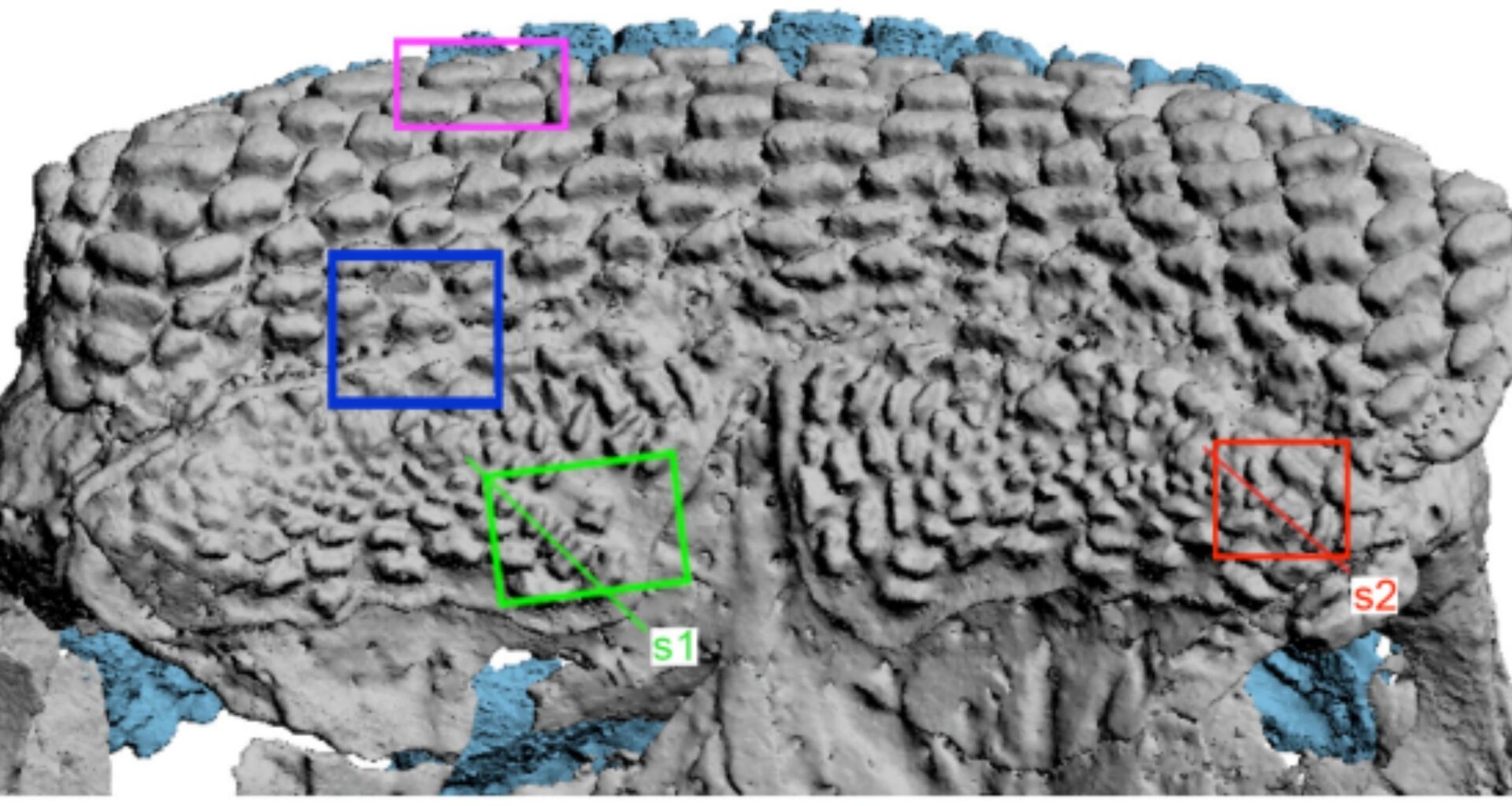
A newly described fossil fish species, Romundina gagnieri, has revealed teeth growing on bony plates that line the roof of its mouth. This extends the acquisition of teeth in jawed fishes to a far earlier stage in vertebrate evolution.
That architecture reframes how jaws and teeth first emerged together in fishes, shifting the starting point for a defining feature of vertebrate life.
Clues inside a jawed fish skull

Those tooth-bearing plates appear on fragments of an armored skull recovered from Arctic rocks. They preserve rare details of an early jawed mouth.
Working directly with this material, Dr. Sebastien Olive at the Royal Belgian Institute of Natural Sciences (RBINS) documented how the plates formed and expanded as the animal matured.
The growth pattern in the jawed fish shows teeth added in a widening sequence across the plate, rather than advancing from a single rear position, as was long assumed.
That constraint limits how early jaws can be reconstructed and sets up the need to compare this pattern with other armored fishes next.
Meet Romundina gagnieri
Field crews found the skull pieces in northern Canada, in rocks laid down about 400 million years ago. The discovery happened in 1995 on Prince of Wales Island, where ancient seabeds now sit high and dry.
In the report, the team named the animal Romundina gagnieri and placed it among the early jawed fishes. Its Arctic origin adds a rare datapoint from a time when fossils of early mouths remain frustratingly scarce.
Back then, oceans held placoderms, extinct armored fish with bony head shields, that are positioned near the base of the jawed fish branch, in terms of their evolution.
Unlike modern sharks or bony fish, many placoderms carried biting surfaces on separate plates, not on the jaw edges.
Researchers once assumed those plates lacked true teeth, because the fossil record often preserves smooth surfaces where teeth should stand.
Evidence from a 2012 paper showed some placoderms did grow teeth, setting the stage for deeper comparisons.
A circular tooth record
Within Romundina gagnieri, the tooth plate preserved a growth record that ran from the center to the rim.
Scanning revealed older teeth near the center and newer teeth added around them, so the plate widened as it aged.
That pattern contradicted the idea that early teeth always appeared from the back of the mouth, then marched forward.
By changing where new teeth appeared, the fossil supports a more flexible starting point for the first jawed fish lineages.
Seeing without breaking bone
To see tiny structures inside the plate, the team relied on synchrotron imaging, which involves a particle ring that produces intense X-rays.
That beam passed through the fossil from many angles, and software stacked the slices into a detailed three-dimensional model.
Because the method leaves the specimen intact, researchers can recheck features later as new questions and new tools arise.
Even with that resolution, the best images cannot replace missing fossils from other species and other parts of the jaw.
Scientific argument about jawed fishes
For decades, researchers have argued about whether teeth started on the skin and moved inward, or began inside the mouth.
A 2016 review laid out these competing origins, linking them to how tooth tissues form during development.
In 2020, a study argued that placoderm teeth mostly appeared at the back of the mouth.
The plates from the Arctic fossil make that argument harder to support, because their tooth record did not match a single, back-only rule.
More than teeth alone
The scans also exposed odontodes, hard bumps of mineralized tissue in skin or mouth, that were layered over some teeth.
These coverings grew in steps and sometimes hid broken teeth underneath, showing that the bite surface changed over time.
The study also noted patches of extra hard mineral on some teeth, which could have helped crush stubborn prey.
Because researchers at RBINS could not confirm the origin of these coverings, they left open whether they counted as teeth or something else.
Teeth allowed new feeding behaviors
Once jaws carried teeth, animals could grip, slice, and crush food instead of only filtering it or sucking it up.
Different tooth shapes and growth patterns can spread chewing forces, because harder tips meet food first and wear fastest.
“This allowed our distant ancestors to exploit new food sources and occupy new ecological resources,” said Dr. Olive.
That feeding control helped jawed vertebrates expand into many habitats, giving later lineages more ways to survive in changing seas.
Lessons from Romundina gagnieri
By comparing this Arctic fish to other armored relatives, the team argued that some mouth traits go far back in time.
Similar tooth plates appear in arthrodires, a placoderm group with jointed head armor, so the researchers inferred a shared design.
“We are looking here at one of the first steps in tooth evolution,” said Dr. Olive.
Because the placoderm family tree still carries uncertainties, researchers treat this ancestor claim as a strong but testable working idea.
The Arctic fish offered a rare look at early dental plates, and its tooth growth pattern widened the story of ancient jaws.
Future finds and more scans of related fossils will show whether this design marks a true great-grandmother, or simply one evolutionary branch among many.
The study is published in Royal Society Open Science.
—–
Like what you read? Subscribe to our newsletter for engaging articles, exclusive content, and the latest updates.
Check us out on EarthSnap, a free app brought to you by Eric Ralls and Earth.com.
—–