
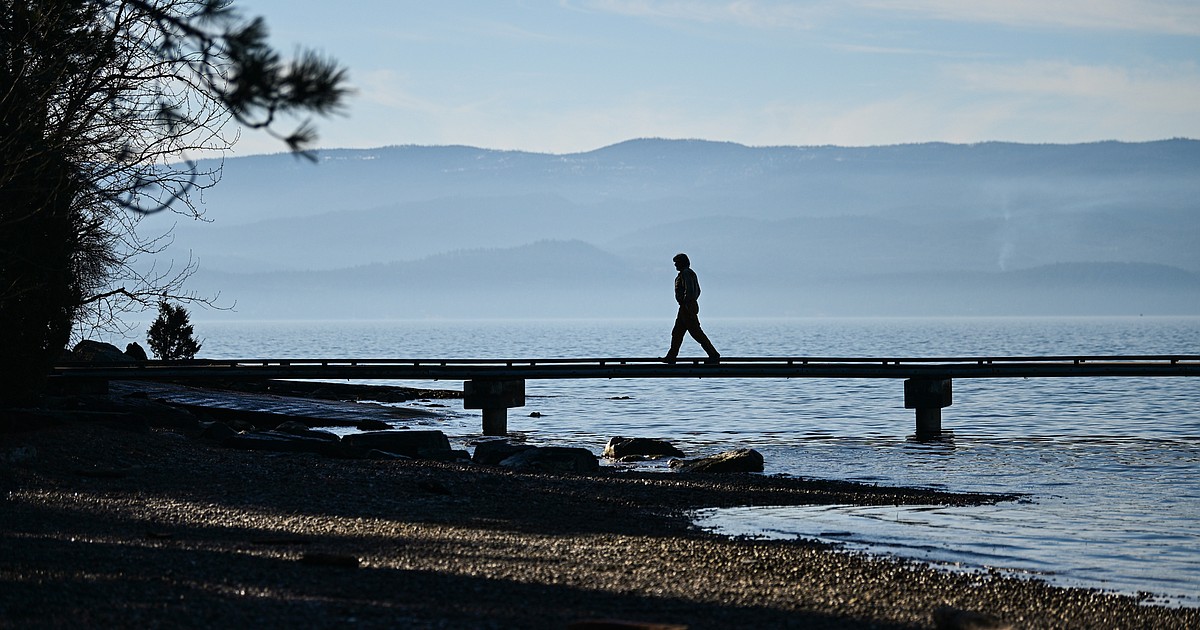
Jeremy Newell felt relief when he saw the weekly forecast called for near-50-degree days in the first week of February.
Newell had nothing against the litany of snow sports that dominate the Flathead Valley during the winter months, but he had spent weeks worrying over his own recreational prospects, many of which centered on the private dock that jutted a few dozen feet from his Lakeside property.
Most years, the structure was high and dry by early February as the water level in Flathead Lake slowly dropped from a summertime high of 2,893 feet to a springtime low of 2,883 feet. This year, Newell watched in nervous anticipation as a slurry of ice encased the dock’s legs in late January.
“If you get a foot-thick ice, which does happen, it could tear these docks right up,” he said. “The damage can be monstrous.”
So far, Newell said he hasn’t noticed any damage to his dock, but the unusually high water level remains unnerving. Flathead Lake currently sits at about 2,891 feet — more than five feet above the norm for the beginning of February and two feet below full pool — and plenty of other residents along the lake’s shore have reported damage to docks and boat lifts over the past few months.
The trouble started in early December, when a category 5 atmospheric river dumped near-record amounts of precipitation across the Pacific Northwest. With the deluge came a directive to dam managers from the U.S. Army Corps of Engineers: Hold as much water in the reservoirs as you can.
That’s exactly what managers at the SKQ Dam on the southern end of Flathead Lake did, said Energy Keepers CEO Brian Lipscomb. The tribally affiliated corporation has managed operations at the dam in accordance with a 1965 Memorandum of Understanding with the U.S. Army Corps of Engineers since 2015. The document includes a directive to draw the water level of the lake down to 2,883 feet by April 15, if conditions allow, to mitigate the impact of spring floods.
Lipscomb said managers were on track to reach that goal when they first received word from the U.S. Army Corps of Engineers on Dec. 1. Managers immediately maximized outflows from the dam to make room for the forecasted onslaught of water, but Flathead Lake still filled to capacity by the end of the month, as did every other reservoir in the Columbia River Basin.
“That has never happened in December before,” Lipscomb said. “We essentially got a spring-type storm during December.”
A week later, an equally massive windstorm ripped through the Flathead Valley and whipped the lake’s surface into a frenzy of whitecaps.
“Usually, the water is down low enough so docks wouldn’t be affected,” said Tyler Cochran, the operations manager of the dock construction company Dock Masters in Polson. “With the water being full pool, it caused a lot of damage.”
Cochran said he has received more repair requests this winter than in any of the previous five years he has worked in dock construction. The damage has varied, with some docks missing a few planks, and others completely decimated by the duo of winter storms.
If the lake ices over before the water level is lowered, Cochran expects to see even more widespread damage.
“It would wipe out a lot of boat lifts and docks,” he said of a possible freeze, adding that he has seen floes of ice sheer through steel in extreme conditions.
RETIRED HYDROGEOLOGIST Mark Lorang suspects the storms also caused a substantial amount of shoreline erosion. While erosion and sedimentation have been perennial problems for the lake, Lorang said the effects are typically most pronounced during the summer months, when the water level is kept high for recreationists.
“Now we get to do it in the winter too,” he said with a dry laugh.
The upside of the December storms was a chance for Lorang to test the erosion mitigation technology he has perfected over the better part of the past decade.
On Dec. 17, as gusts toppled 18-wheelers and powerlines across the Flathead Valley, Lorang stood on a spit of gravel in Woods Bay State Park. He had nicknamed the spot Storm Beach because it tended to receive the brunt of the lake’s wave energy.
That day was no exception. Gravel churned in the froth, pebbles crashing against each other, just like they were supposed to.
Lorang helped install the stretch of gravel, which he calls a dynamic equilibrium beach, in April 2025 with the aim of reducing erosion along the lake’s eastern shoreline. Traditional means of erosion mitigation like storm walls and riprap tend to deflect the destructive energy of waves farther down the shoreline, where they often crashed against docks and other infrastructure. But the gravel used to make dynamic equilibrium beaches moves with the motion of the waves, absorbing the water’s energy.
Even in the most extreme of circumstances — winds gusting at 30-40 miles per hour and the lake at full pool — Lorang saw no evidence of erosion along the shoreline of Woods Bay.
“Storm Beach will accommodate severe storms well into the future, even those that occur during lake levels at or exceeding 2,893 feet,” he later wrote in a report for Montana Fish, Wildlife and Parks. “The wave-erosion problem at this site has been solved.”
Elsewhere on Flathead Lake, docks and other structures continue to encroach upon the shoreline, even as climate change increases the frequency and severity of violent storms and creates more uncertainty in the management of the lake’s water level.
“It’s a really bad negative feedback loop, and we can do a lot to stop it,” said Lorang.
Dynamic equilibrium beaches are one way lakeside residents can learn to go with the flow of the lake.
IN TOTAL, the Flathead Basin received more than twice the median amount of precipitation for the month of December. Cycling through that much water takes time, said Lipscomb, as well as cooperation with other dam managers in the watershed.
Energy Keepers has maintained outflows from the SKQ Dam at 13,000 cubic feet per second since early December. That is the maximum outflow considered safe for downstream conditions and dam operations, said Lipscomb, as well as a 4,000 cubic feet per second increase from what has long been considered the wintertime norm.
But outflows from Hungry Horse Dam, which sits about 50 miles upstream from the SKQ Dam, also increased following the December storms, and much of the water flowing out of Flathead Lake was offset by inflows from the Flathead River.
Lipscomb said outflows from Hungry Horse Dam are now being cut back and that residents can expect the water level in Flathead Lake to fall more rapidly in the coming weeks.
“We’re releasing as much [water] as we can,” said Lipscomb. “We plan on continuing to release as much as we physically can.”
He anticipates that the lake will reach its lowest level for the season in late March.
Unless, of course, the Flathead Valley experiences yet another unprecedented storm.
Reporter Hailey Smalley can be reached at 758-4433 or [email protected].
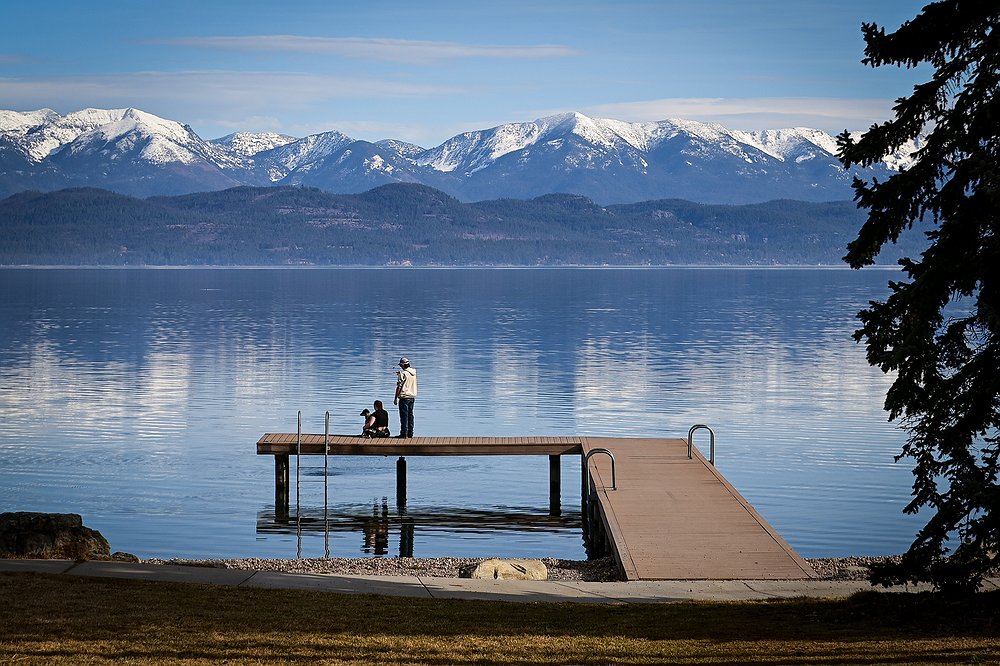 A couple walks a dog out onto a swimming dock at Volunteer Park in Lakeside on Wednesday, Feb. 4. (Casey Kreider/Daily Inter Lake)
Casey Kreider