
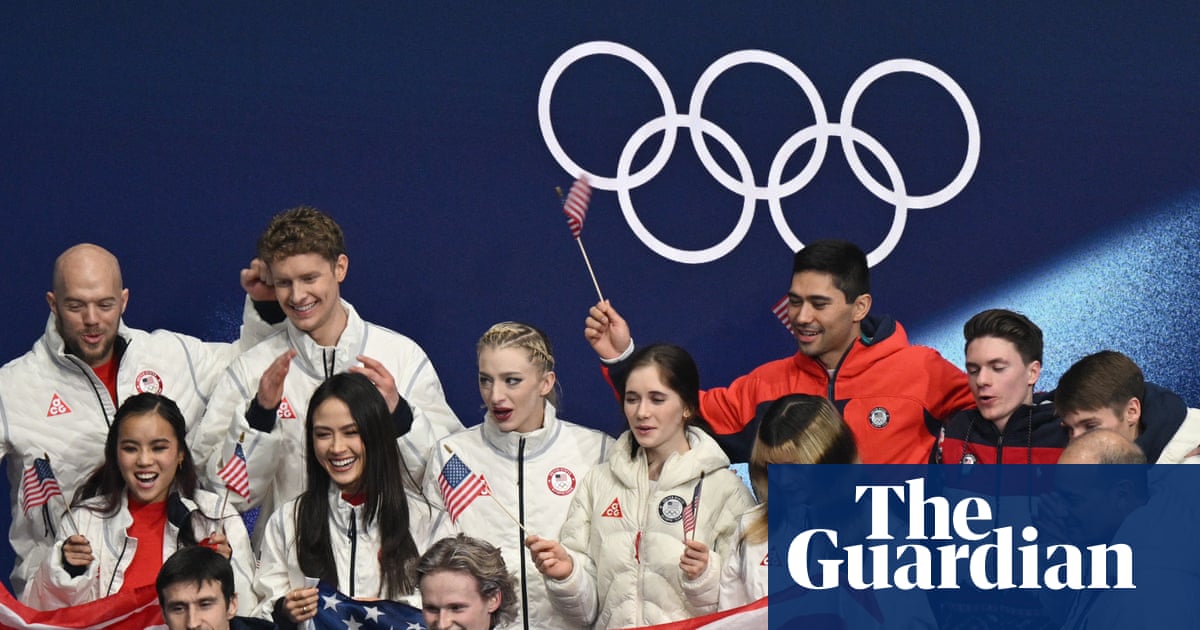
The United States held off a late charge from Japan to retain the Olympic team figure skating title on Sunday, with Ilia Malinin delivering in the men’s free skate to secure gold after three days of competition. Japan finished with silver, while host nation Italy claimed bronze.
The United States survived a final-day surge from Japan to retain the Olympic team figure skating title on Sunday night, with Ilia Malinin delivering under intense pressure in the men’s free skate to secure gold at the Milano Cortina Games. Japan finished one point behind in silver, while host nation Italy claimed bronze after three days of tightly contested competition.
The final standings – 69 points for the United States, 68 for Japan and 60 for Italy – reflected just how narrow the margin was in one of the most dramatic Olympic team events since the format was introduced in 2014. What had begun as a comfortable American lead after two days turned into a head-to-head showdown in the final session, ultimately decided by the sport’s most technically ambitious skater.
American hopes had rested heavily on Malinin, the 21-year-old two-time world champion who has gone more than two years without losing a competition. But he entered the decisive free skate carrying unusual pressure after a below-par short program on Saturday left the defending champions vulnerable. When Japan erased the remaining US cushion earlier Sunday, the outcome effectively came down to Malinin versus Japan’s Shun Sato in the final discipline.
Malinin, who has built his reputation on pushing the technical ceiling of men’s skating, adjusted his strategy under Olympic pressure. Expected to attempt as many as seven quadruple jumps, he instead delivered five while skating to a cinematic indie-folk compilation of songs with a personal voice-over called The Voice. He opened aggressively with a quad flip, later landing a quad toe loop and quad Salchow in combination passes that steadied the program after early mistakes, including a shaky quad Lutz landing and two planned quads downgraded to triples – among them the much-anticipated quad Axel.
Even without his most ambitious layout, Malinin’s technical base value proved the difference. His score of 200.03 points – nearly 40 points below his season best but still comfortably ahead of the field – put him beyond immediate reach. When Sato followed with a clean but less difficult program set to Igor Stravinsky’s The Firebird featuring three quadruple jumps, his 194.86 left Japan just short.
The American finished his routine with back-to-back combinations – a quad toe-triple flip followed by a quad Salchow-triple Axel – drawing a roar from a crowd packed with both American and Japanese supporters. It was not perfection by his stratospheric standards, but it was enough.
The path to that moment had been anything but straightforward for the United States.
Japan’s comeback began in the pairs free skate, where world champions Riku Miura and Ryuichi Kihara delivered one of the defining performances of the competition. Their routine, which opened with a massive triple twist lift and ended with Kihara raising Miura overhead into their final pose, earned a career-best 155.55 points and pulled Japan sharply back into contention.
“We were trying to aim for about 145 or a little bit higher, and when we saw that it was 155, there was so much joy,” Miura said afterward. “We were overwhelmed with emotions.”
USA’s Amber Glenn performs on Sunday night. Photograph: Filippo Tomasi/IPA Sport/ipa-agency.net/Shutterstock
The Americans needed stability in that segment and got it from Ellie Kam and Danny O’Shea – the outsiders of a US team stacked with current world champions in every other discipline – who delivered the best free skate of their partnership when it mattered most. Their program, set to a mash-up including the Eurythmics’ Sweet Dreams and Tears For Fears’ Everybody Wants to Rule the World, scored 135.36 points, limiting the damage by keeping the US ahead of Canada and preventing a larger swing toward Japan.
“We walked into the rink with positive emotions, with an offensive attitude,” O’Shea said. “That showed on the ice.”
Japan’s momentum continued in the women’s free skate. Kaori Sakamoto produced a commanding performance worth 148.62 points to win the segment and erase the remaining US. lead. The result was compounded when American Amber Glenn, competing in place of world champion Alysa Liu, finished third after multiple mistakes, including a spin-out on her opening triple Axel attempt and a missed combination later in the program.
“I feel guilty. I am sorry that I put this kind of pressure on Ilia,” Glenn said afterward. “It wasn’t how I wanted to feel. The adrenaline was really up and I think I just crashed a little bit.”
The shift left the two countries tied entering the men’s free skate – though Japan technically held the edge after winning more individual segments across the event.
Malinin ultimately delivered the closing performance the United States needed, reinforcing his reputation as the sport’s most reliable high-pressure finisher. The son of former Olympic skaters Tatiana Malinina and Roman Skorniakov, he has grown up inside elite competition, but Sunday represented his first Olympic moment as the undisputed anchor of a team title defense.
The American victory was built across the roster. Ice dance world champions Madison Chock and Evan Bates won both of their segments earlier in the competition, providing critical early points that ultimately proved decisive in the final standings. Teammates have jokingly referred to the married duo as Mr and Mrs America, a nod to their consistency and leadership inside the team environment.
The title also carries historical context. The United States were elevated to Olympic team champions from the Beijing Winter Games after Russia were stripped of gold following Kamila Valieva’s doping case, with Japan also moving up to silver. Sunday’s result marked the first time the Americans have defended the title on the ice itself.
For Italy, bronze represented a milestone moment. The host nation had never medaled in the team event before, and strong performances throughout the week – including a crowd-pleassemen’s free skate from Matteo Rizzo – allowed them to hold off challengers including Georgia, which finished fourth and are still seeking their first Winter Olympic medal in any sport.
In the end, the competition came down to a familiar Olympic equation: technical risk versus execution, depth versus star power, and the ability to deliver in the final moment. On Sunday night, with the title hanging in the balance, Malinin did exactly that – not perfectly, but decisively enough to keep Olympic team gold in American hands.