
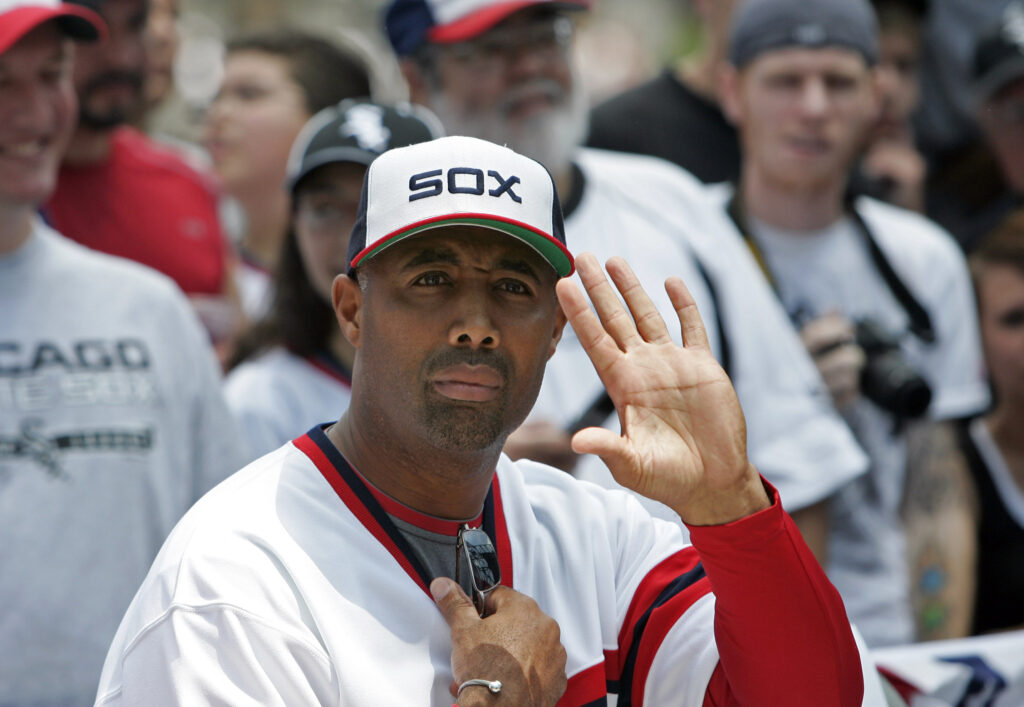
T.R. Sullivan was a legend on the Rangers beat. He retired in December 2020 after 32 years writing for the Denison Herald, Fort Worth Star-Telegram and MLB.com. T.R. is also a friend to MLBTR. A couple of months ago, he kindly offered up a retrospective on the Frank Robinson for Milt Pappas trade. “I just felt like writing it,” T.R. explained. More recently, Texas got shut down by a snowstorm, which T.R. took as an opportunity to explore the 1989 trade involving Harold Baines, Sammy Sosa and others. We’re proud to publish it!
Texas Gov. George W. Bush was in the middle of an ultimately successful run for the White House in 2000 when he made a guest appearance on Late Night with David Letterman.
At one point, they started talking about Bush’s biggest mistakes, the ones he really regretted.
“Well,” Bush said with a sly smile. “I once traded away Sammy Sosa.”
The line got big laughs from the audience – coming at the height of Sosa’s career as a power-hitting outfielder – but probably not as much from Rangers fans watching at home in Texas. Bush’s twin daughters Jenna and Barbara probably weren’t amused either considering the same trade also involved Rangers shortstop Scott Fletcher.
The veteran infielder just happened to be their favorite player. They named their dog “Spot” in his honor.
The reality is Bush did not make that trade. True, he was the Rangers co-managing general partner in 1989 when Sosa, Fletcher and pitcher Wilson Álvarez were traded to the White Sox for outfielder Harold Baines and infielder Fred Manrique.
But the guy who made the trade was general manager Tom Grieve, who many years later would confess, “The minute I made that trade I knew it was a mistake. We made the deal for all the wrong reasons.”
The guy on the other end of the deal was White Sox GM Larry Himes, who would later hold the same position with the Cubs. In both jobs, Himes pulled off a trade that involved acquiring Sosa for a veteran All-Star designated hitter.
The first trade was not a popular one with White Sox fans at the time.
“It’s an unpopular decision as far as the fans are concerned…it doesn’t mean it wasn’t a good decision,” Himes said in the Chicago Tribune.
The Rangers-White Sox trade came down on July 29, 1989. At the time, the Rangers were trying to stay alive in the A.L West race and the White Sox were in a rebuilding mode. It was a classic mid-season trade, just like hundreds of others that are made or at least talked about at the trade deadline down through the years.
But this trade turned out different. This is the trade that wouldn’t go away. Instead, as the years passed, it really did take on a life of its own with a bewildering number of twists and turns involving implications felt from the White House and halls of Congress to the National Baseball Hall of Fame in Cooperstown.
In short, the trade involved a future member of the Hall of Fame, but not the one everybody expected, the one who ended up having to testify in front of Congress on national television at the height of baseball’s steroids scandal.
It would be quite a stretch to say Harold Baines was ever considered a superstar at any point of his career. What is true is he was admired and respected, a consistently productive player popular among White Sox fans.
The story goes Baines was originally “discovered” by Bill Veeck while playing Little League baseball in his hometown of St. Michaels on Maryland’s Eastern Shore sometime around 1971. In December of 1975, Veeck led a syndicate that bought the White Sox and the club selected Baines with the first overall pick in 1977.
However it came down, it was an excellent pick. In 1980, Baines, at age 21, became a regular in the White Sox outfield. Three years later, he helped lead the White Sox to their first post-season appearance in 24 years when they won the A.L. West title.
They lost to the Orioles in the ALCS, but Baines had established himself at least as a star. Over a seven-year stretch from 1982-88, Baines hit .290/.343/.467 while averaging 21 home runs and 96 RBI per season.
During the 1988 season, Baines signed a two-year extension that kept him under contract through the 1990 season at a salary of $1.2 million. But the White Sox finished 71-90 in 1988 and went 8-16 in April to start the ’89 season.
Himes, with a deep background in scouting and player development, was eager to rebuild around young players but had little to offer. Baines was the best but had been relegated to designated hitter because of bad knees. In 1987-88, he started a total of 17 games in the outfield.
The Rangers went 70-91 in 1988, their second straight losing season after a surprising 87-75, second-place finish in 1986 under manager Bobby Valentine. The Rangers still had plenty of young talent and Grieve got aggressive at the 1988 Winter Meetings, trading for All-Star second baseman Julio Franco from the Indians and first baseman Rafael Palmeiro from the Cubs. They also signed free agent pitcher Nolan Ryan.
The changes paid off immediately as the Rangers began ’89 by going 17-5 in April, putting them in first place and on the cover of Sports Illustrated. They cooled off after that but were just 5 ½ games out at the All-Star break.
Grieve and Himes started talking early in the season and the discussions lasted for over two months. In June, the Rangers lineup took a hit when Buddy Bell, their best DH candidate, retired because of bad knees. Valentine made it clear he wanted a middle-of-lineup bat and there was no question Baines was the obvious target.
The White Sox wanted young players and the Rangers were loaded. In retrospect, they had one of the most talented farm systems ever assembled in baseball history. When the Rangers went to Spring Training, their system had no less than 10 players who would be selected All-Stars at some point in their careers.
Hall of Famer Iván Rodríguez was at the top of the list, along with pitchers Kevin Brown, Kenny Rogers, Roger Pavlik, Robb Nen and Álvarez, infielders Dean Palmer and José Hernández, and outfielders Juan González and Sosa. Pitcher Darren Oliver was never an All-Star but was on the Hall of Fame ballot for one year.
Himes wanted both González (19) and Sosa (20), who were playing at Double-A Tulsa. González was considered the best prospect with monster power potential. Sosa’s power wasn’t as pronounced yet, but he was 6-foot, 165 pounds and could run. In 1988, playing in the Florida State League, Sosa stole 42 bases and hit 12 triples, with the speed and the arm to be a dynamic defensive player.
Grieve balked at Himes’ price. He even told associates he wouldn’t trade either player for Baines.
Sosa, playing at Double-A Tulsa, got called up on June 16 when outfielder Pete Incaviglia was placed on the disabled list and went immediately into the lineup against the Yankees in New York. Sosa batted leadoff and played center field, going 2-for-4, in his first game.
He stayed up for a month, playing in 25 games and hitting .238/.238/.310, before being sent down on July 20.
While he was in Arlington, I asked Valentine what Sosa’s best season would look like. He said .280 with 20 home runs and 80 RBI.
Himes was more interested in Sosa’s speed. He was on record in the weeks leading up to the trade that the White Sox needed more speed. He professed his love for the 1959 Go-Go White Sox, a team that won the A.L. pennant on an offense built around speed.
“To win in (old Comiskey Park), you need speed on defense, speed on offense,” Himes told the Chicago Tribune. “We definitely need speed.”
Álvarez, at age 19, was called up by the Rangers on Monday July 24 to take a spot start against the Blue Jays. He had made just seven starts at Double-A Tulsa after a promotion from Class-A and went 2-2 with a 2.06 ERA and a 1.16 WHIP.
He was clearly a top pitching prospect, and Himes was hardly deterred when Álvarez got knocked out of the first inning against the Blue Jays without retiring a batter. Valentine said the fastball was outstanding, but Álvarez was tipping his off-speed pitches.
The two sides continued to talk the rest of the week. The White Sox also tried to get speedy Gold Glove outfielder Gary Pettis from the Tigers later that week, but that deal fell though.
The Rangers and the White Sox finally agreed to include Fletcher, which balanced out the financial part of the deal. Fletcher had been the Rangers starting shortstop for the previous three seasons, and had signed a three-year, $3.8 million extension in the winter. But the Rangers were starting to see progress from Jeff Kunkel, their No. 1 pick from 1983 who appeared ready to become their full-time shortstop.
Fletcher replaced Steve Lyons as the White Sox second baseman. Lyons and Manrique had been sharing the position. The White Sox preferred Lyons, and Manrique went to Texas as the typical utility infielder who ached for a full-time role.
Valentine spoke to Jim Fregosi, the White Sox manager in 1986-88, and received a positive report on Manrique’s defensive abilities. But Manrique’s slash of .258/.301/.365 in 320 games with the White Sox with just 11 home runs and 96 RBI hardly suggested the offensive talent to be an everyday player.
Grieve finally blinked and the trade was announced on Saturday morning of July 29: Baines and Manrique to Texas for Fletcher, Sosa and Álvarez. In Texas, the Rangers were lauded for doing what it took to keep their team in contention.
“For the past couple of years, we’ve been trying to fill the DH spot,” Grieve said. “We think we’ve filled in with the best DH in baseball. We just didn’t do this for the last two months of this season. Harold Baines is only 30. There is no reason why he can’t be our DH for the next 4-6 years.”
As for Chicago…
“Sosa has a chance to be a five-tool player,” Himes said. “We added one outstanding athlete to the organization. And when we look at Álvarez, we see a guy who can be a No. 1 or 2 starter.”
Veteran White Sox catcher Carlton Fisk didn’t see it that way, according to Chicago Tribune reporter Alan Solomon.
“Harold and Freddy for one major league player?” Fisk said. “Two major-leaguers for one. And not just a major leaguer. Harold Baines. Harold Baines. You know what I mean? Harold Baines.”
Three weeks later, the Rangers went to Chicago for a four-game weekend series, and, on the fourth day, the White Sox announced they were retiring Baines’ No. 3 jersey in a brief ceremony before Sunday’s game.
It was an impromptu gesture from out of the blue, clearly done to mollify the negative reaction to the trade. Baines was told before the game. His wife Marla wasn’t even there. His brother represented the family.
“As you know, I am a man of few words,” Baines said. “But I am appreciative of all the great times in Chicago. Thank you very much.”
Less than two weeks after the trade, Kunkel suffered a hyper-extended right knee. Manrique was given a chance to play but did not distinguish himself, making 11 errors in 54 games.
When Kunkel started 14 of the last 15 games, Manrique knew where he stood and wasn’t happy about it. Two days after the season was over, Manrique was arrested by Arlington police for driving while intoxicated.
Grieve called Manrique to offer support. He asked the player if there was anything the club could do to help.
“Yeah,” Manrique said. “Get me the hell out of here.”
The Rangers did so next year at the end of Spring Training, trading Manrique to the Twins for a player to be named later.
The Rangers struggled even with Baines being in the lineup and went 28-33 after the trade. Baines hit .285/.333/.390 in 50 games for Texas, missing nine games because of a strained left hamstring. He had two RBI in his last 20 games, and the Rangers finished 16 games behind the world champion Athletics.
The Rangers weren’t dismayed. Grieve kept pointing out the trade was for the long-term and Baines was coming back in 1990. He was also eligible for free agency after the season, but a contract extension was possible.
Baines was better in 1990, but the Rangers were not. They crashed and burned early, going 19-28 through the first two months and were 15 games out of first place at the end of May.
It never got better and the Rangers decided a sore-legged designated hitter really didn’t fit in with their long-term plans. Baines was hitting .290/.377/.449 with 13 home runs and 44 RBI through 103 games, when the Rangers traded him to the first-place Athletics for Minor League pitchers Scott Chiamparino and Joe Bitker.
Grieve, in reviewing the Baines-Sosa deal, ever honest admitted, “The trade was not a success. What the final outcome will be, time will tell. But I’m not suggesting the players we’re getting are the equivalent of what we traded to get Harold.”
Chiamparino at least had a chance to make up for the loss of Álvarez. At the time, he was pitching at Triple-A Tacoma with a record of 13-9 and a 3.28 ERA. He made five starts for the Rangers in September and was 1-2 with a 2.63 ERA. But then he developed chronic elbow problems over the next few years, and his career was pretty much over at the age of 27. He ended up working for agent Scott Boras.
It took time but Álvarez ended up fulfilling expectations. In 1993, he went 15-8 with a 2.95 ERA in helping the White Sox win the A.L. West. The Rangers finished second, eight games back.
Grieve, who was fired after the 1994 season, always insisted losing Álvarez was worse than Sosa. He pointed to the 1993 season.
“You don’t think Alvarez’s 15 wins would have made a difference?” Grieve said.
Neither Himes nor Sosa were with the White Sox in 1993. Himes was fired at the end of the 1990 season even though the White Sox won 94 games that year. Sosa, closely fulfilling Valentine’s assessment, hit .233 with 15 home runs and 70 RBI although he did steal 32 bases.
He was worse in 1992, hitting .203 with 10 home runs and 33 RBI. He also struck out 98 times in 316 at-bats. Sosa had the speed and arm strength to be a plus defender, but his hitting was questionable.
Himes still loved him and traded for him again. Himes was hired as the Cubs GM after the 1991 season and the following Spring Training he acquired Sosa and pitcher Ken Patterson from the White Sox for veteran outfielder-turned-DH George Bell.
One year later, Sosa hit 33 home runs for the Cubs. He was 24 and his strength was no longer speed and defense. It was sheer power. The entire world saw that in 1998 when he hit 66 home runs and was the 1998 N.L. MVP.
That was the year Sosa and Mark McGwire electrified baseball with their pursuit of Roger Maris; single-season home run record. McGwire finished with 70 but Sosa was at the top of his game. In nine-year stretch between 1995-2003, he averaged 49.3 home runs per season.
He retired after the 2007 season – a year spent with the Rangers – with 609 home runs, which should have made him an automatic selection to the Hall of Fame.
Except, Sosa was prominent among players who were allegedly linked to steroid use. Although there was never a “smoking gun,” to prove the allegations, the fact that the kid who Larry Himes loved for his speed and defense ended up looking like an Olympic weightlifter did not help his cause. As the issue of steroids increasingly dominated baseball, there was open speculation about the source of Sosa’s power.
At his 2004 State of the Union address, President Bush said it was time to get steroids out of sports. He didn’t mention Sosa. But Sosa was among those players called upon to testify before a Congressional committee on March 17, 2005. Sosa insisted he was clean but was unconvincing to the committee, the national television audience and ultimately Hall of Fame voters.
Sosa was on the Hall of Fame ballot from 2013 to 2002. In the 10th and final year of the ballot, he received 18.5 percent of the vote. A player needs 75 percent to be elected. It was the highest percentage he received during his 10 years – one year he received just 7 percent – and his time was up.
Baines stayed in the game until 2001, a hired bat traded from one team to another, including two more stints with the team that retired his uniform in 1989. In 1999, 10 years after the trade, he was selected to the A.L. All-Star Game while serving as the Orioles designated hitter.
Six weeks later, he was traded to the Indians. By the time he retired in 2001, Baines had been traded five times in his 22-year career on July 29 or later during the season.
Baines retired with a .289 career batting average, 2,866 hits and 384 RBI, an admirable career free of any hint or suspicion of performance-enhancing drug taint. But, like Sosa, he received little support from the BBWAA Hall of Fame voters, dropping off after five tries with just 4.8 percent of the vote.
Eight years later, Baines was elected to the Hall of Fame by the Veterans’ Committee. Sosa is still waiting.
Photo courtesy of Jerry Lai, Imagn Images