
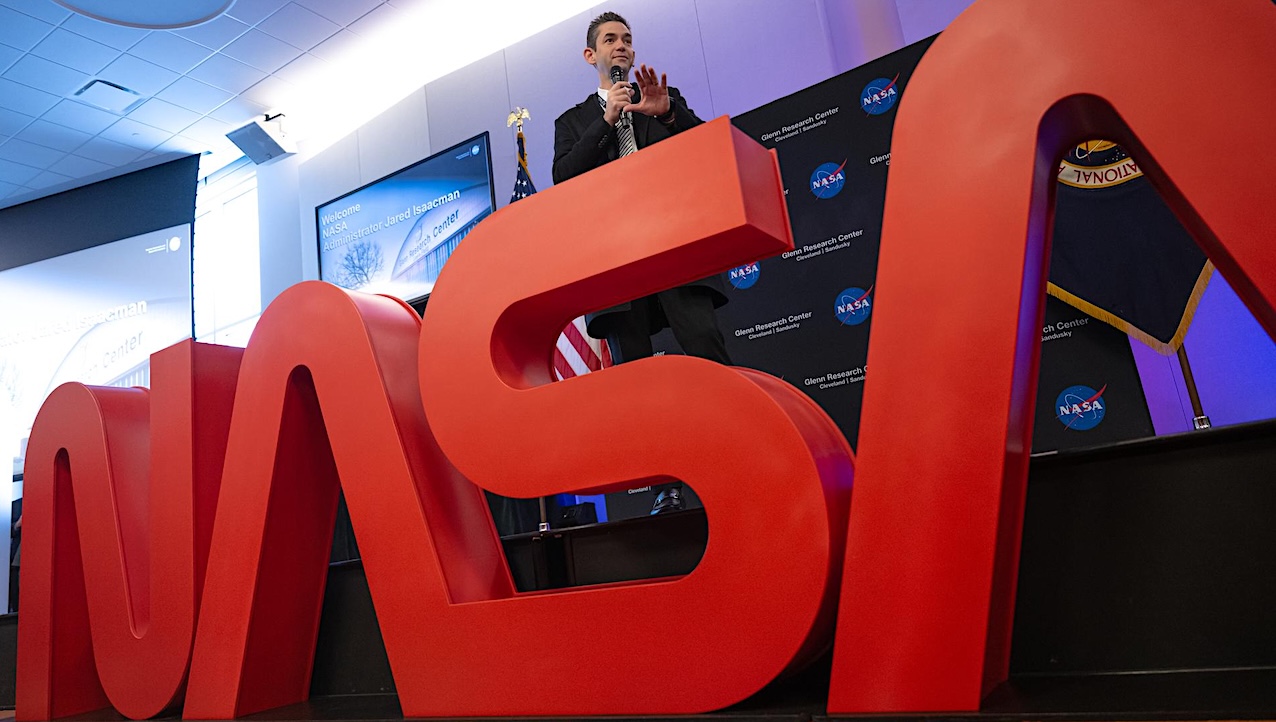
NASA Administrator Jared Isaacman speaks during a workforce Q&A session, Tuesday, Jan. 27, 2026, at NASA’s Glenn Research Center in Cleveland, Ohio. Glenn marks the eleventh stop in Isaacman’s roadshow to visit NASA facilities and engage directly with the agency’s workforce. Photo Credit: (NASA/John Kraus)
—- Keith’s note: I have annotated Jared Isaacman’s new directive “Workforce Directive: Restoring NASA’s Core Competencies“ with some of my thoughts. This directive does bear a certain similarity to a posting “Recognize, Reward, Inspire” that he made on 16 January 2026 – and the earlier Project Athena document he produced in 2025 before becoming administrator and benefited from some sanity checks during his first month on the job and his road trip to all the NASA centers. This is a somewhat stream of consciousness ramble on my part (as is usually the case on NASAWatch – and I may fiddle with it). Before I start, there are some prevailing, over-arching, and hard-to-avoid factors: (more below)
NASA lost a lot of expertise from civil servant and contractor layoffs/departures.
Cuts and cancelations of missions and research affected university researchers and students.
The impact of diminished union participation is going to be felt as new employees arrive.
Outright censure of DEI-related efforts has disenfranchised many and soured relations with large external communities.
The newly baselined Schedule P/C for civil servants – with its expanded policy-adherence provisions and severance options – is not exactly the best part of a recruiting portfolio.
The threat of massive threatened NASA budget cuts – realized and reversed reduced NASA’s capabilities.
Society as a whole is under considerable socioeconomic stress – everyone at NASA included and everyone has issues at home to contend with.
Taken together the NASA/space community/family had a rough 2025 and it will take a lot for it to rebound from a year of stress and uncertainty and adapt to new paradigms.
In the mean time NASA will be operating with less capacity of all kinds than it had just one year ago.
The National Space Council is gone. The NASA Advisory council is inert and in limbo. All agency working groups have been cut lose. So external input has shrunk.
NASA has no real strategic plan against which to map all of the changes it is going to make. Every employee should know exactly where they fit in terms of that plan and the changes mentioned below. If not, and the stove pipes will simply re-emerge, and this will all be a waste of time.
That said …
There is a White House Executive Order Ensuring American Space Superiority
NASA has a national and global branding reach infused with awe and hope and wonder and adventure that few entities can match.
The whole exploring the universe thing is never boring and can be inspirational in a life-altering way – once it is communicated properly.
All that being said (gulp) NASA is about to go back to the Moon with humans for the first time in half a century. How is that not kick-ass exciting? Like I keep saying, for 70% of humanity this will be their first mission to the Moon.
Oh yes, I am working on an audience evaluation for NASA’s Artemis II efforts specifically and its broader efforts overall. I should say plural i.e audiences. NASA tends to aim its usual outreach efforts at its old, mostly unchanged notion of what THEY think their audience should be – without too much though given to the vastly greater diversity of taxpayers, stakeholders, policy makers, fans, detractors, possible new employees, and others that their efforts affect in the real world outside the space bubble. And when it comes to soliciting feedback and doing follow-up on some of its coolest things, well, NASA needs to work on that too.
Some Thoughts On NASA’s New Workforce Directive: Restoring NASA’s Core Competencies
Background
NASA’s ability to deliver on its mission has become increasingly dependent on external vendors and contractors for core functions and workforce talent—from engineering and operations to manufacturing and repair. While partnerships remain vital, this trend has eroded internal capabilities, increased program risk, reduced flexibility in addressing emergent technical challenges, and added well more than a billion dollars in annual overhead—diverting resources from science and discovery.
Factors contributing to this reliance include concerns over exceeding artificial civil servant hiring ceilings, and assumptions that outsourcing would provide greater workforce flexibility. Even if these assumptions hold in some cases, the overall effect deprives NASA of critical institutional knowledge, and limits resources essential for mission success.
—- Keith’s note: these factors are, of course, are trends that have their roots in decades of NASA being jostled around by changing and confusing mandates, uncertain budgets congressional whims, and expanding inefficiencies rampant and unchecked within large aerospace contractors – and the inability of NASA itself to adjust workforce and skillsets to stay in synch with all of this.
As a result, it is not surprising that multiple programs have experienced suboptimal outcomes in cost and schedule. Multiple prime contractors, hundreds of sub-contractors, tens of thousands of contract employees, and duplicative layers of management create complexity and inefficiency. Variances in policies, tools, and systems across this spectrum further challenge budgets, timelines, and outcomes.
To achieve the President’s national space policy and maintain U.S. leadership in space exploration, NASA must urgently restore and retain in-house engineering, operational, and scientific excellence, and reclaim technical autonomy. This directive establishes actions to rebuild internal talent, strengthen contractual provisions, and foster a culture of technical resilience.
—- Keith’s note: NASA watched a lot of expertise walk out the door in 2025. Some of it is gone forever. Some of it was not needed anyway. But those who remain survived this activity and are going to need some reassurance that the agency still values them. But NASA will also need to be finding ways to recruit/entice new people that making a career move to NASA is not going to be yanked away from them. New (younger) blood is desperately needed. In addition to youthful energy, people with new skill sets that NASA needs – plus expertise from outside the space bubble that the agency itself is probably not even aware that it needs – will need to be brought on board. And to be brutally honest, the newly-announced Schedule P/C for civil servants – with its expanded policy-adherence provisions and severance options – is not exactly the best part of a recruiting portfolio.
This foundation will be strengthened by contractors in non-core areas and for surge requirements, complemented by our extensive network of international and commercial partners. Together, we will deliver on NASA’s world-changing mission of science, exploration, and discovery.
Directive Actions
NASA recognizes that contractors have and will continue to play a vital role in achieving mission objectives. This directive focuses on correcting over-reliance on outsourced engineering and staffing that diminishes NASA’s core competencies and resources essential to agency priorities. The future state aims to use contracted workforce primarily for limited-term assignments, surge staffing, and specialized functions outside NASA’s core competencies.
—- Keith’s note: having been both a NASA civil servant and contractor employee, one thing always stays with me – how civil servant and contractors interact. When everyone feels that they are part of a team regardless of their badge and are treated accordingly you get the most benefit. When civil servants treat contractor employees as disposable items you don’t get all that you could otherwise get. Conversely when contractors see NASA as a endless gravy train to be drained at every possible juncture you also diminish the end results – and reduced resources that would other be available for other things. This is a two way street. Yes I am being naive that doesn’t mean that I am wrong.
Within 30 days, Center Directors, Mission Directorate leadership, and the Office of the Chief Human Capital Officer shall:
—- Keith’s note: between DOGE efforts, buyouts, layoffs etc – much of which was done with little or no strategic planning – with a large amount of fear, uncertainty, and random body counts, NASA has been left with lots of expertise holes. These gaps are at all levels. Some are generic, others are very specific. BUT – This is also an opportunity to see if things can be done with fewer choke points – committees, management steps, meetings,etc. That said, NASA is inevitably going to have to hire back expertise – either as civil servants or contractors and look into buying back departed expertise ‘by the yard’, often at a greater expense. Having just let thousands of people walk out the door this may be harder than it might otherwise have been. But enticing people to come explore the universe can be irresistable.
Conduct a Workforce Assessment: Identify outsourced or missing technical and operational expertise and provide a proposal to convert core roles to civil service. Categorize proposal by priority, mapping to core competency and current contracting mechanisms. Emphasize solutions that enable mission execution without introducing additional redundant layers of management.
— Keith’s note: this needs to be done without the hindrance of stovepipes within directorates, missions, a centers, and other divisions of NASA otherwise you may see duplication in hiring where skills might otherwise be shared across new boundaries – and between geographically separate locations. If NASA can reprogram ancient 70s-era software on Voyager spacecraft in interstellar space then they can make hybrid work happen back on Earth. Right?
Conduct a Work Assessment: Identify engineering, operational, scientific, manufacturing, and other mission-critical work currently outsourced, and provide a proposal for what should be brought in-house, aligned with the workforce assessment.
— Keith’s note: NASA does not really have a strategic plan – i.e. a document that is an actual plan with an inherent strategy. Instead, every few years, they make a list of all the things the agency may be doing – or wants to do -and works backward using word salad and pretty graphics to make it all sound like it is the result of strategic planning. This is done when in fact the ‘strategic plan’ and whatever operating plan it spawns – is a conglomeration of ever changing Administration guidance, congressional priorities, anodyne guidance fom the National Academy and advisory groups, and the end result of lobbying pressure from big aerospace to keep their gravy train going. If NASA cannot provide a real strategic plan against which to map its needs and priorities then it will have a miserable time trying to reconfigure the agency to meet whatever the agency is supposed to do – and avoid adding capabilities for things it is not supposed to do.
Within 60 days, the Office of the Chief Human Capital Officer, Office of Procurement, and Office of the Chief Financial Officer shall:
Develop Transition Strategy: Consolidate workforce assessments and create an implementation plan to convert or add targeted roles to civil service, addressing contract changes, renegotiations or terminations, timelines, and cost implications.
Establish Rapid Onboarding Process: Implement streamlined process that ensures candidates can be rapidly brought into civil servant positions without disrupting operational capacity, minimizing gaps in mission-critical support.
Strengthen the Talent Pipeline: In collaboration with the Office of Personnel Management, develop strategies to attract industry and academic talent and embed civil servants with industry partners to accelerate learning and knowledge transfer aligned with national space policy objectives.
Enhance Training Programs: Assess and develop internal training and mentorship initiatives to ensure continuity of knowledge and technical depth across generations of NASA engineers, operations personnel, and technicians.
Focus Internship Opportunities: Develop a plan to expand the current internship program with a focus on standardizing and enhancing experience, to develop in-house technical talent focused on the highest priority agency requirements.
Strengthen Framework for Technical Autonomy
Within 30 days, the Office of Procurement shall:
Ensure Repair and Operation Autonomy: Incorporate right-to-repair provisions in all future and applicable existing contracts, guaranteeing NASA access to specifications, parts, tools, schematics, software, and technical documentation necessary for internal manufacturing, repair, and operations.
Remove Restrictive Clauses: Eliminate contract language requiring NASA-fabricated replacement hardware to be returned to vendors for inspection after delivery of out-of-spec hardware.
Address Intellectual Property Barriers: To the extent reasonable under existing and ongoing procurements, review and propose modifications to eliminate IF restrictions that prevent NASA from performing internal repairs or redesigns, as needed to meet urgent Presidential space policy objectives.
—- Keith’s note: speaking as someone who has been on expeditions to remote, dangerous places (with astronauts and space scientists) and operated sophisticated technology while there – you are simply not going to explore all of these distant worlds with humans if you send people who cannot fix things – and send things that cannot be fixed. Moreover, you need these people to be able to use back-up methods – some of which rely on simpler technology and basic survival and exploration skills. You cannot treat your tools as if they were just another black box that you can replace with a call to Amazon or hack with an update you just download. These skills should be adopted by everyone at NASA – not just the people who climb into the rocket ships. And in seeking new employees, these skills should be a prerequisite part of recruitment and hiring.
Within 60 days, center directors shall:
Propose Makerspaces at Each Center: develop plan to create a makerspace at each center to enable rapid prototyping and proposal development. Include an assessment of potential funding mechanisms, such as sponsorships from partners and critical vendors, to support implementation and sustainability.
—- Keith’s note: Back in the early 2000s Pete Worden was the center director at NASA Ames. A community of younger folks at ARC, JSC and elsewhere pushed for the implementation of Maker spaces. Lots of ideas fell on the floor – but lessons were learned. In some cases the lessons learned led to bigger things. Much bigger things made of smaller and smaller pieces. Many of these younger folks left the agency. Companies sprang from the Ames experience – the most notable being Planet which has totally upended the notion that you need big satellites to do important things. NASA loves to brag about its whole ‘spinoff’ mantra – which is fine. It is important to let taxpayers know that while NASA explores the universe, there is another use for the technologies that they develop. But NASA sucks when it comes to ‘spin-in’ capabilities – which are a pre-requisite to keep the flow of fresh ideas and talent into the agency such that they can be applied internally and leap back out of the agency into the larger world where they can add to the nation’s productivity.
This Directive does not reflect any intent or commitment, implied or otherwise, to take any action regarding any particular existing or future contract with the agency.
—- Keith’s note: yea you need this sort of boiler plate disclosure thing here to keep the NASA lawyers happy. At least Jared did not use crutch words like “notional” or “program of record” or “pre-decisional” or confuse nouns with verbs and capitalize weirdly – as NASA is fond of doing.
Jared Isaacman
NASA Administrator