

Initial signs of India’s direct-to-consumer fragrance and deodorants segment attracting risk capital are emerging, with several early-stage brands in talks to raise funds.
DSG Consumer Partners is in discussions to invest Rs 18-20 crore in Phitku, which sells alum-based underarm roll-ons and is doing monthly sales of Rs 1.5-2.0 crore, said people in the know. Verlinvest-backed V3 Ventures is negotiating a Rs 20-25 crore investment in Fraganote, which currently posts Rs 2.0-2.5 crore in monthly revenue.
According to founders and consumer-focused investors, this interest comes on the back of growing demand from Gen Z and increasing premiumisation trend pushing consumers to shift from deodorant sprays to perfumes. Investors see a wide gap in products priced between Rs 1,500 and Rs 4,000 for a 100 ml pack.
“We believe fragrances will be among the fastest-growing sub-segments within BPC (beauty and personal care)…the emergence of Gen Z as a consumption cohort is a key driver of this trend,” said Fireside Ventures partner Adarsh Menon.
 ETtech
“What’s interesting here is that this awareness has not followed the typical global progression. In most markets, consumers move from deodorants to EDC, then to EDT, and eventually to EDP. India has effectively bypassed that curve and transitioned directly from deodorants to EDP,” Menon said.
Perfumes are commonly grouped into three types based on the concentration of aromatic oils and their longevity. Eau de Cologne (EDC) has the lowest oil concentration and the lightest wear, followed by Eau de Toilette (EDT), which is stronger and lasts longer. Eau de Parfum (EDP) contains the highest concentration of fragrance oils among the three and delivers the longest-lasting scent. Deodorants are largely aerosol-based sprays, although newer form factors such as roll-ons are gaining traction.
“We are not in a position to comment on specific funding details or projections at this time,” Fraganote cofounder Garima Kakkar said in response to an emailed query on latest funding discussions. V3 Ventures did not respond to queries.
Phitku and DSG Consumer Partners also did not respond to queries.
Fraganote had last year raised around Rs 8.5 crore, led by Rukam Capital. Besides Fraganote and Phitku, actor Samantha Ruth Prabhu’s perfume brand Secret Alchemist last month received a Rs 20-25 crore investment from Unilever Ventures and DSG Consumer Partners, while Indore-based brand House of EM5 raised angel investment from Boat cofounder Aman Gupta and cricketer Surya Kumar Yadav.
Awareness, premiumisation
“The two main drivers are premiumisation, and a growing awareness that aerosols can be harmful for the skin and potentially carcinogenic over time. Because of this, consumers are upgrading from deodorants to proper fragrances,” said Yash Dholakia, partner at consumer-focused investor Sauce VC.
“In the first phase, brands did well by offering replica fragrances at lower price points, which worked digitally and enabled easy experimentation. Now, consumers are moving towards Rs 2,000-3,000 EDP, which is a very premium price point,” Dholakia said.
Beauty retailer Nykaa has started opening retail outlets dedicated to fragrances under the Nykaa Perfumery banner seeing the growth in this category. The company opened two such stores last quarter and plans to open more.
“This is really to drive the adoption of fragrance by the Indian consumer. We think it’s an underpenetrated category, but to improve penetration, we need to increase education and awareness around fragrance, especially luxury fragrances,” Nykaa executive director Anchit Nayar said during the company’s third-quarter earnings call.
Market segmentation
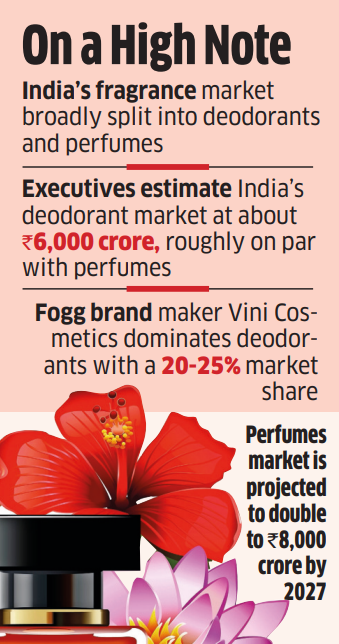
At a high level, the market splits into perfumes and deodorants. Industry executives estimate India’s deodorant market to be about Rs 6,000 crore, roughly on par with perfumes. The deodorants space is led by Vini Cosmetics through its Fogg brand, with an estimated 20-25% market share.
Separately, the perfumes market, estimated at about Rs 4,000 crore in 2022, is projected to double to Rs 8,000 crore by 2027. The category comprises four segments: international-premium, international-mass, domestic-premium and domestic-mass.
From an investor lens, both deodorants and perfumes have attracted private equity capital so far, but venture investors have yet to take significant bets, with the category still finding its footing.
KKR acquired a 54% stake in Vini Cosmetics for $625 million in 2021, valuing the company at $1.2 billion, while Bellavita, which sells relatively lower-priced perfumes, raised capital from homegrown PE firm Ananta Capital. While the Fogg maker posted operating revenue of Rs 1,200 crore in FY25, marking 16% growth from the previous year, Bellavita crossed the Rs 500-crore top-line mark last fiscal year.
Among those raising funds, investors pointed out that D2C brands are trying to establish differentiation in their offerings.
“Fraganote is all about artisanal fragrances. Its perfumes use a higher concentration of perfume oils,” an investor said.
“There are brands betting on ‘better-for-you’ fragrances with cleaner ingredients. Some brands are experimenting with solid perfumes and wax-based formats, again with a clean-label positioning. Others are going after very premium fragrances,” Sauce VC’s Dholakia said. “You now see brands experimenting across price points. Some consumers are willing to pay Rs 4,000-5,000 for a 50 ml bottle, and brands are testing that willingness.”
The real gap was in products that are priced roughly between Rs 1,500 and Rs 4,000, Fireside Ventures’ Menon said. “We think this is a large white space and where meaningful brands will get built.”