
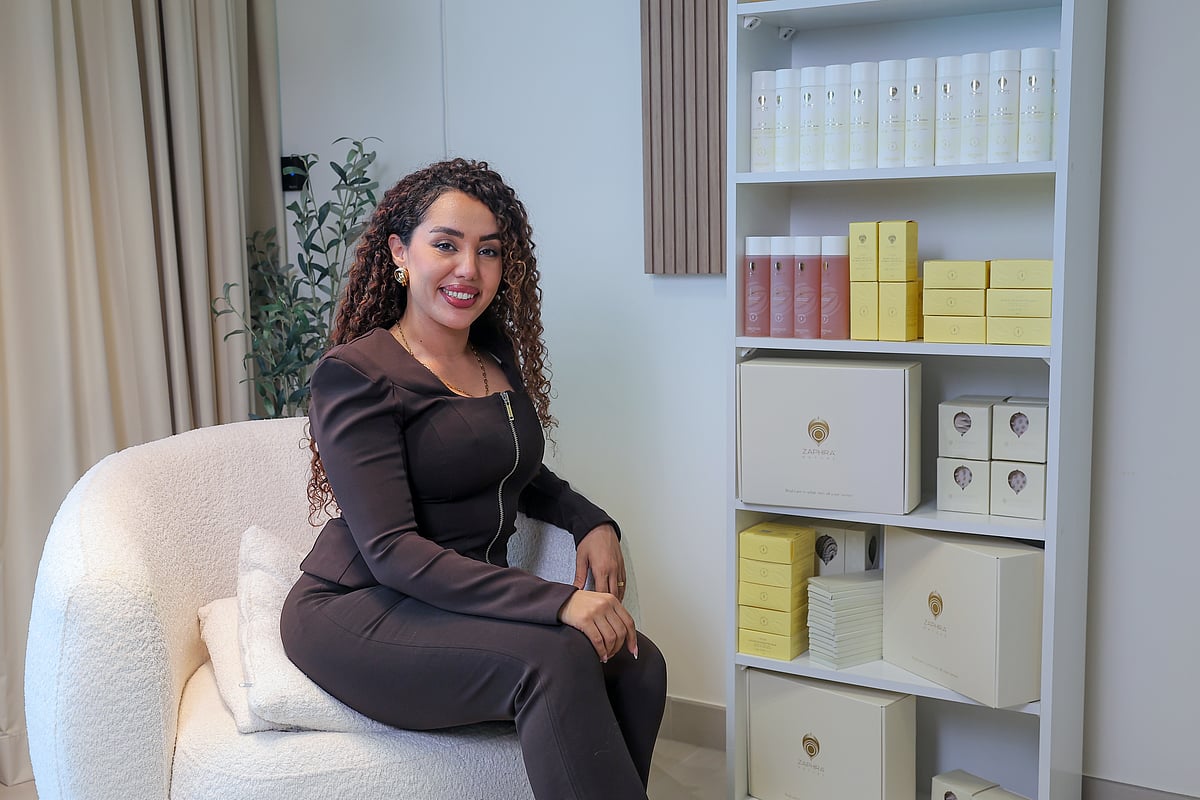
She is now the founder of Zaphira Nature, a clean haircare company developed for textured and curly hair, with formulations designed to perform under GCC conditions, including high humidity, intense heat, prolonged sun exposure, and water quality that differs from that in European and North American markets.
The foundation of the business lies in her childhood. Growing up with curly hair, Bouchouicha-Sykora was repeatedly told that her hair was difficult or unsuitable. “As a child, that messaging is confusing and damaging because you don’t yet have the language or confidence to push back,” she said, explaining how those perceptions shaped both self-image and daily routines.
Those views followed her into professional environments, where she was told that her hair didn’t look “polished” or “professional”. By the time she was 22, the lack of viable options had narrowed further. Keratin straightening appeared to solve the immediate issue, though the emotional impact lingered. “It worked on the surface, but I remember looking in the mirror and feeling disconnected from myself,” she said. “I had changed something that was deeply tied to my identity.”
From personal frustration to market insight
The move to Dubai was expected to change that equation. With its diverse population and extensive retail market, she assumed products suited to textured hair would be easier to find. Instead, the opposite proved true. Most formulas available on shelves had been designed for cooler, less humid climates and struggled to perform consistently in the Gulf.
“Nothing addressed the combination of humidity, heat, sun exposure and water quality,” she said, noting that the issue went beyond preference or styling trends. Products were failing at a technical level, forcing consumers to compensate through heavier styling, repeated treatments or chemical processing.
What had long been treated as an individual challenge was clearly a regional product gap, where demand existed but formulations had not been adapted to local conditions. The idea of building something purpose-designed for the GCC began to take shape from that point.
Why formulation became the hardest part
Turning that idea into a viable product required decisions that slowed progress but preserved control. The most difficult phase came during formulation and manufacturing, when many producers preferred ready-made formulas or limited ingredient inventories to reduce costs and development time.
“I had to be very firm in saying no, repeatedly, and explain why a customised formulation was non-negotiable,” she said, explaining that adapting existing products would not solve the underlying problem.
Her professional training influenced how that phase unfolded. With a background in accounting and auditing, she approached formulation with a detail-driven mindset, questioning each ingredient, process and cost line. “That level of scrutiny sometimes slowed things down, but it also protected the integrity of the brand,” she said.
The experience, according to her, clarified an operating principle that continues to guide decisions. “Clarity is everything,” she said. “When you are clear on your standards, you can manage pressure and delays without losing direction.”
Early signals that the approach was working
Initial validation came from positive customer response. Buyers began sharing that the products helped them manage their hair more effectively and feel comfortable wearing it naturally in professional and social settings. “When customers tell me they finally understand their hair, that matters to me,” she said, pointing out that such confidence often takes years to build.
From a business perspective, she views the decision to develop GCC-specific formulations as the brand’s defining feature, despite the longer timelines and higher upfront investment required. The focus on regional relevance, she said, allowed trust to develop organically.
Building within the UAE ecosystem
The UAE’s infrastructure played a practical role in supporting that process. Manufacturers, logistics partners, creative professionals and retail networks are accessible within a single market, reducing complexity during early stages of growth.
Equally important was the openness of the business environment. “People are willing to listen, share advice and make introductions if they see seriousness and commitment,” she said, adding that support for locally developed brands has grown, particularly those addressing real regional needs instead of replicating global templates.
Dubai’s consumer base also shaped product refinement. Products are tested daily under demanding conditions, and weaknesses surface quickly, creating a direct feedback loop.
Funding, control and pace
Zaphira Nature has been self-funded since inception, with growth managed through reinvestment instead of external capital. That approach, according to the founder, preserved independence and allowed decisions to remain aligned with long-term priorities.
Bouchouicha-Sykora does not come from a business family and relied on research, structure and experience to navigate financial risk and operational decisions. “Experience became my education,” she said. “Each challenge forced me to learn faster and make better decisions.”
There were moments of doubt, particularly during early sales conversations and partnership discussions, where rejection was common and progress slower than expected, especially when asking consumers to reconsider established habits.
“A young brand develops in stages,” she said, adding that consistency and patience mattered more than early momentum.
Looking ahead
Over the next five years, she expects the brand to strengthen its presence across the GCC, with selective expansion into Europe and the US, while maintaining a focus on consistency. Education will also play a larger role. Haircare, she believes, should be practical and understandable, helping consumers make informed choices rather than relying on trial and error.
Her advice to new founders reflects that perspective. “Start with honesty,” she said. “Be clear about the problem you are solving and why you are doing it.”
Dubai provided Bouchouicha-Sykora with the conditions that clarified what worked and what did not, shaping both the product and the discipline behind it, and turning long-standing experience into a business built around regional relevance.

Nivetha Dayanand is Assistant Business Editor at Gulf News, where she spends her days unpacking money, markets, aviation, and the big shifts shaping life in the Gulf. Before returning to Gulf News, she launched Finance Middle East, complete with a podcast and video series.
Her reporting has taken her from breaking spot news to long-form features and high-profile interviews. Nivetha has interviewed Prince Khaled bin Alwaleed Al Saud, Indian ministers Hardeep Singh Puri and N. Chandrababu Naidu, IMF’s Jihad Azour, and a long list of CEOs, regulators, and founders who are reshaping the region’s economy.
An Erasmus Mundus journalism alum, Nivetha has shared classrooms and newsrooms with journalists from more than 40 countries, which probably explains her weakness for data, context, and a good follow-up question.
When she is away from her keyboard (AFK), you are most likely to find her at the gym with an Eminem playlist, bingeing One Piece, or exploring games on her PS5.