

Seyfarth Shaw LLP are most popular:
within Compliance and Consumer Protection topic(s)
A federal District Judge in Washington, D.C. has issued a ruling affecting hundreds of thousands of
Haitian Temporary Protected Status (TPS) holders and the employers
who rely on them. On February 2, 2026, the court granted a stay
blocking the Department of Homeland Security’s (DHS) attempt to
terminate Haiti’s TPS designation. The decision in Lesly
Miot et al. v. Trump et al. preserves the status quo and
allows Haitian TPS holders whose status was due to expire today,
February 3, to continue living and working lawfully in the United
States while litigation proceeds.
Litigation History
In July 2024, DHS announced that then Secretary Mayorkas would
extend and newly designate Haiti for TPS through February 3, 2026,
but later Federal Register notices (Feb 2025 and July 2025)
shortened it to August 3, 2025 and then announced a termination
effective September 2, 2025.
However a July 15, 2025 judgment from the U.S. District Court
for the Eastern District of New York (in Haitian Evangelical
Clergy Ass’n v. Trump) pushed any termination date to no
earlier than February 3, 2026. As a result of the litigation in
November of 2025, DHS announced that Haiti’s TPS designation
would end on February 3, 2026.
Then What Happened?
Five Haitian TPS holders challenged the decision, arguing that
DHS failed to follow statutory requirements and acted for
impermissible reasons. After an extensive review of the
administrative record, the DC District court agreed that the
plaintiffs are likely to succeed on the merits in the order issued
February 2, 2026.
In the detailed 83‑page opinion, the court issued a stay
under the Administrative Procedure Act (APA) § 705,
effectively pausing DHS’s termination decision and ensuring
that Haitian TPS holders maintain their status for the time
being.
The court explains that under U.S. administrative law, an agency
decision can be struck down as “arbitrary and capricious”
if it does not reflect reasoned decision-making, e.g., the agency
ignored key facts, relies on irrelevant factors, gives an
explanation that clashes with the record evidence, or offers a
rationale that just does not make sense. Even though judges are not
supposed to substitute their own judgment for the agency’s,
they still must make sure the agency stayed within the bounds of
rational, evidence-based decision-making and connected the facts to
the outcome.
The plaintiffs argue that Secretary Noem’s explanation for
ending Haiti’s TPS designation was implausible and contradicted
the evidence in the record. The government mostly does not directly
refute that; instead, it argues the court should not
“second-guess” the Secretary or reweigh competing
evidence. Judge Reyes agrees with that general principle, but says
the court’s job is still to check whether the decision was
reasoned, principled, and grounded in the record. Here, the court
concludes it was not.
Finally, the court notes the Secretary provided two reasons for
terminating Haiti’s TPS designation: (1) Haiti no longer has
“extraordinary and temporary conditions” preventing
people from returning safely, and (2) allowing Haitian TPS holders
to remain in the U.S. is “contrary to the national
interest.”
The court says neither justification holds up under the
APA’s arbitrary-and-capricious review.
More on Why the Court Hit the “Pause”
Button
1.DHS failed to consult with required agencies.
The TPS statute mandates consultation with “appropriate
agencies” before a decision to extend or terminate a TPS
designation. The court found that DHS relied on a single brief
email exchange with a State Department staffer, far from the
meaningful consultation Congress intended.
2.Evidence suggested a predetermined outcome.
The court noted that DHS has terminated all twelve TPS designations
that have come up for review since 2025, with little indication of
individualized analysis. That pattern supported the plaintiffs’
claim that decisions were preordained rather than the product of a
good‑faith review.
3.The record did not support DHS’s conclusions about
conditions in Haiti. The administrative record described
Haiti as facing widespread violence, mass displacement, collapsed
institutions, and severe humanitarian conditions, including a State
Department “Do Not Travel” advisory. DHS nevertheless
concluded that Haitians could safely return, without identifying a
single safe region. The court found this conclusion inconsistent
with the evidence before the agency.
4.Plaintiffs were likely to succeed on their Equal
Protection claim. The court found substantial indicators
that racial and national‑origin animus influenced the
decision‑making process, including statements by senior
government officials about Haitian and other non‑white
immigrants and inconsistencies between DHS’s stated rationale
and the record.
Impact on Employers
Because the court issued a § 705 stay, Haitian TPS
holders retain their TPS status and remain
employment‑authorized; essentially, their Employment
Authorization Documents (EADs) remain valid. We expect U.S.
Citizenship and Immigration Services (USCIS) to update its TPS Haiti webpage, and consistent with its
approach for TPS Honduras, Nicaragua, Nepal, Syria and other
countries during ongoing litigation–to omit a specific
work‑authorization expiration date while the case remains
pending.
What Employers Should Do
Work with your immigration compliance counsel to determine what
date to record in Section 2 or Supplement B for the expiration date
and keep it consistent so that these employees can be identified,
especially if DHS wins on appeal or if USCIS issues guidance, also
consider any notes or documents to attach;
Monitor Updates: Stay informed on USCIS guidance for Form I-9
completion and any DOJ/IER advisories regarding hiring
practices;
Consider operational plans for compliance adjustments if TPS
status changes again;
Internal Communication: Ensure HR and compliance teams
understand the current protections and pending guidance to avoid
errors in onboarding or reverification; and,
Ensure that any electronic Form I-9 system you may be using
does not block hiring or reverification of employees with TPS EADs
extended by litigation.
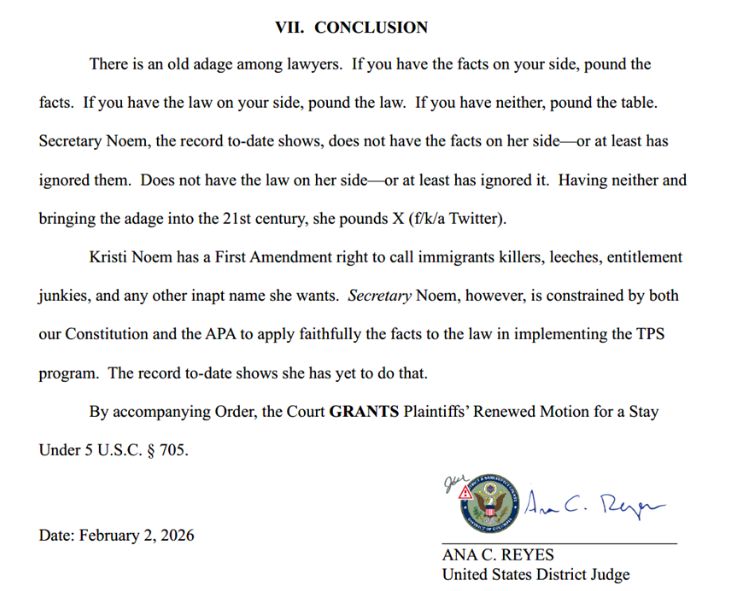
Sharing Judge Reyes’ Conclusion
Looking Ahead
The ruling averts the immediate loss of work authorization for
countless individuals employed in sectors already experiencing
workforce shortages. DHS has indicated it will appeal with DHS
spokesperson Tricia McLaughlin posting on X:
“Temporary means temporary and the final word will
not be from an activist judge legislating from the
bench.”
For now, the message for employers is clear: no immediate change
to Haitian TPS or work authorization, and TPS Haiti recipients may
continue to work.
The content of this article is intended to provide a general
guide to the subject matter. Specialist advice should be sought
about your specific circumstances.