
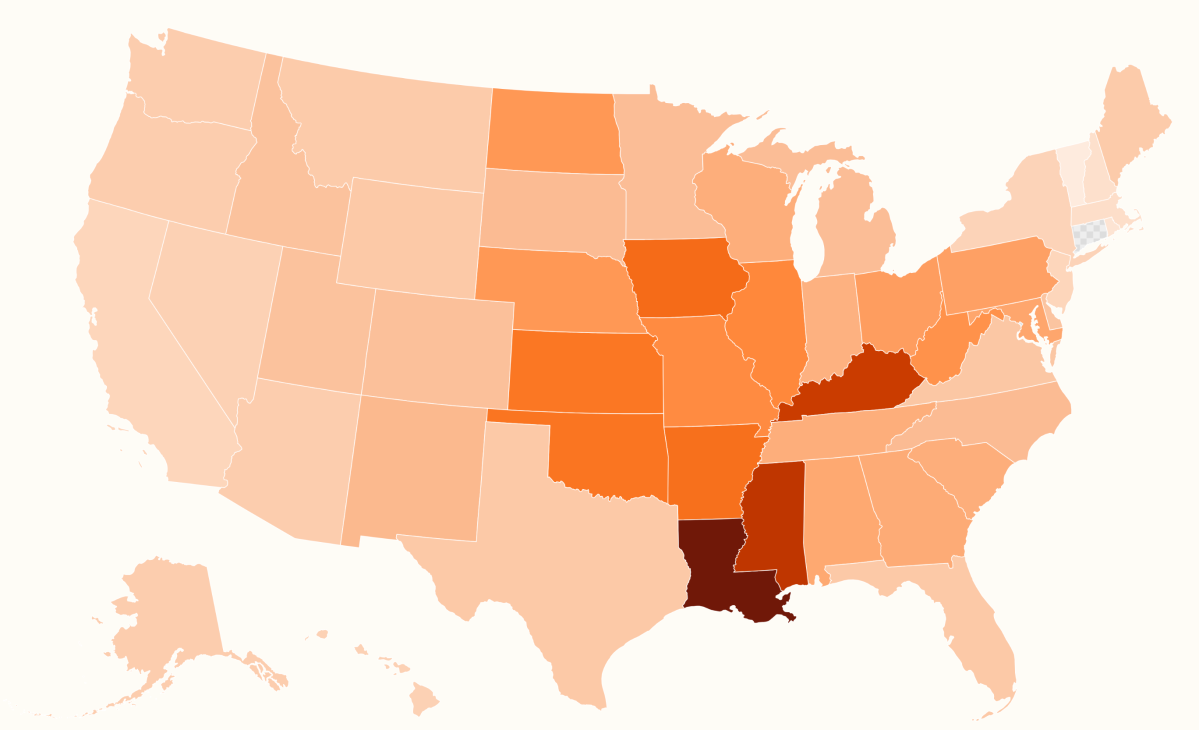
A small but notable share of U.S. homeowners are facing a crisis of negative equity, with certain states seeing a significant share of properties whose outstanding loans now outsize their current value.
According to a recent report from the real estate analytics firm ATTOM, there has been an uptick in the number of homes whose owners are “seriously underwater”—meaning their mortgage balances exceed estimated market values by at least 25 percent.
Why It Matters
The U.S. housing market, in part because of its centrality to past financial crises, has been a key point of interest for economists in recent months. Declining home sales, muted buyer demand and inventory struggles are among the issues prompting some to caution that it could take years for the housing market to return to its pre-pandemic conditions.
However, at least in terms of home equity, ATTOM said the new figures showed only modest increases and suggested the housing market was “stabilizing after years of rapid price appreciation, with equity positions still strong by long-term standards.”
What To Know
According to ATTOM’s methodology, a property is considered seriously underwater if the owner owes at least 25 percent more than the current estimated market value of their home. Among the 64 million properties analyzed in the fourth quarter of 2025, the firm said 3 percent could fall under this definition, the highest level since the first quarter of 2023 but down from over 6 percent pre-COVID.
“The overall level of serious negative equity remains historically low,” ATTOM wrote, “reflecting the lasting impact of strong price gains earlier in the decade and generally conservative mortgage lending.”
According to its analysis, higher rates of negative equity are concentrated in the South and Midwest. Louisiana stood out as the state with the highest share of seriously underwater properties at 10.7 percent, down from 11.2 percent in the third quarter of 2025 but up from 9.5 percent a year prior.
Louisiana has for months scored poorly in terms of home equity. According to a mid-2025 study by Bankrate, the state is the only market besides Washington, D.C., where average equity has declined since 2020, which the personal finance website said could be attributed to “slower home price growth, climbing insurance costs and growing climate risks/extreme weather incidents.”
Louisiana is followed by Mississippi and Kentucky, with 8.3 percent and 7.9 percent of properties seriously underwater, respectively.
By ZIP code, the five areas with the highest shares were 67846 in Garden City, Kansas (52 percent of mortgaged homes); 22968 in Ruckersville, Virginia (42 percent); 19132 in Philadelphia, Pennsylvania (35 percent); 53206 in Milwaukee, Wisconsin (29 percent); and 70601 in Lake Charles, Louisiana (28 percent).
On the other end, 0.7 percent of properties in Vermont could be considered seriously underwater, followed by Rhode Island at 1 percent and New Hampshire at 1.2 percent.
These states are home to some of the more “equity rich” markets, according to ATTOM, meaning those where loan-to-value ratios are 50 percent or lower.
In the fourth quarter, states with the largest share of equity-rich mortgaged properties were clustered in the Northeast and West, which ATTOM said highlighted “the influence of higher home values and long term price growth in those regions.” Vermont topped the list at 87 percent of homes, followed by New Hampshire (60 percent), Rhode Island (59 percent), Maine (58 percent) and Montana (57 percent).
What People Are Saying
ATTOM CEO Rob Barber said: “After years of rapid gains, homeowner equity is settling into a more sustainable range, and that’s not a negative sign for the market. Even with a modest pullback in equity-rich properties and a slight uptick in seriously underwater homes, overall equity levels remain remarkably strong by historical standards. As we move toward the spring buying season, these numbers suggest a housing market that is stabilizing rather than overheating, giving homeowners a solid financial foundation while allowing for healthier market dynamics.”
What Happens Next
Looking ahead, experts say the housing market will continue to track the country’s overall economic trajectory, with broader affordability issues and labor market conditions weighing on buyer demand.

In a polarized era, the center is dismissed as bland. At Newsweek, ours is different: The Courageous Center—it’s not “both sides,” it’s sharp, challenging and alive with ideas. We follow facts, not factions. If that sounds like the kind of journalism you want to see thrive, we need you.
When you become a Newsweek Member, you support a mission to keep the center strong and vibrant. Members enjoy: Ad-free browsing, exclusive content and editor conversations. Help keep the center courageous. Join today.
