
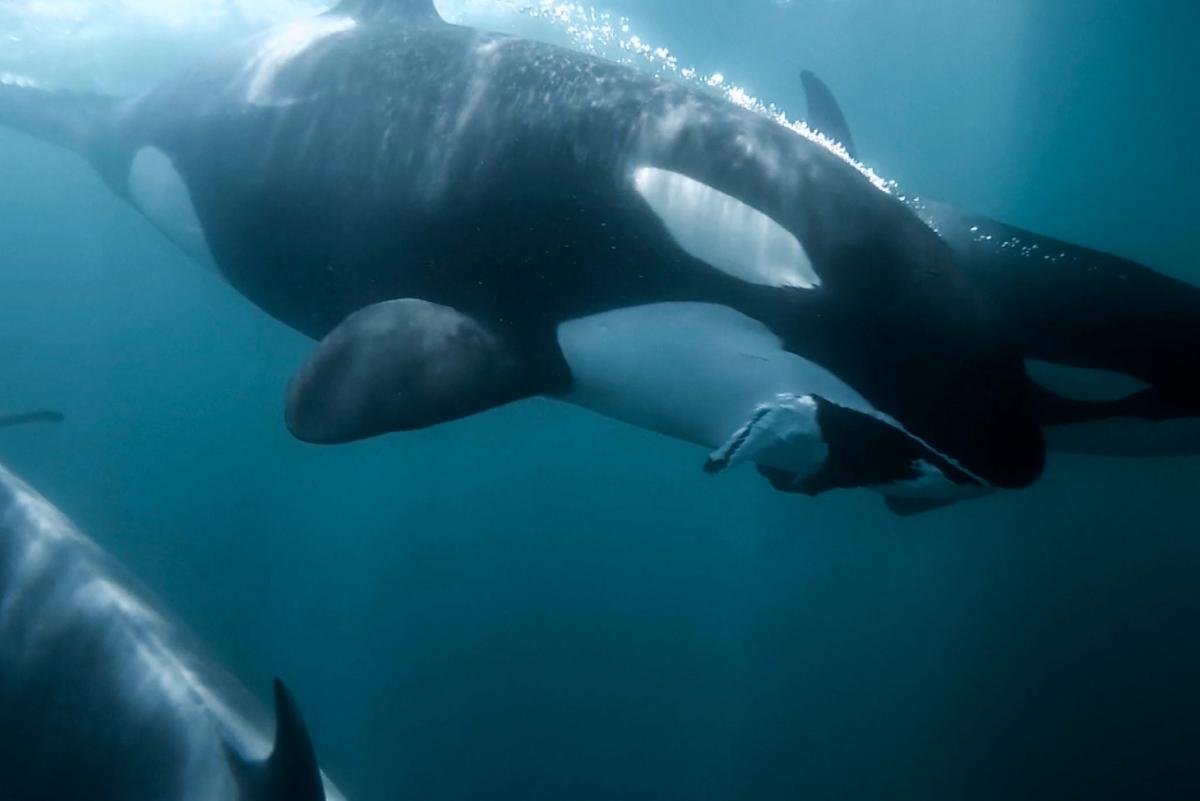
‘Orcas are psychos,’ quipped a close friend recently. He wasn’t joking, nor was he ill-informed. In fact, he is probably the world’s leading historian of whales and people. He had just watched a BBC Earth clip, narrated by David Attenborough, in which three killer whales separate a male humpback calf from his mother in the waters of Western Australia. The video’s closing footage, with two of the orcas escorting the naive youngster to his imminent death, resembles nothing so much as a kidnapping:
Many people might regard my friend’s comment as anachronistic. Following the first live display at marine parks in the mid-1960s, the frightening reputation of orcas vanished almost overnight. For decades after, when most people thought of the species, they pictured commercialised versions such as Shamu or the eponymous orca of Free Willy (1993) – virtual sea pandas. That warm and fuzzy image survived Blackfish (2013), whose viewers generally accepted the documentary’s thesis that orca attacks on trainers were due to the evils of captivity.
Recent encounters in the wild have only cemented this view. Researchers have observed orcas apparently offering gifts to human swimmers, as well as sophisticated group behaviours such as food sharing. Even the recent trend of killer whales disabling and sinking yachts near Gibraltar seems to have elicited sentiments of environmental guilt and socioeconomic catharsis rather than fear – at least from people not on the boats. Orcas have decided to ‘eat the rich’ and ‘take back the ocean’, declared the Twitterverse. The top marine predators were taking revenge for the harm humans had done them.
Is this the same creature that abducts whale calves? It seems the stuff of cognitive dissonance. After decades of scientific attention and public enthusiasm, we thought we knew orcas. But even now, they still offer surprises and contradictions. Captivity taught us long ago that individual killer whales have distinct personalities, but since then researchers have identified separate populations around the world, marked by unique linguistic and food cultures. They’ve observed apparent altruism, playfulness and curiosity within pods and populations, but also seemingly sadistic cruelty and a willingness to torment prey – and even to commit infanticide toward their own species. These discoveries have only complicated our understanding of who – or what – orcas really are.
Yet perhaps what shapes our perceptions of this apex predator has less to do with scientific findings than with our own shifting cultural priorities. A historical view of our relationship with orcas reveals that they have often served as a Rorschach test for humanity’s conflicted attitudes toward the sea. These creatures evolved to navigate an aquatic and acoustic world that is fundamentally alien to us, so we have long struggled to comprehend their behaviour. The question, then, is not whether we can ever truly know a species so unlike ourselves, but whether we might better understand ourselves through them.
If the Twitterverse is right, and orcas really are taking revenge, I’m glad they didn’t start earlier. In the 1970s, my father, a fisherman and biologist, helped capture killer whales on both sides of the United States-Canada border. He even worked briefly for SeaWorld, where my mother and I test-drove the first Shamu stroller in 1976. As I grew up in the Pacific Northwest, often working as a commercial fisherman myself, I watched my dad wrestle with the changing meaning of his past, as orcas became iconic and their capture morphed into our region’s original sin.
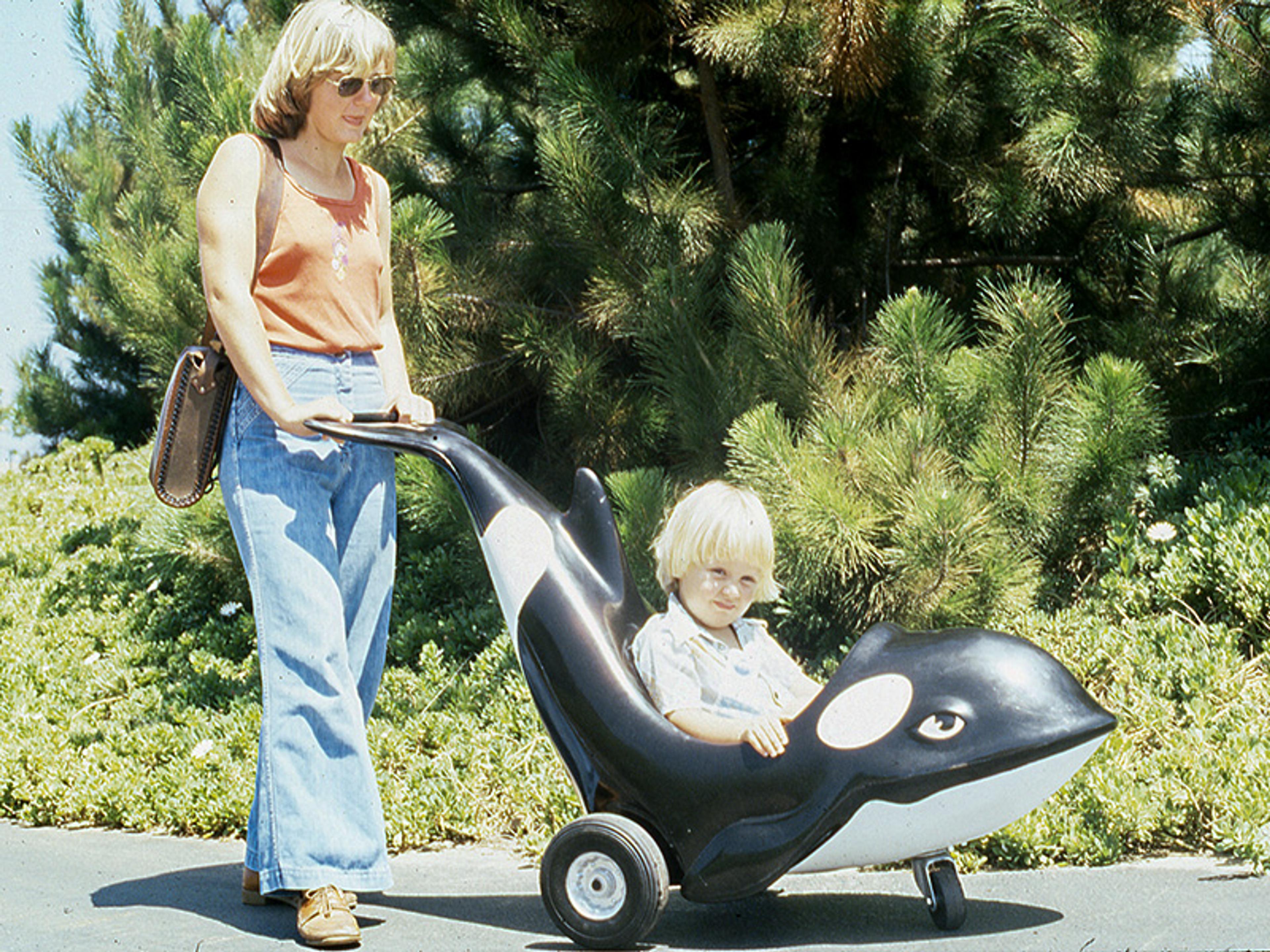
The author with his mother, Jan, at SeaWorld in 1976
That history loomed over my childhood. In the late 1970s, we lived on a fishing boat in southeast Alaska where I spent most days rowing feral in my inflatable raft. My parents cautioned me to avoid bears and showed me the glowing eyes of wolves at night, but they never warned me about orcas. For those who haven’t seen them in the wild, the aura of the species is difficult to describe. They enter each body of water as if they own the place and have never known fear. As a five-year-old, I found them mesmerising but a bit unnerving.
‘What are those, mom?’ I asked, as black fins sliced the water nearby.
‘Don’t worry. They’re just killer whales.’
‘Killer whales?!’ I screamed. ‘Should I row back?’
‘No. They won’t hurt you. It’s just a name. Dad has fed them with his hands.’
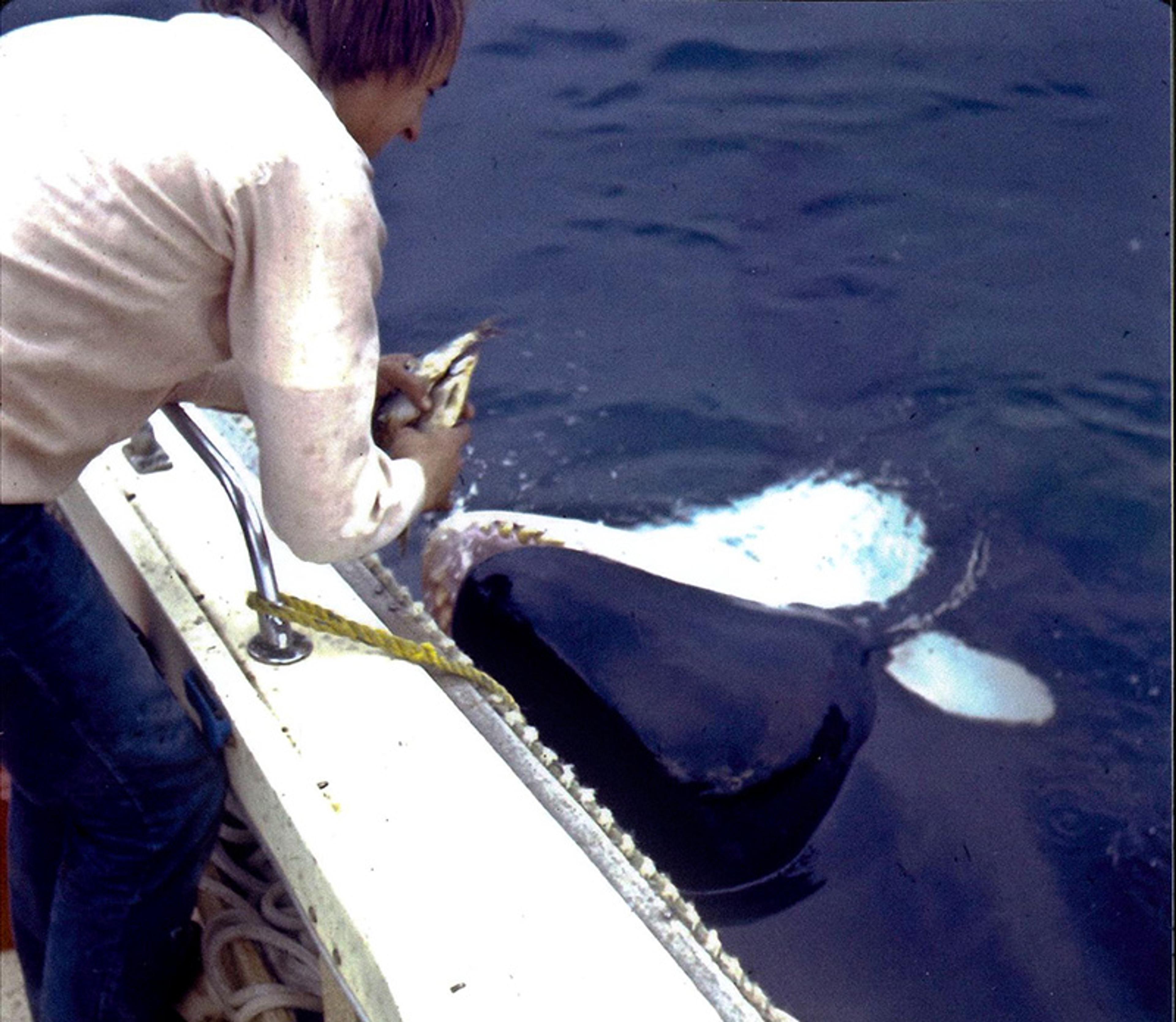
The author’s father, John, feeding a captured orca in Pedder Bay, British Columbia, 1973
Rapid changes in culture, media and technology have sequentially reframed the ocean’s apex predator
I encountered a very different creature on the small screen in 1984. Left alone one summer evening, I flipped to HBO, where I came upon the thriller Orca: The Killer Whale (1977). I had jumped in during an especially violent scene. In the waters of Newfoundland, a fisherman named Nolan, played by Richard Harris, attempts to take a killer whale for captivity, accidentally harpooning a pregnant female. After being hauled aboard, the mortally injured animal miscarries her foetus as her nearby mate shrieks in anguish. For the rest of the movie, the male orca pursues the fisherman, in one scene pulling his waterfront home into the sea and biting off the leg of a character played by Bo Derek, and eventually hurling Nolan to his death against an iceberg. Although an attempt to piggyback on the success of Jaws (1975), it is a very different film. In contrast to Steven Spielberg’s drone-like great white, the antagonist of Orca is a moral being out to avenge his family – a fact the guilt-ridden Nolan fully appreciates. At 10 years old, I understood little of this, but the film left me feeling unsettled and nauseous. Not only was this vengeful wraith quite different from the orcas I had seen in captivity and in the wild, but Nolan could have been my dad.
In truth, popular perceptions of killer whales have always told us more about people in a particular time and place than about the species itself. Rapid changes in culture, media and technology have sequentially reframed the ocean’s apex predator, often to the bemusement of marine mammologists. In the countercultural cauldron of late 1960s and early ’70s Vancouver, for example, the scientist-turned-activist Paul Spong urged listeners to adopt the term ‘orca’, believing humans would feel a deep spiritual connection to the species if only they eschewed the phrase ‘killer whale’. Etymologically, it was a silly argument. The name ‘killer whale’ stems from an erroneous translation of the Spanish asesino de ballenas – killer of whales: it was never meant to imply predation on humans. Likewise, ‘orca’ was hardly a new-age term: it is short for Orcinus orca – which can be translated as ‘demon from the underworld’ – surely a more frightening phrase than ‘killer whale’ in the days when students learned their Latin. For centuries, the men who worked the sea used the terms interchangeably, and both conjured a predator that competed for resources and potentially ate people.
Modern-day urbanites would surely scoff at such notions, but fear of orcas was hardly irrational. They are terrifying to their prey, and terrestrial and marine predators do kill people. Nor is there compelling evidence to suggest that killer whales feel any special affinity for humans. More likely, they refrain from attacking people because their mothers didn’t teach them to eat us. Food culture shapes the organisation and behaviour of orca populations around the world. In my region, northern and southern ‘resident’ populations focus on Chinook salmon, while ‘transients’ – or ‘Bigg’s’ killer whales – exclusively eat other marine mammals. They are utterly xenophobic: the two populations have different dialects and never socialise or interbreed in the wild. They also elicit vastly different responses from observers. One can relate to a marine predator that eats fish – salmon don’t vocalise, and they bear little resemblance to us. Watching an orca torment and dismember a screaming seal pup in front of its mother, on the other hand, tends to unnerve witnesses. It isn’t hard to imagine ourselves on the receiving end of those conical teeth, just as it is difficult to deny that a human in a wetsuit resembles a seal or porpoise.
While researching my book Orca (2018), I interviewed Graeme Ellis, who has worked with and studied killer whales for more than 50 years, and he told me he won’t get into the water when transients are nearby. ‘They are killer whales,’ Ellis reminded me. ‘That’s why I always laugh when people want to call them “orcas”, ’cause they are killer whales, for god’s sake! Just watch them kill something.’
Sealers and whalers certainly found them frightening. ‘These killers are a spouting fish, but voracious, armed with formidable teeth and a huge dorsal fin,’ reads the log entry from 14 February 1858 of the US whaling ship Saratoga. ‘They are the deadly enemy of all the right whale species. Their favourite morsel of food is the tongue, they attack the whale in concert, worrying him until they force his mouth open, when they seize upon the tongue and soon despatch him.’ Writing in the early 1870s, the former whaling captain Charles Scammon, who himself helped drive California grey whales nearly to extinction, described killer whales as ‘marine beasts, that roam over every ocean; entering bays and lagoons, where they spread terror and death.’ When orcas target a whale, he added, the larger animal is often so paralysed with fear that it offers ‘but little resistance to the assaults of its merciless destroyers’.
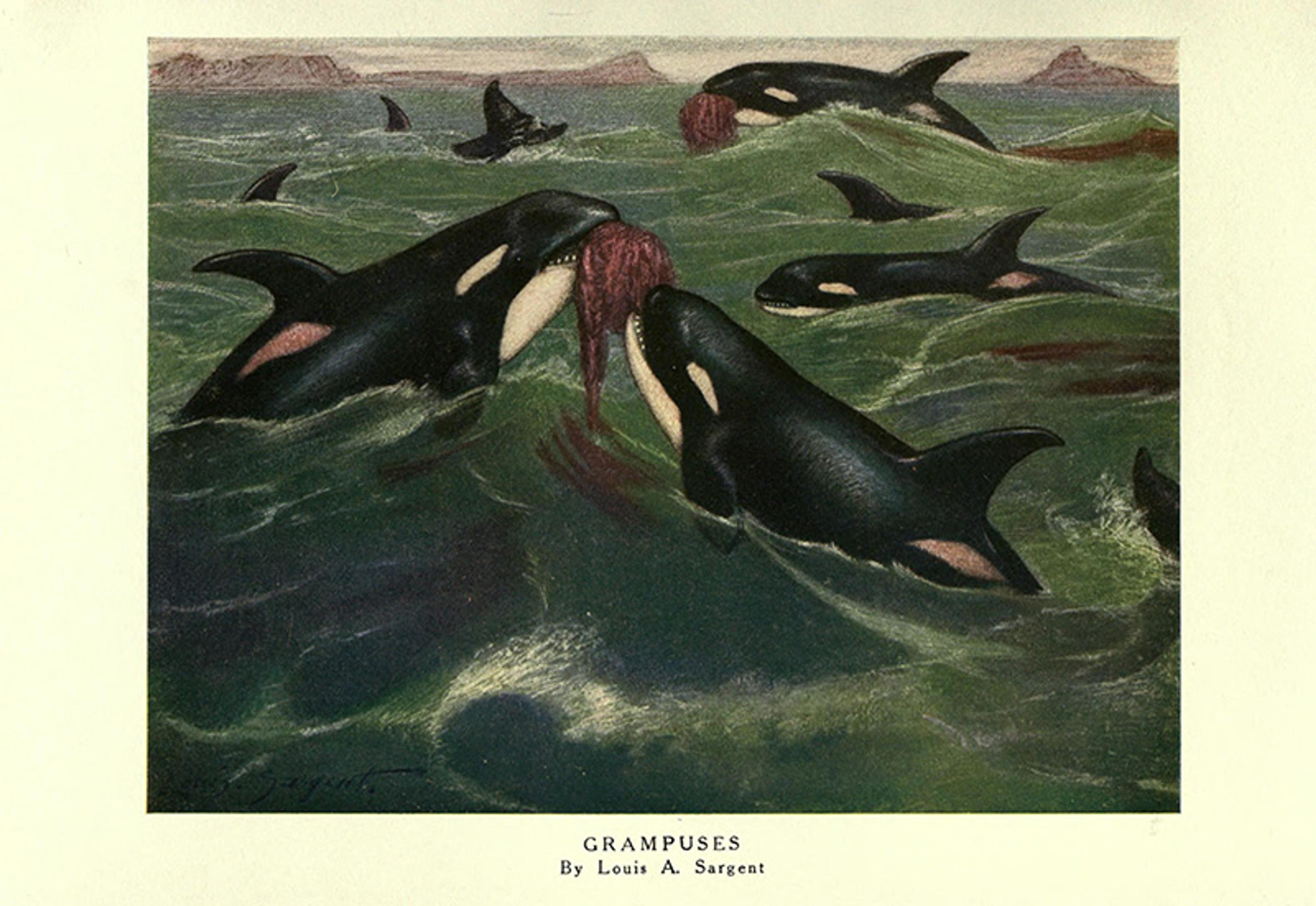
Courtesy the Biodiversity Heritage Library
Scammon called them ‘wolves of the ocean’, and it seemed plausible that they could attack humans. After watching orcas break through ice in Antarctica in 1911, in apparent pursuit of his expedition’s journalist, the explorer Robert Scott reported that the species would ‘undoubtedly snap up anyone who was unfortunate enough to fall into the water’. His account circulated widely, along with apocryphal reports of killer whales being found with dozens of whole seals and porpoises in their stomachs. A popular picture was forming of a cunning and voracious predator.
The article framed observers as would-be protecters of the panicked pinnipeds
The power of that image becomes apparent when examining the front page of the 7 May 1937 edition of the Oakland Tribune. Even today, the headline seems breathless: ‘Monster Cavorts Off Islands In Grim Chase To The Kill’. Just below it sits a striking black-and-white photo taken from East Landing on the Farallon Islands off the coast of San Francisco. In the foreground, a female orca races toward a nearby group of northern fur seals, who have raised their heads from the water in terror. In the background, framed by the faint foggy outline of the Bay Area, sits the Sequoia, a tender for the US Lighthouse Service. At the far left, a small skiff, or surfboat, carrying men and supplies, approaches the viewer. It is a busy scene, the action nearly leaping from the page.
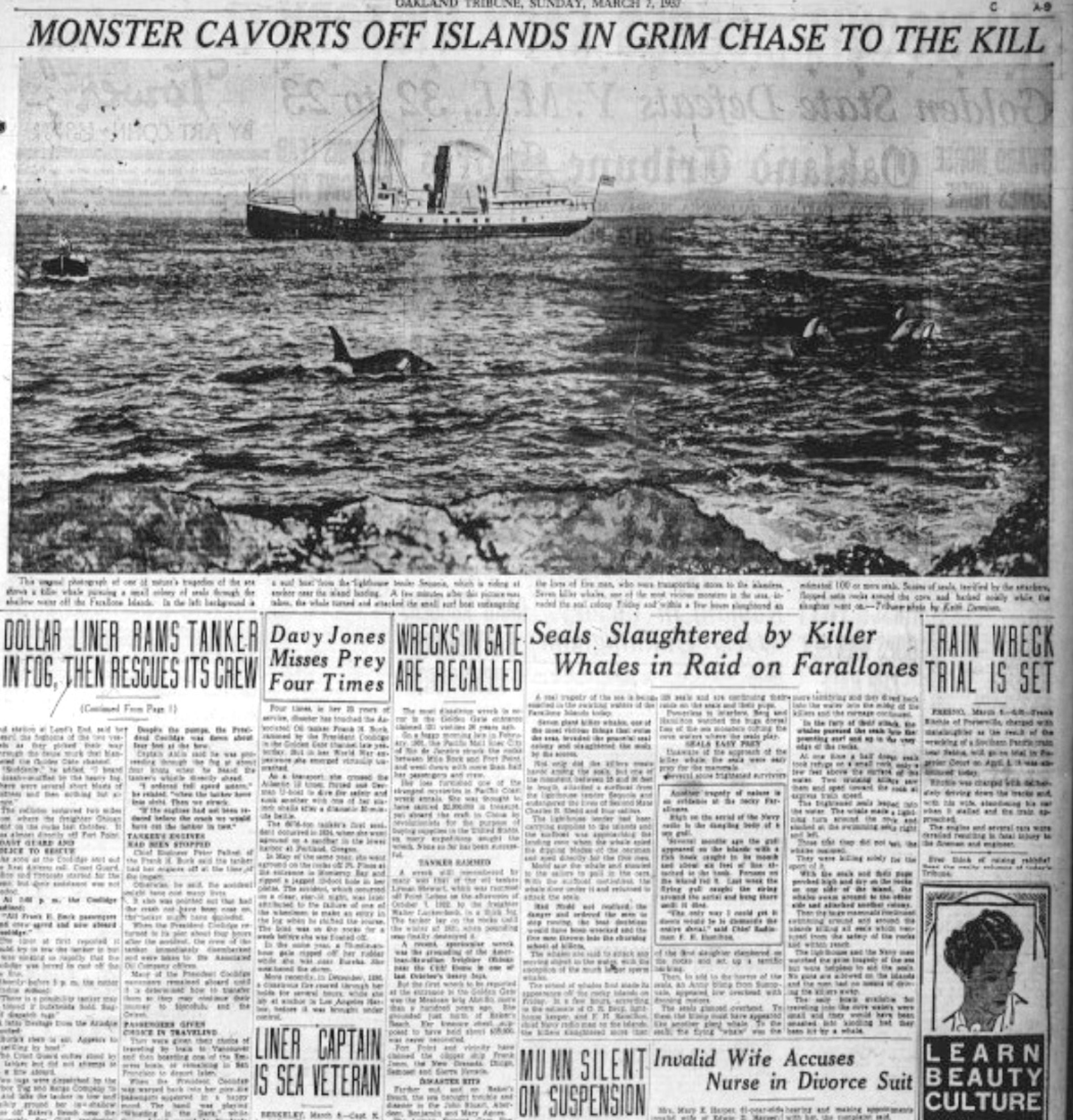
Courtesy the CDNC
The orcas had come for the seals. As the article recounted, ‘seven giant killer whales, one of the most vicious things that swim in the seas, invaded the peaceful seal colony and slaughtered the seals by the scores.’ To witnesses, the predators seemed motivated as much by cruelty as hunger. ‘Those that they did not eat, the whales maimed,’ the writer observed. ‘They were killed solely for the sport of it.’
‘Vicious’, ‘invaded’, ‘slaughtered’ – such language could once have described human violence on the Farallones. Beginning in the early 1800s, commercial hunters had decimated the islands’ once-vast northern fur seal population, which remained tiny a century later. Yet the article framed observers as would-be protecters of the panicked pinnipeds. ‘The lighthouse and the Navy men watched the grim tragedy of the sea but were helpless to aid the seals,’ it explained. ‘No guns are allowed on the islands, and the men had no means of driving the killers away.’
Still worse, it seemed humans might be on the menu. ‘A few minutes after this picture was taken,’ reads the caption, ‘the whale turned and attacked the small surf boat endangering the lives of five men,’ among them Second Mate Charles B Medd. The boat had been approaching the rocky cove, noted the article, when the orca suddenly ‘sped directly for the five men’, who quickly pulled in their oars. ‘With the surfboat motionless, the whale dove under it and returned to attack the seals,’ the story noted. ‘Had Medd not realised the danger and ordered the men to stop rowing,’ it added, ‘the boat doubtless would have been wrecked and the five men thrown into the churning school of killers.’
At this point, the careful reader might note a problem with the story: the ‘attack’ didn’t happen. The encounter occurred, to be sure, but unlike the recent incidents in the waters of Iberia, the orca dove under the surfboat rather than striking it. Yet these facts mattered little: the San Francisco Chronicle, the Los Angeles Times, even The New York Times picked up the story, and the reputation of Orcinus orca grew ever more fearsome.
That infamy only grew after the Second World War. In December 1953, for example, the cover of Stag magazine featured an ink drawing of a killer whale throwing two helpless men from a raft.
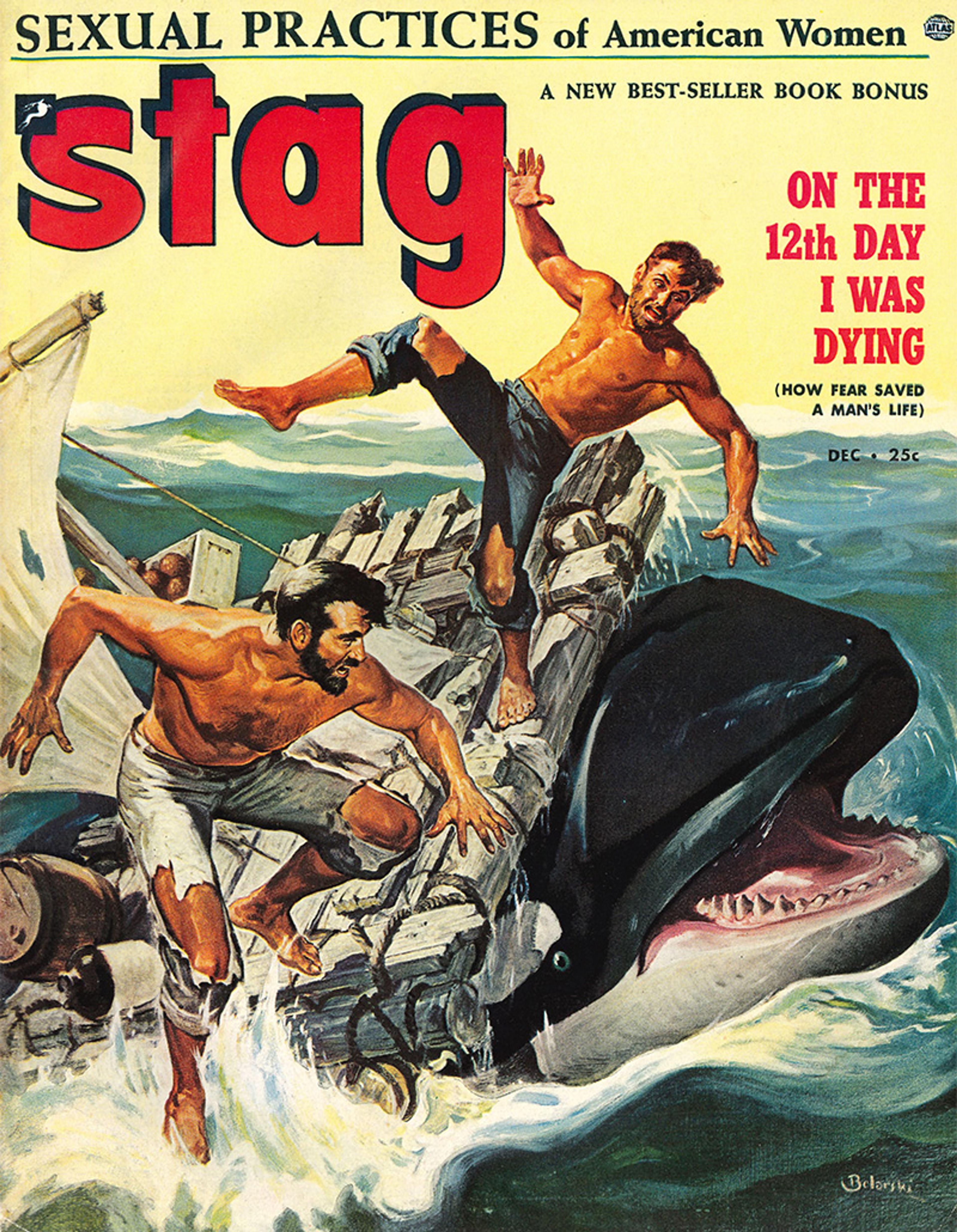
Image supplied by the author
A popular men’s adventure magazine, Stag circulated widely in the US armed forces. It seems likely, then, that many American troops at the US Naval Air Station in Keflavik, Iceland had seen the December issue by the summer of 1954, when the Icelandic government requested help protecting the herring fishery from marauding killer whales. Over the following years, planes from the base regularly strafed orcas, slaughtering hundreds. Such actions were hardly surprising. The US Navy’s diving manual described killer whales as ‘ruthless and ferocious’, instructing divers to ‘get out of the water’ if any appeared. As one writer quipped: ‘There is no treatment for being eaten by the orca except reincarnation.’
It was a quirk of geography and history that caused the US-Canadian Pacific Northwest, where I grew up, to reshape popular views of the species. The region’s population centres sat on Puget Sound, the Strait of Juan de Fuca, and the Strait of Georgia – a transborder marine ecosystem now called the Salish Sea. This was also the main range of what scientists would later label the ‘southern resident killer whales’: three pods (J, K, L) that rely primarily on Chinook salmon.
Well into the 1960s, the people of the region tended to regard orcas as pests and threats rather than local attractions. This included scientists at what is now the Marine Mammal Laboratory in Seattle, who worried that killer whales were diminishing the federal government’s annual fur seal harvest in Alaska. Through the 1960s, they worked with whalers to harpoon orcas and examine their stomach contents. In 1961, The Seattle Times celebrated one such kill, in which the lab’s esteemed scientist, Victor Scheffer, described the species as ‘crazed by blood’. Likewise, in British Columbia, the federal Department of Fisheries officials mounted a machine gun near Campbell River to kill orcas they worried would threaten the local sport fishing industry, which attracted celebrities such as John Wayne and Bob Hope.
Yet in this same period, at the height of the violence, live capture sparked a transformation. It began accidentally. In the summer of 1964, employees of the Vancouver Aquarium harpooned a killer whale calf, whose body it planned to use to design a sculpture for its new foyer. When the youngster didn’t die, they led him to Vancouver, where they named him ‘Moby Doll’. The animal lived less than three months, but his docility surprised everyone. The following year, Ted Griffin, the owner of Seattle Marine Aquarium, purchased a large male orca from Canadian fishermen, who had accidentally trapped the animal behind their nets. Dubbed ‘Namu’, the whale made headlines around the world as Griffin towed his prize south in a hastily constructed sea pen.
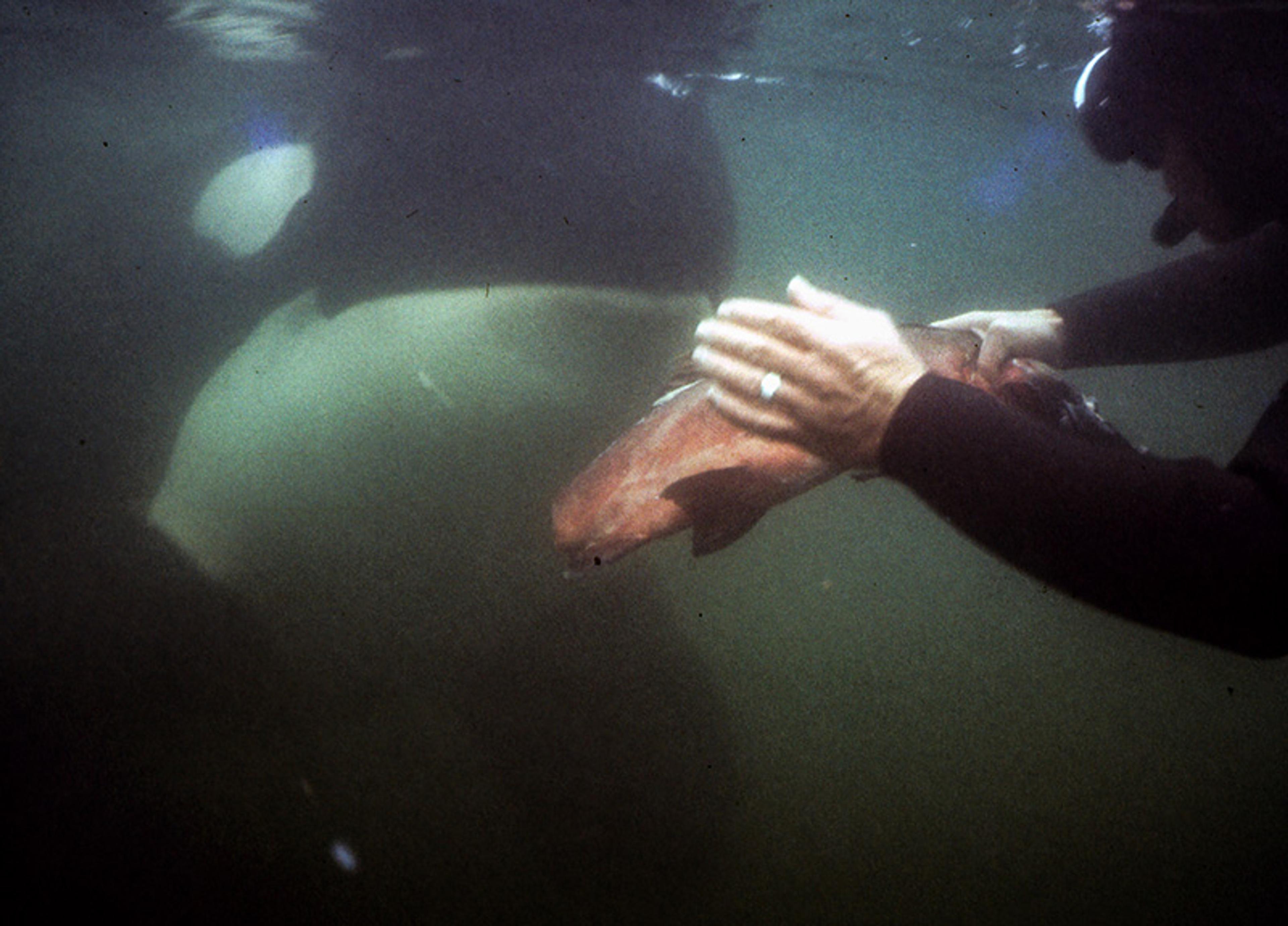
Ted Griffin with Namu, 1965
Still convinced that killer whales posed a threat to humans, scientists were incredulous when Griffin ventured into the water with Namu. Rather than devouring the aquarium owner, the formidable predator let Griffin touch, brush and even ride him. Soon the two offered the world’s first orca shows on the Seattle waterfront. Millions would read about their relationship in Griffin’s article in National Geographic, ‘Making Friends With a Killer Whale’ (1966), and many more would see a fictionalised version in the film Namu: The Killer Whale (1966) (later released as Namu: My Best Friend), by the producers of Flipper (1963). Although he survived for only a year in captivity, Namu had a profound impact in two important ways: first, the public marvelled at his gentleness with Griffin; second, his popularity convinced oceanariums around the world to acquire their own orcas. In the following years, Griffin supplied most of them, including SeaWorld’s first ‘Shamu’ (short for ‘She-Namu’). Today, people around the world regard orca captivity as anathema. It is easy to forget, then, that in the 1960s and early ’70s, the debate wasn’t between whale catching and whale watching: it was between whale catching and whale killing. In the four decades following the Second World War, commercial whalers – primarily Japanese and Soviet – slaughtered some 2 million whales including hundreds, perhaps thousands, of orcas.
The public turned against orca capture, even as concern for the species spurred the first extensive research
Live display represented a sea change in the perception and study of the species. Captive orcas drew crowds, giving most visitors their first close view of cetaceans and first sense of them as individuals. In 1964, no one on Earth had seen a live killer whale on display in captivity, and scientific research had been limited to dissecting carcasses of animals killed by whalers or discovered onshore. By 1970, some 30 million people had viewed them at aquariums and marine parks. They weren’t just spectators: many were scientists with the first access to live orcas in the history of cetology. And in the process of studying their physiology, diving mechanisms and acoustic capacity, they came to know killer whales as individuals with personalities. Among them was Skana, a female orca captured by Griffin and bought by the Vancouver Aquarium in 1967. Through her impact on Spong, the scientist-activist, and her subsequently inspiring Greenpeace’s antiwhaling campaign of the mid-1970s, Skana may have been the most influential cetacean in human history.
By that time, the public had turned sharply against orca capture, even as enthusiasm and concern for the species spurred the first extensive research in the wild. At the head of the effort was Michael Bigg, an innovative marine mammologist at the Pacific Biological Station in Nanaimo, British Columbia, now regarded as the founding father of killer whale research.
Working partly with captive orcas at the marine park Sealand of the Pacific, Bigg developed a system for identifying individual animals by their dorsal fins and distinctive ‘saddle’ patches (the marking behind their dorsal fins).
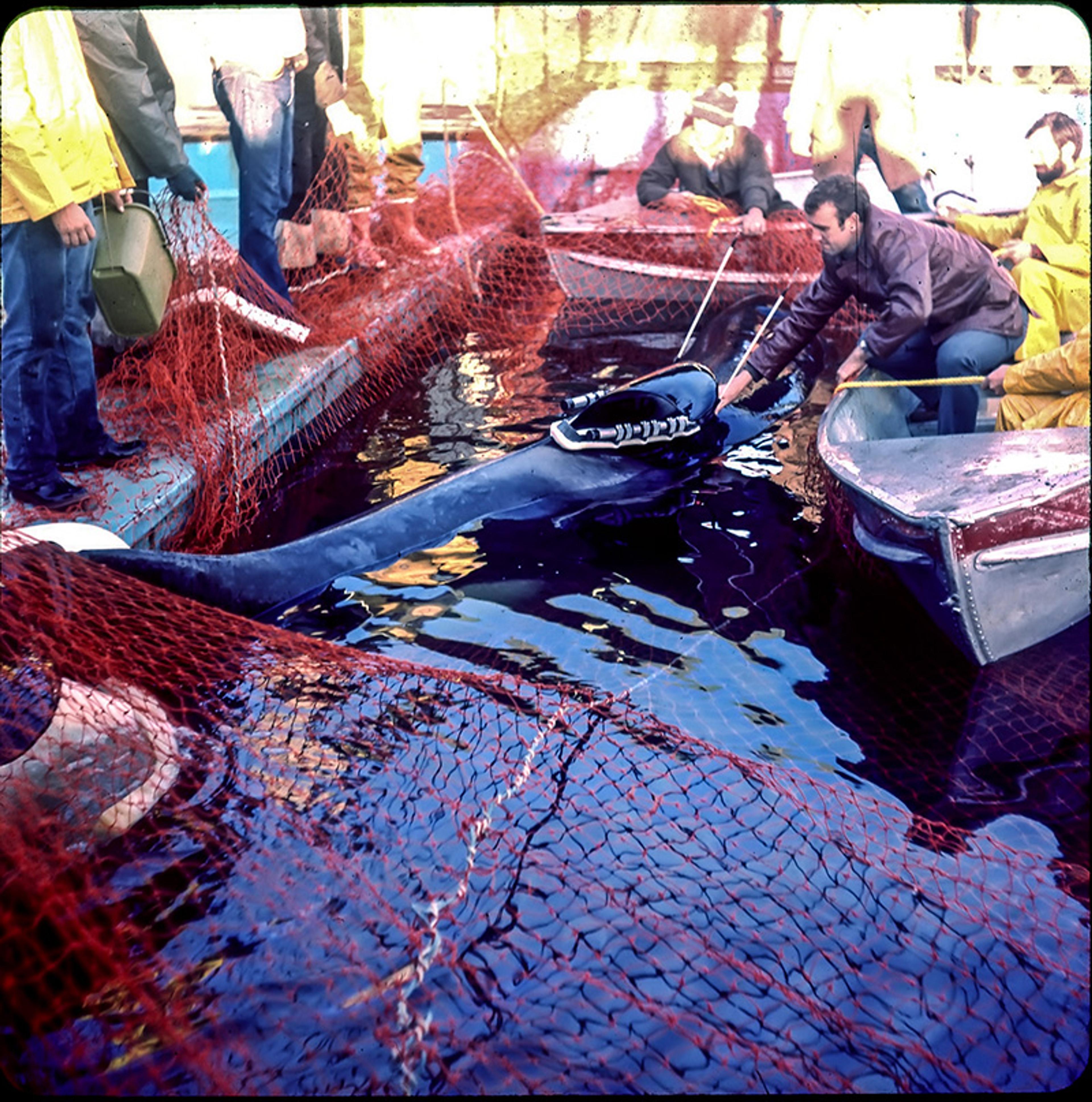
Michael Bigg testing a radio pack on Haida, an orca at Sealand of the Pacific, 1973
‘Mike modelled it after studies that had been done on African zebras and lions and so on using markings,’ explains Graeme Ellis, who worked for two decades as Bigg’s assistant. ‘That’s where the idea came from, and he wanted to know if it would work on a marine mammal.’ Other researchers were sceptical, arguing that the only way to identify individuals was to catch and mark them with dry ice and even lasers. ‘I will never forget going down to a meeting with Mike in Seattle,’ Ellis recalls. Bigg’s young assistant was furious when researchers from the Marine Mammal Laboratory and SeaWorld dismissed his mentor’s ideas, but Bigg proved patient. ‘Mike was great that way,’ Ellis reflected. ‘Once he saw it was something that was going to work, he would just pursue it… he always said: “The truth will come out in the long run”.’
Eventually, Bigg’s system did win out, opening the door to understanding the pod structures and population dynamics of killer whales around the world. In the summer of 1981, he presented his findings at the International Whaling Commission (IWC) meeting in the UK, helping to convince the organisation to stop the killing of orcas until further population studies could be done. The following year, amid heavy lobbying by Spong and Greenpeace, the IWC passed a commercial whaling moratorium. By then, orcas were becoming icons. In the 1980s and ’90s, whale-watching companies appeared, and government laboratories that had once targeted orcas for killing and dissection were charged with protecting them.
I encountered the species often in the 1990s. My father and I were fishermen, regularly running boats from Seattle to southeast Alaska to fish for salmon. In the Inside Passage between Vancouver Island and the mainland, phalanxes of killer whales would sometimes cruise beside us for hours at a time. Years later, I would learn that these were northern residents, hunting for Chinook salmon in and around Johnstone Strait. As I stared transfixed (at times forgetting to maintain our course), I often thought of my Finnish great-grandfather, who fished for Chinook salmon at the mouth of the Columbia River in the 1930s and ’40s. When orcas appeared, he and his fellow gillnetters would simply head for shore. Two generations later, killer whales didn’t scare us anymore. I just watched them, wondering what to make of these commanding, inscrutable creatures who hardly seemed to notice us.
Activists and filmmakers often look expectantly to Indigenous peoples for special stories and connections to killer whales. I suspect this grows tiresome. After all, it wasn’t the First Peoples of the Pacific Coast who elevated orcas above other species – that was the work of white environmentalists in the 1970s and ’80s. Yet thousands of years of living in a place yields knowledge and lessons, as I have witnessed firsthand. The summer I turned 16, I worked on a purse seining (large net) fishing vessel owned by the Tlingit skipper Mac Demmert, based in Craig, Alaska. One early morning, our crew was waiting impatiently to set our net, counting the minutes before the fishing opening officially began. Feeling a bit queasy from the ocean swells, I steadied myself on the rolling deck and waited for the signal to pull the pin and release the skiff with my dad at its helm. ‘Right when I tell you, OK?’ Mac yelled down to me from the wheelhouse. I nodded, looking and feeling green.
At that moment, we heard a loud blow. ‘Hold on,’ barked Mac, taking a long look at the dozen or so orcas swimming nearby. They were passing astern, exactly where we planned to set. ‘Let’s wait a bit and let them fish first,’ he smiled. ‘They’ve got to make a living, too.’ I’d never thought of it that way, but in hindsight, I’d been prepared to accept it. Over the years, new findings about orcas had seeped into school curricula and media coverage in Puget Sound, much of it drawn from Bigg’s research. Two months later, in October 1990, I came home from school to find my father looking ashen. Bigg had died of cancer at 50. Yet he had inspired others who carried on his work.
The sight of Tahlequah, pushing her dead calf through the Salish Sea, captured headlines around the world
By the time I began my own research on people and orcas 20 years later, as a historian rather than a scientist, the transformation of the human relationship with killer whales seemed complete and my questions straightforward. Why did we go from fearing to loving this apex predator so quickly? What did that change reveal about them and us? The pivotal step came with humans viewing orcas as individuals with their own connections, families and even potential relations with us. And the driving force of that change was captivity itself, which transformed popular and scientific views of the species from the fearsome ‘killer’ to the loveable ‘orca’.
It was hardly a groundbreaking insight. ‘Seeing them in aquariums individualised these creatures,’ explained the biologist Victor Scheffer as early as 1994. ‘They weren’t just whales in the abstract.’ That reality became apparent in the summer of 2018, when the sight of a southern resident, Tahlequah, pushing her dead calf through the Salish Sea, captured headlines around the world. Although not intended as such, the young mother’s mourning became a political act in the human world, pushing governments and citizens toward greater protections for orcas. As I explained in many a book talk, although the southern residents were endangered, humans had entered a positive new phase in our policy and behaviour toward them.
Yet historians are far better at analysing the past than predicting the future. I had little sense of how new technology, particularly drone footage of killer whales hunting other marine mammals, would reframe views of the species. Of course, the combination of tenderness toward family and cruelty toward prey is hardly unusual among predators, humans among them. Nevertheless, it is difficult to think of Willy or Shamu after watching footage of orcas killing grey whale calves or chasing sea otters.
Nor did I foresee the trend of orcas disabling yachts in the North Atlantic. In the wake of the 2013 documentary Blackfish, amid public concern toward captivity, climate change and ecological collapse, it was probably inevitable that many would interpret the boat strikes as retribution for the sins of humanity. Of course, we don’t know why killer whales are detaching rudders and puncturing hulls, but we can be reasonably sure it has nothing to do with SeaWorld, overfishing, or resentment of the rich. Like the 1970s depictions of whales as ‘buddhas of the sea’, narratives of ecological reckoning are human stories told to and for other humans. They reveal little about the inner lives of orcas, or any other animals for that matter.
Yet these encounters have made their mark on popular culture. In addition to footage of killer whales striking and disabling yachts, one can easily find AI videos of orcas doing far greater damage. Philosophers have already reflected a great deal on how generative AI is changing what it means to be human. Yet one wonders how it will alter what it means to be an orca, at least in the shifting human imagination. At the very least, it seems clear that the disabling and sinking of boats off Gibraltar has inspired new myths of the vengeful killer whale.
Authentic video of orca damage
AI-generated video of orca damage
In this light, the new horror film Killer Whale (2026), which features a vindictive orca out for revenge for captivity, could meet a more favourable reception than its predecessor Orca. The 1977 film flopped because it was out of step with the zeitgeist. Its depiction of the mourning male orca as a moral actor seemed plausible, but audiences baulked at his violence toward humans. Live aquarium displays and new research had banished the image of the terrifying ‘killer’ that had once haunted whalers and sealers. In contrast, public hostility to captivity and reactions to the recent yachts strikes, especially on social media, hint that many people long for nature’s retribution. And so orcas continue to reflect our hopes and fears back to us. First a fearsome predator, then a mascot for marine parks and hippies alike, the killer whale may be making the transition to nemesis of greedy and extractive capitalism. Yet one cannot help but conclude that it is we ourselves, not orcas, who have changed.