
Home price growth has slowed to 0.9% in December 2025, but many markets are seeing only a decline.
Annual home price growth of less than 1% is one of the softest rates since the post-Great Recession recovery, according to a new U.S. home price insights report from data research firm Cotality.
“We are seeing a significant departure from the rapid surges of recent years; while the upward pressure on prices remains, the momentum has moderated enough to suggest that the market is finally becoming more navigable for prospective buyers,” Cotality’s chief economist, Selma Hepp, said in the report.
The South and the West are getting hit the worst. Here, negative price declines are the norm. Florida, Texas, Colorado, Washington, DC, Hawaii, Arizona, Utah, Oregon, and California have seen the steepest declines in Cotality’s Home Price Index (HPI), which predicts the risk of metros in a downturn by analyzing multiple market segments and 45 years of home price trends using proprietary statistical models.
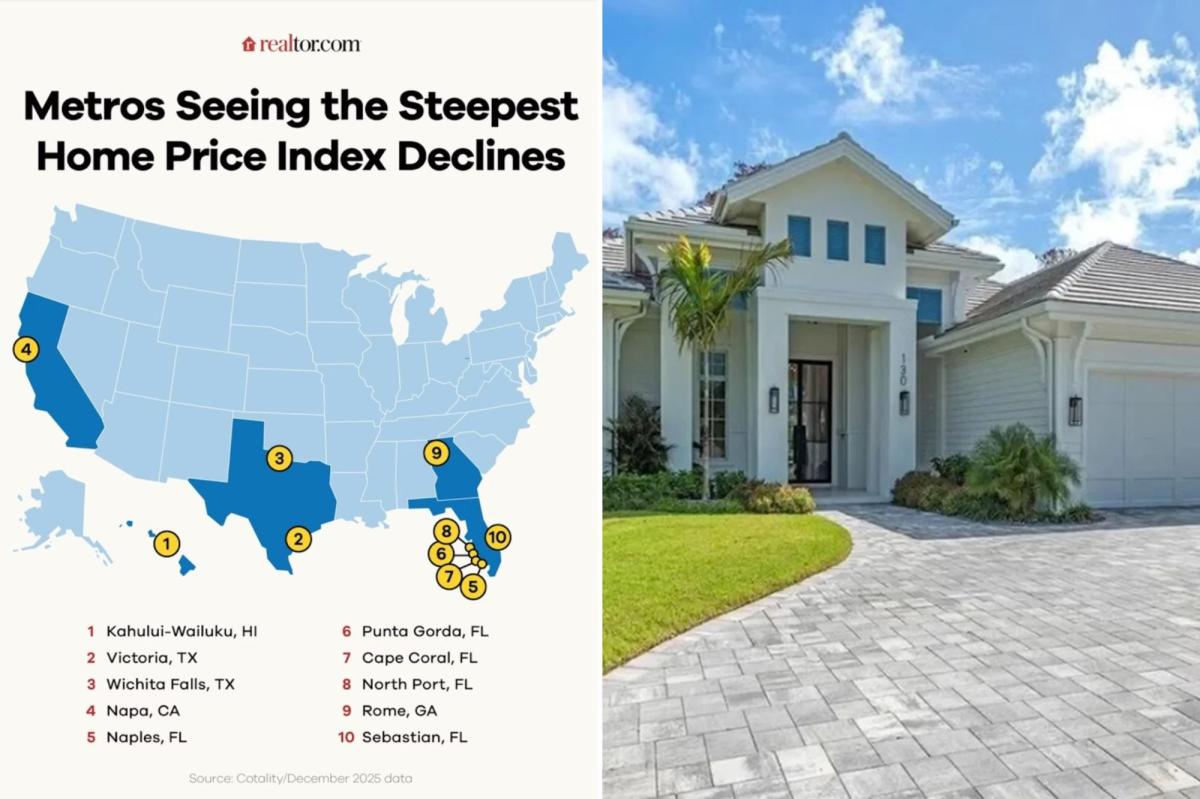
The coolest markets with the sharpest HPI decline are Kahului–Wailuku, HI; Victoria, TX; Wichita Falls, TX; Napa, CA; Naples, FL; Punta Gorda, FL; Cape Coral, FL; North Port, FL; Rome, GA; and Sebastian, FL.
Punta Gorda has also seen the biggest equity percentage drop at -7.97%, with a median $26,624 plunge in value.
Many markets are seeing home price declines. Realtor.com
Why are home valuations in decline?
Much of it is attributed to higher inventory levels and slowing in-migration in markets that previously saw rapid expansion, says the report.
During the COVID-19 pandemic times, with mortgage rates at historic lows, people in urban areas rushed into many of these markets now approaching or in a downturn—especially Florida and Texas—as they sought more space and fewer restrictions, pushing prices up to unsustainable levels.
Those markets are now seeing a hard correction, especially in Florida. The Sunshine State takes half the spots on the list.
Cotality calls the declines a “return to a long‑anticipated normalization driven by economic and housing fundamentals. The frantic bidding wars and double‑digit price surges of recent years have given way to a market where buyers and sellers must gradually realign their expectations.”
In Florida, this is already happening.
Start your day with all you need to know
Morning Report delivers the latest news, videos, photos and more.
Thanks for signing up!
“As sellers lose their leverage in this environment, they’re getting more realistic in their pricing,” Douglas Elliman agent Michael Merrill, who works in Vero Beach, tells Realtor.com®.
Even as billionaires flock to the state for its friendlier tax policies, the average resident is struggling with a loss of equity on top of higher (though stabilizing) housing costs.
“The reason [Florida] homes have lost value is higher inventory, less migration to the area, and sellers overpricing the homes,” adds Brenden Rendo, a strategic real estate adviser at Real Estate Bees who serves Central Florida.
The Sunshine State takes all the top five spots of markets facing the highest risk of continuing future declines: Cape Coral, Lakeland, North Port, Palm Bay, and even West Palm Beach, which has seen an influx of luxury developers.
Two Texas metros are in the top three markets seeing a hard correction: Victoria and Wichita Falls.
Los Angeles real estate investor Jameson Tyler Drew, who witnessed the exodus of residents from California to Texas during the pandemic, says many people—both current and potential residents—are disenchanted with the Lone Star State because it’s no longer as affordable as it was.
“The luster of Texas seems to be fading pretty quickly as prices increased these last few years,” he tells Realtor.com. “People I’ve spoken to have found its property taxes higher than that in California, and their commutes are becoming longer and longer. Now, people who leave California just go to Midwestern cities directly.”
He names Milwaukee, Indianapolis, and even Chicago as places where California transplants are seeking more affordable pastures. Others are looking to cheaper areas in the Golden State, including Fresno and Bakersfield–Delano.
Hawaii and Napa in a downturn?
A couple of unexpected metros—both pricey and known for their beauty—had two of the steepest HPI declines: Kahului-Wailuku, HI (No. 1), and Napa, CA (No. 4). They have median list prices of $1,049,500 (down from $1.42 million in August 2023) and $1,304,500 (down from $1.79 million in June 2023), respectively.
In January, 10% (188 listings) and 11.6% (56 listings) of listings in Kahului-Wuiluku and Napa, respectively, saw price reductions, according to Realtor.com data.
Cotality‘s principal economist, Thom Malone, attributes the HPI declines in these two coveted markets to home insurance costs.
“Hawaii’s insurance costs have skyrocketed in the wake of the 2023 fires, and Napa is the same story, with most of the county being classified as very high wildfire risk,” he tells Realtor.com.
“The decline in prices is necessary to compensate the buyer for the [rising] insurance costs, since the attractiveness of the areas has not changed otherwise.”
Kahului-Wailuku, HI
The median list price in Kahului-Wailuku, HI is $1,049,500. Realtor.com
HPI percentage drop: 8%
Median list price: $1,049,500
Victoria, TX
HPI percentage drop: 7.4%
Median list price: $276,100
Wichita Falls-TX
HPI percentage drop: 7.2%
Median list price: $199,575
Napa, CA
The median list price in Napa, CA is $1,304,500. Realtor.com
HPI percentage drop: 7.1%
Median list price: $1,304,500
Naples, FL
The median list price in Naples, FL is $729,725. Realtor.com
HPI percentage drop: 6.8%
Median list price: $729,725
Punta Gorda, FL
HPI percentage drop: 6.2%
Median list price: $384,750
Cape Coral, FL
HPI percentage drop: 6.2%
Median list price: $399,949
North Port, FL
The median list price in North Port, FL is $479,900. Realtor.com
HPI percentage drop: 5.9%
Median list price: $479,900
Rome, GA
HPI percentage drop: 5.2%
Median list price: $296,950
Sebastian, FL
HPI percentage drop: 5.2%
Median list price: $442,725