
Karen Nickel told 5 On Your Side about a conversation with a homeowner: “When asked if she left anything inside the home, she said, ‘My heart.’”
FLORISSANT, Mo. — On Monday morning, the first home was officially demolished in the Cades Cove neighborhood in north St. Louis County.
Six homes will be torn down to remove the radioactive waste underneath.
This is all happening on Cades Cove Drive in Florissant. It’s a neighborhood sitting near Coldwater Creek.
The Formerly Utilized Sites Remedial Action Program, or FUSRAP, of the U.S. Army Corps of Engineers (USACE) is responsible for the cleanup. FUSRAP handles contamination cleanup from the nation’s early atomic energy program.
The USACE has stated this demolition is a first in the nation, marking the first time residential properties are removed under the FUSRAP program.

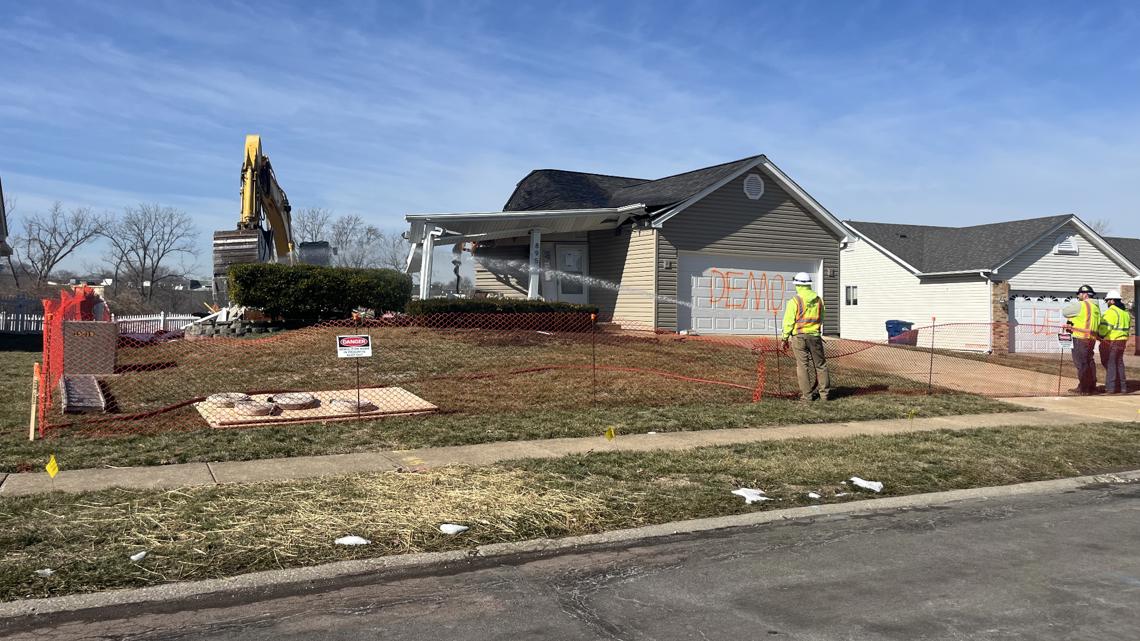
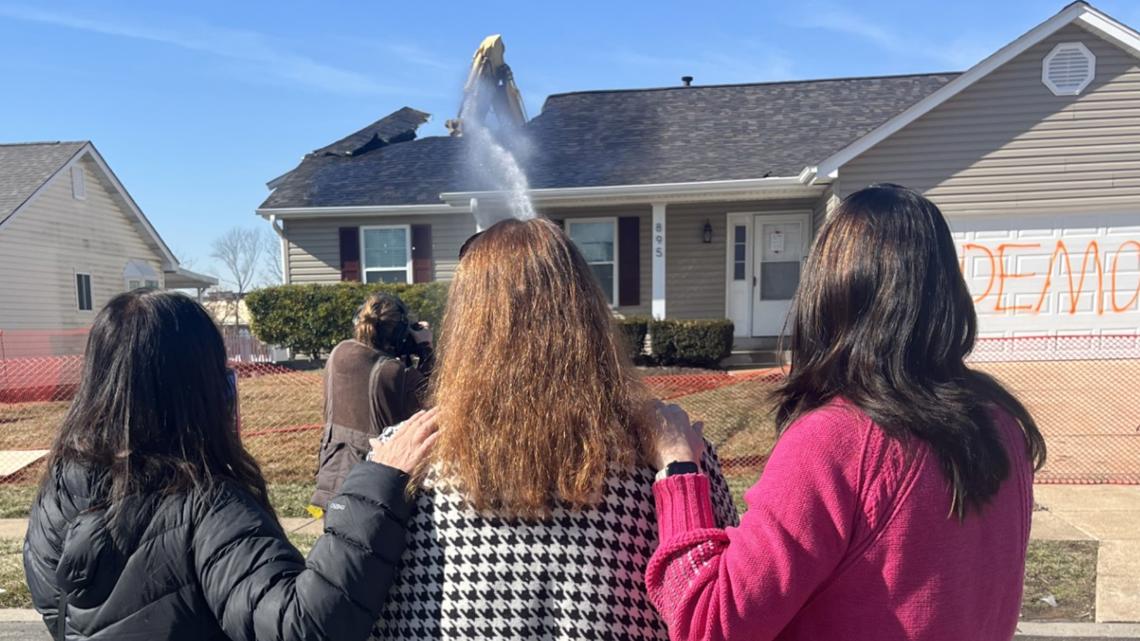
As an excavator clawed at her home, a homeowner watched 28 years of memories disappear in less than an hour.
She stood side by side the advocacy group Just Moms STL.
Just Moms cofounder Karen Nickel wanted to provide support for families.
Nickel told 5 On Your Side, “When asked if she left anything inside the home, she said, ‘My heart.’”
All six families have been officially relocated for several months. The USACE said families worked with their real estate team.
“We worked with each one of the families, one on one, to relocate them to a comparable home,” said US Army Corps of Engineers St. Louis District Deputy Commander Lt. Cl. Andrew James. “I can’t go into the specifics of each one of the negotiations and where they ended up out of respect for the privacy of those homeowners.”

Explanation behind removal
James explained that the Cades Cove subdivision was built on top of a meander.
It’s a meander of Coldwater Creek, which is contaminated with radioactive waste. That’s because St. Louis was behind the uranium processing for the atomic bomb.
Decades ago, the radioactive waste was improperly stored, eventually making its way into the creek.
“(The radioactive waste) is so close to their foundations, I mean the, the process is going to cause damage to the homes and so the only way to safely do this is to demo the homes,” shared James.
Air monitoring is promised during this process, as crews dig below the surface, from two and a half feet to 17 feet.
The Army Corps of Engineers provided the following details about the demolition and remediation efforts:
Scope of Work: The six homes will be demolished one at a time, with demolition expected to take approximately one month. Following demolition, full remediation of the site, including the excavation and removal of contaminated soil, will take less than one year to complete.Health and Safety Measures: During demolition and remediation, strict controls will be in place to prevent the spread of contamination. Air monitoring will occur continuously, and dust will be controlled with water misting. The site will be fenced off to limit access, ensuring the safety of both workers and the public.Traffic: No road closures are anticipated. Some temporary traffic control measures may be implemented, but no delays for traffic are expected.Return of Land to Homeowners: Once remediation is complete, the land will be restored to a condition that meets the highest safety standards and returned to the homeowners.Ongoing Communication: The U.S. Army Corps of Engineers will continue to provide updates to the public through social media, community meetings, and the project website. Residents and local officials will be kept informed of progress and any potential impacts to the neighborhood.
Phil Moser, Chief of the FUSRAP Environmental Branch of the St. Louis District, US Army Corps of Engineers, said, “The safety measures that we take as far as sufficiently wetting the area, making sure that there is no airborne contamination coming up, they will not be wearing masks or breathing apparatus because of the levels of contamination do not sufficiently rise to that level.”
He noted crews will be wearing protective clothing on their hands and feet. At times, they’ll be in full suits while digging.
“The demolition of the homes requires no protective gear for contamination. The contamination is subsurface and when the crews go in and actually do remediation, then they’ll take the appropriate precautions associated with that,” added Moser.
5 On Your Side learned there were delays to the start of this demolition process due to the demolition permitting process. Contractors had to disconnect utilities at all the homes before permits could be applied for. There was also waiting for approvals.
Efforts focused on Cades Cove began in 2018, which ended up in the removal of homes in February 2026.
What’s next
5 On Your Side reporter Justina Coronel asked Moser whether they suspect other neighborhoods could be impacted in a similar way
Moser answered, “No other data suggests there’s another Cades Cove.”
The six families have already been relocated, but it’s clear their hearts are with their Cades Cove homes.
Nickel shared, “This might be the first step to making north county whole again, but man have we paid the price… have these individuals here paid the price.”
From demolition to remediation, the project is expected to wrap up by this fall.
Throughout this process, homeowners will remain owners of the property. From there, the property will be returned to the homeowners.
The radioactive waste will be shipped to a disposal site in Utah.
5 On Your Side confirmed with the USACE that clean up for Coldwater Creek is still expected to be done by 2038.