
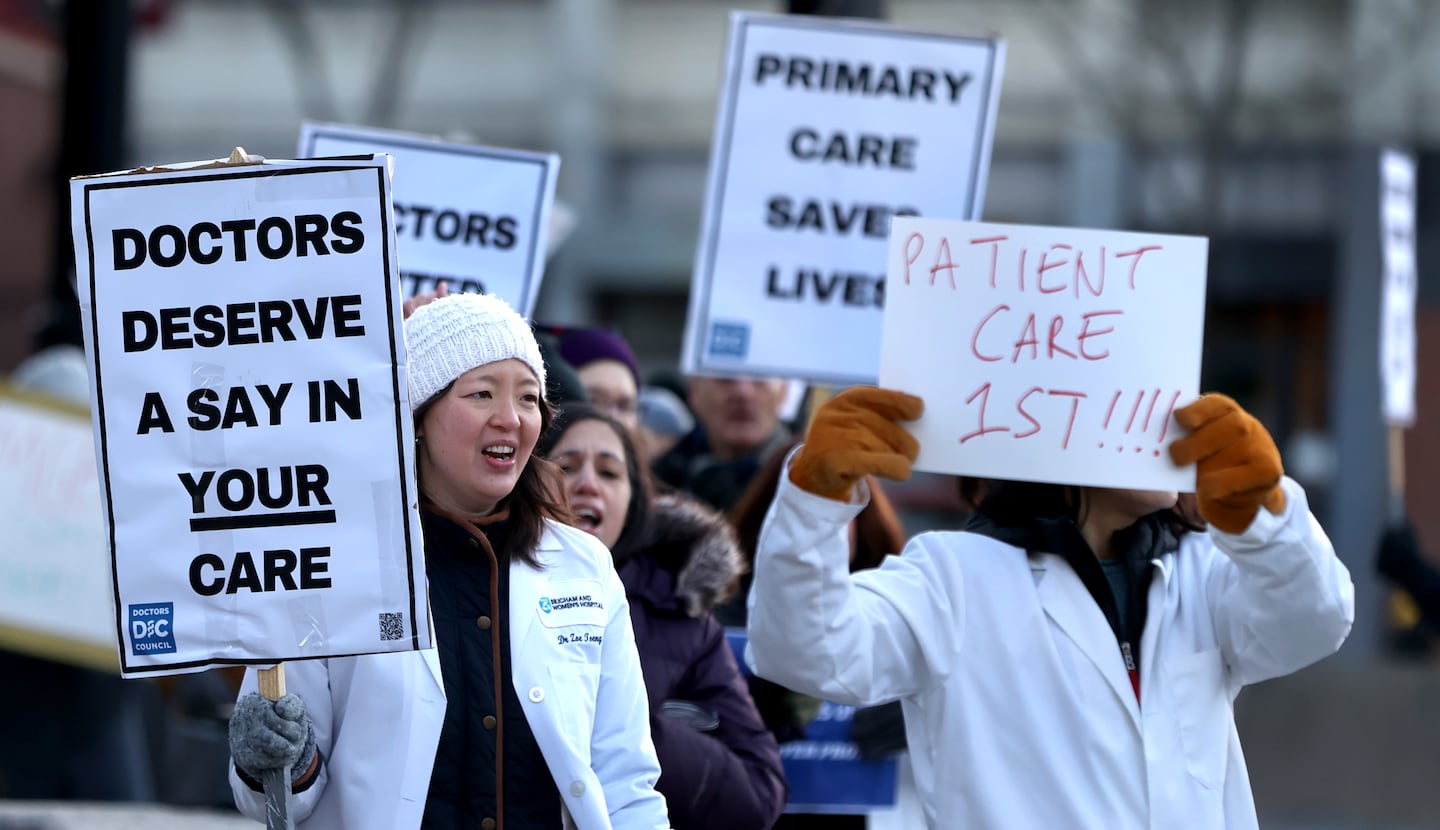
MGB contends many of the doctors who voted 183 to 26 to form the first union of primary care doctors in the state weren’t eligible to do so because of a technical rule. The health system filed the appeal days before the votes were counted. Members of the union call the appeal a delay tactic.
Tseng and two other primary care physicians, Dr. Michael Barnett and Dr. Kristen Gunning, have met virtually with senators and representatives about a dozen times since December. They persuaded three lawmakers, Senator Paul Feeney of Foxborough, Senator Jason Lewis of Winchester, and Representative Sally Kerans of Danvers, all Democrats, to host a briefing on Tuesday where the doctors will speak.
None of the lawmakers were available for comment on Monday.
At the legislative briefing, the doctors said they plan to explain that it’s important for MGB to recognize the union and to begin contract talks because doctors are burning out and need better working conditions, pay, and benefits. They also intend to ask lawmakers to sign a petition pressing MGB to drop its appeal.
“MGB is not going to come to the table on their own, so we’re going to other stakeholders to make the case that we think this [union] is in everybody’s best interest,” said Barnett, a primary care doctor at Brigham.
Barnett noted that state officials and MGB itself have acknowledged that there is a shortage of primary care clinicians in Massachusetts, as there is elsewhere in the country.
Four in 10 Massachusetts residents reported difficulty accessing primary care, according to a study by the Massachusetts Health Policy Commission last January. Wait times for a new patient appointment in Boston stretched to 40 days — twice the average of 15 other cities studied. Governor Maura Healey, in her State of the Commonwealth address last year, mentioned the dire state of primary care, and said she would earmark resources to address it.
Among the many woes identified by the Health Policy Commission: physicians struggling with overwhelming workloads; an aging and burned-out workforce; short-staffed practices; and a meager pipeline of new clinicians.
The situation is unlikely to improve any time soon. Over the next decade, the number of primary care physicians in Massachusetts is expected to rise by less than 4 percent, to 7,940, according to workforce data from the US Department of Health and Human Services.
Economics helps explain the anemic growth. A newly minted doctor can graduate from medical school with easily over $200,000 in debt. To pay it off, many opt to become specialists, who typically earn much more than primary care doctors.
At MGB, primary care doctors say they are also grappling with upheaval at their health system. In particular, they say, MGB’s ongoing effort to merge its two flagship Harvard-affiliated medical centers has left them without a voice in health care policy decisions.
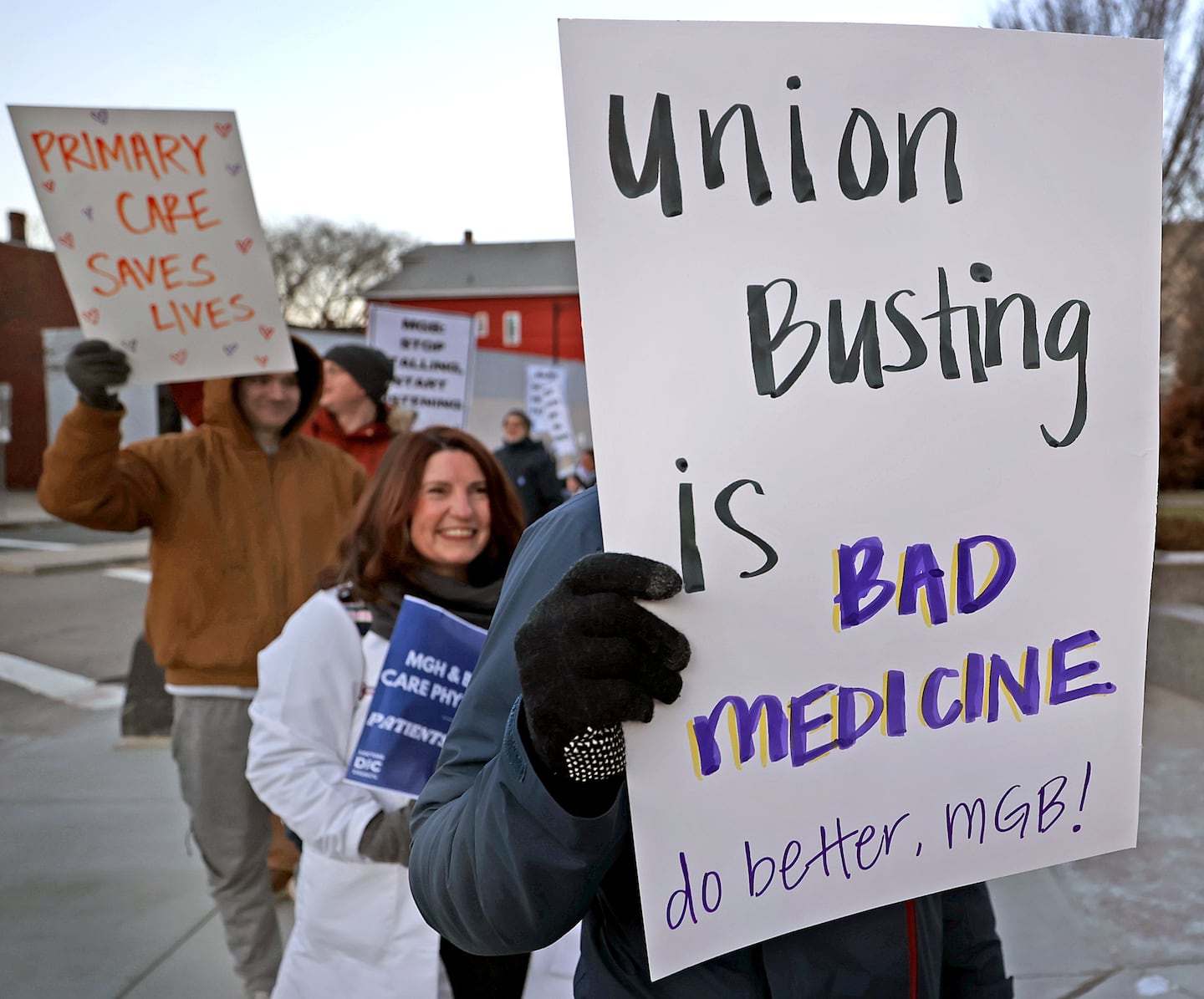 Primary care doctors from Brigham and Women’s and Massachusetts General Hospital picketed in 2024. David L. Ryan/Globe Staff
Tseng says that Brigham in 2023 abruptly closed the Newton medical practice she had worked in for a decade. Tseng, who subsequently moved to a Brigham clinic in the Longwood Medical Area, said she had no say in the matter.
Tseng said she believes the union would give her greater say in how she practices primary care at MGB as well as better pay and benefits and a more manageable work schedule.
She currently has about 1,000 patients whom she treats in a year. She sees patients for roughly 20 hours a week, making her technically a part-time physician. In fact, she actually works close to 50 to 60 hours a week — sometimes late into the night at home — because of all her administrative work. Those duties include checking lab test results, communicating with patients on the phone or on the patient portal, calling in prescriptions, and dealing with insurers, she said.
She said she would “like to see a more reasonable work week and not feel I have to run, after putting my kids to bed, back to work.”
MGB has repeatedly said that it recognizes the crisis in primary care and is taking steps to address it. Last May, after primary care doctors began a weeks-long vote on the union, MGB pledged to invest nearly $400 million over the next five years to enhance primary care.
MGB hasn’t provided a breakdown of how it will spend that sum. But it has cited initiatives such as “Care Connect,” an online platform it launched in September for the 15,000 MGB patients without a primary care doctor.
Care Connect deploys an artificial intelligence app that questions patients, reviews medical records, and produces a list of potential diagnoses. A chatbot that is available 24/7 interviews the patient, then sets up a telehealth appointment with a physician in as little as half an hour.
MGB has also introduced AI-powered note-taking to relieve physicians of much of the burden of filling out medical records.
“We deeply value our physicians and have been working since fall of 2023 to improve the primary care experience based on direct physician feedback,” MGB spokesperson Jessica Pastore said in a statement on Monday.
Nonetheless, MGB isn’t backing off from its appeal of the union vote.
The health system says the NLRB regional director in Boston erred by authorizing as many as 237 primary care doctors at 29 practices to vote on whether to form a union.
In fact, MGB says, as many as three-quarters of those physicians were ineligible to vote under NLRB rules because they work in practices that are integrated into acute-care hospitals with other kinds of doctors. Under the rules, MGB contends, the proposed union would have to include all physicians at those hospitals, an argument the regional director previously rejected.
“We’ve followed National Labor Relations Board procedures from the beginning and will continue to do so as we advocate for consistent application of labor law,” Pastore said on Monday.
For more than six months, MGB’s appeal had been in limbo because President Trump’s firing of one member of the NLRB last January and failure to fill that vacancy and two others had left the five-member labor watchdog without a quorum. In December, however, the Senate confirmed two appointees nominated by Trump. Every Republican voted for the nominees, and all Democrats voted against them.
Jonathan Saltzman can be reached at jonathan.saltzman@globe.com.