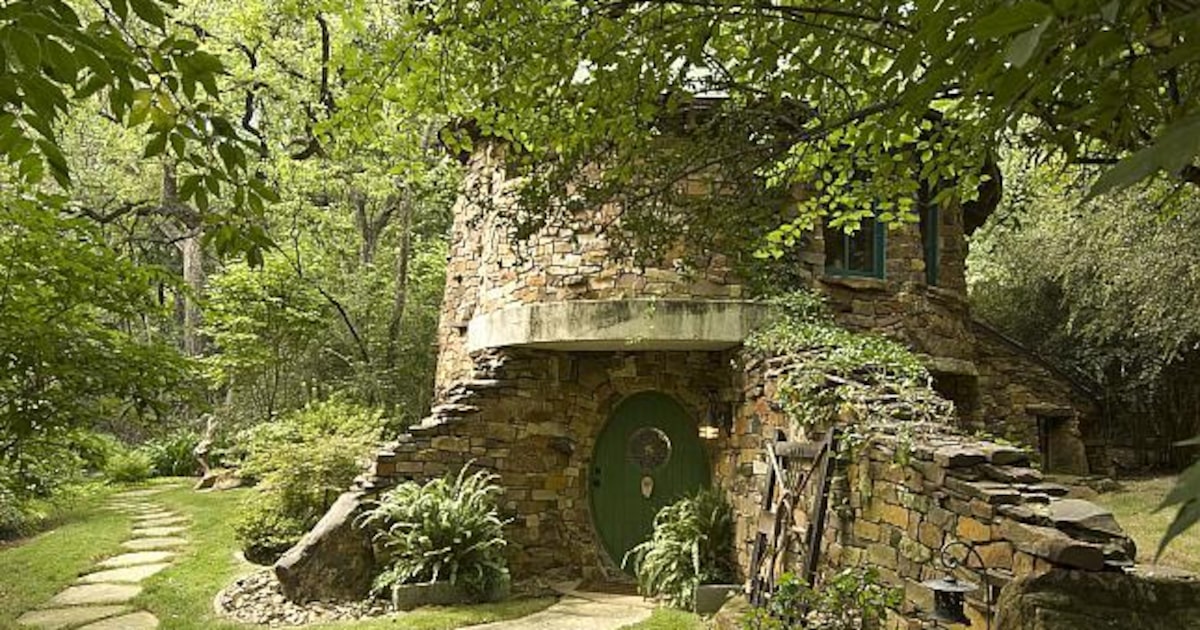
There are dragons in Preston Hollow. A hobbit house, too (though no hobbits) on a sequestered compound that brings a bit of J.R.R. Tolkien’s Middle-earth to a corner of Dallas more accustomed to refined homes of aristocratic pretension.
Step over a moat-spanning drawbridge and through a stone entry gate and you will be transported into a medieval fantasy, with secret rooms, trick mirrors, a full-size musk ox (don’t worry, it’s stuffed) and, of course, dragons. One greets you at the front door, breathing white smoke through flared nostrils.
This magical world is the vision of Phyllis Glazer, 77, a sprightly woman of seemingly boundless energy for whom it has been a continuing project of more than two decades. What was originally conceived to be a thatch-roofed Irish cottage (modeled on a house in the John Wayne film The Quiet Man) transformed into something far more ambitious after Glazer, who had never read any of Tolkien’s epic tales, saw Peter Jackson’s version of The Lord of the Rings and decided to make her home in its quaint image.
“It was an escape,” she says of her building project, speaking from a dining room table long enough (it seats 18) to impress the wizard Gandalf. “It was a mythical place that ends up well, and that’s what I needed — to live in a myth that ends well.”
News Roundups
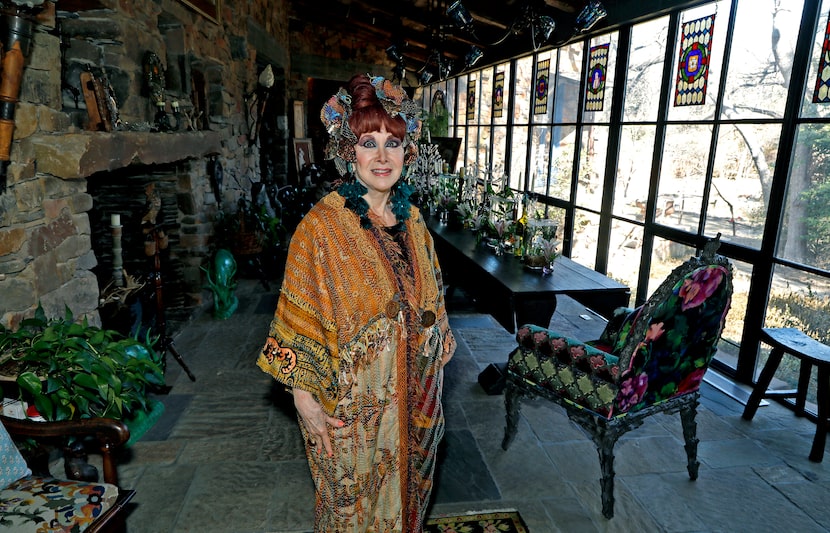
Phyllis Glazer in the dining room of her home in Dallas. She wore flowers in her hair so that her late husband, who had Alzheimer’s disease, would remember who she was.
Stewart F. House / Special Contributor
‘Let her do it, for God’s sake’
When work began on the compound in the early 2000s, Glazer was recovering from a brain tumor and a prolonged environmental battle in the East Texas town of Winona, where she and her husband, Robert Glazer, had a sprawling ranch named for Mel Brooks’ comic Western Blazing Saddles.
Concerns about fumes emanating from a local hazardous-waste disposal site prompted her, in 1992, to form MOSES (Mothers Organized to Stop Environmental Sins). A bitter fight led to the plant’s closure, in 1997, and made Glazer something of a celebrity, featured on NBC’s Dateline and named one of Texas Monthly’s 20 most influential figures that year. The experience, however, was traumatic, leaving her emotionally scarred and fearing for her safety. For months, she traveled with a bodyguard.
“If I survive,” she told her husband, “I want to build a house and do it on my own. I’ve got to have my own life.”
A free spirit, she bristled at being, in her words, a “North Dallas housewife.” The daughter of Holocaust survivors, she had grown up in Tucson and came to Dallas in 1977 as a 29-year-old divorcée looking to reinvent herself. Her mother suggested she contact Glazer, a family acquaintance who ran a successful liquor-distribution business.
She declined. “Call some poor man who doesn’t know me from Adam and say, ‘I’m here, I’ve got two children and a parakeet, do something with me’?” she recalls telling her mother. “I’m not going to do any such thing.” Eventually they met, and it was the match her mother had imagined.
But convincing him to go ahead with the house project took some effort. He was initially “terrified,” according to Glazer, and only acceded after a psychiatrist friend advised him to trust her vision. “You can afford to let her do whatever she wants,” the friend told him. “Let her do it, for God’s sake.”
He died of Alzheimer’s disease in 2009, three years after moving in. What he had feared had become something he loved deeply. “He would call up one of his friends to come over and see it,” says Glazer, “and then he’d be yelling, ‘Phyllis, come explain what this is.’”
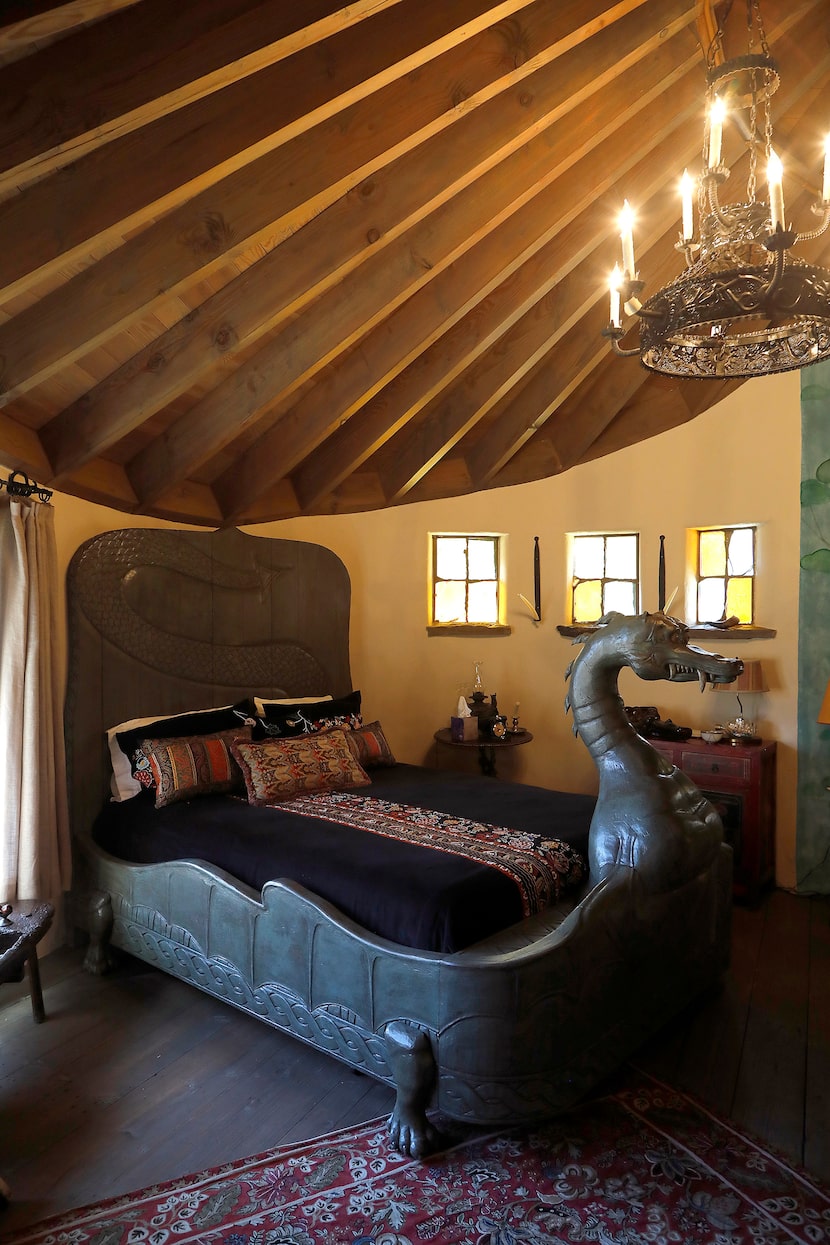
A hand-carved Smaug bed.
Stewart F. House / Special Contributor
‘Sometimes we look back to look forward’
While the house was the product of Glazer’s eccentric vision, she had professional help in its realization. “There were so many artists and artisans involved here,” she says. “The most medieval thing about the house is its making.”
First among those was Dallas-based architect David Stocker, who typically designs more modern homes but was intrigued by the prospect of going back in architectural time. “Sometimes we look back to look forward,” he says. Working with Glazer, whom he describes as a “funky, beautiful personality,” was its own reward. “She’s just a whimsical, outside-the-box thinker.”
The house they designed blends elements from a variety of antique building types — barns, castles, church ruins — into a composition shaped like a giant crab, with pincer-like arms projecting out around a landscaped courtyard with a faux-bois fountain at its center. (Faux-bois is a technique of using concrete to look like wood.) Dallas permitters would not approve Glazer’s desired thatched roof, so Stocker created an undulating slate roof punctured by antique-style chimney pots. “That’s the closest thing to Disney there is,” says Stocker.
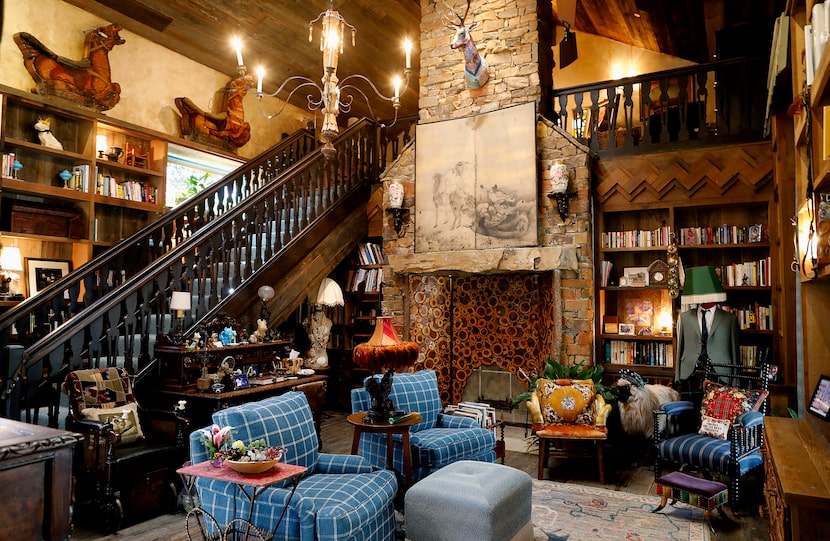
The library has a hidden door in the fireplace.
Stewart F. House / Special Contributor
Remarkably, a house that might have descended into kitschy pastiche never does. In part that is because of the pains taken to employ materials and methods authentic to the medieval period.
Stone walls, for example, are laid without mortar, or dry stacked, in irregular patterns, with bits of sculpture and glass bottles inserted for character. (The bottles were an homage to the family’s liquor business.) Stocker drew the plans for the stone by hand, rather than on a computer, so the design would appear more natural.
Interior walls are roughly plastered and painted using historic standards. Iron door hinges, locks and pintles were forged by Ron Siebler, the beloved Dallas do-everything building craftsman. Even the plumbing is antique.
What ultimately keeps the house from feeling hokey or trite is Glazer’s commitment to her all-encompassing taste. Its theme isn’t so much “hobbit” or “Middle-earth” as it is “Phyllis Glazer.”
To wit: there is hardly a space or surface free of some ornament or object, and much of that material is not medieval at all. Wooden floors are recycled from a 19th-century Heineken factory. The library is modeled on an Adirondack lodge. A kitchen table is the glass-topped face of a 19th-century Parisian clock tower set on the base of an antique, adjustable-height dentist’s chair. (The clock, it should be noted, keeps computer-assisted time.) An adjacent pantry is animated by the door of a London delivery truck with faded signage that reads “Cooked Meats and Sausage.”
None of these things have any relation to Tolkien’s fictional universe, but even if they are anachronistic, they reinforce Glazer’s imaginative gestalt.
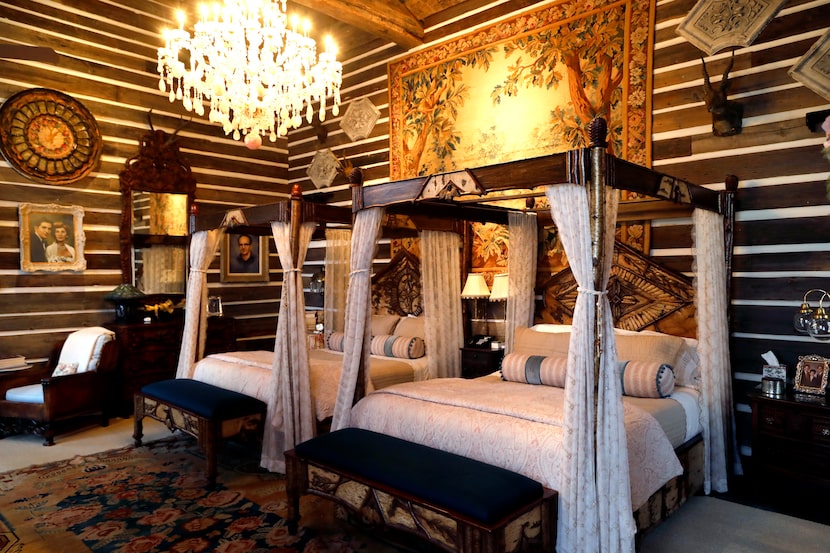
The cabin-style master bedroom.
Stewart F. House / Special Contributor
‘That’s not hobbity enough’
Assembling this dizzying array of objects was a grand project, a mission on which Glazer was accompanied by interior designer Adrienne Morgan, who was on Stocker’s staff when the project began but founded her own firm soon after. For a time, Glazer was the firm’s only client. “Her project was so massive and time consuming that it kept us busy full time,” Morgan says.
Morgan and Glazer spent months traveling together through the United States, France, England, Scotland and Ireland, scouting antique fairs and dealers, flea markets, junk shops and old manor houses selling their patrimony.
“We worked every day,” Morgan recalls, “from the beginning of the morning until night, looking and looking and looking.”
Glazer proved an exacting customer. “I would find pieces to show her and she would reject them,” Morgan says. “She would say, ‘No, that’s not whimsical enough,’ or ‘That’s not hobbity enough.’ She used the word hobbity.”

The glass conservatory.
Stewart F. House / Special Contributor
The fruits of those trips are everywhere apparent in rooms that vary widely in their fidelity to Tolkien’s narratives.
The great room of the house, a space inspired by the forest city Caras Galadhon in The Lord of the Rings, boasts a cathedral ceiling that soars 40 feet in the air and is crossed by branches, tree limbs and vines. Pin lights in the ceiling give the impression of the night sky. The study, meanwhile, has a charming mural, by artist Lynn McLain, of the magical elvish valley of Rivendell.
Shifting away from the Middle-earth aesthetic, the master bedroom is in the style of an Adirondack cabin, with a half-timbered ceiling, a stone fireplace topped with a driftwood lintel and his-and-hers four-poster beds. Why two beds? “My husband snored a lot,” says Glazer. The library shares the bedroom’s woody aesthetic, as do a pair of rooms accessed through a hidden door in its fireplace.
The home’s most enchanting room might be its glass-enclosed conservatory, a miniature forest dense with ferns and tropical plants selected by Glazer and landscape architect Rosa Finsley. Floating above is a stained-glass dragon mobile created by Siebler and artist Jeff Green.
The conservatory opens out to a small woodland — call it Glazer Shire — bisected by a small creek. Crossing it, a stone path leads up a gentle incline to the Hobbit House, a cylindrical stone guest cottage with an oval door (painted green, of course) and round windows. Is Bilbo Baggins inside? No, but there are other attractions. A staircase winds up to a bunk room, or cell, set behind an iron prison gate once used at the French penal colony of Devil’s Island. A level above is a larger guest room with a hand-carved bed that takes the form of Smaug, Tolkien’s treasure-hoarding dragon. Visitors can descend from that room to the ground floor on a slide that corkscrews around the central stair.
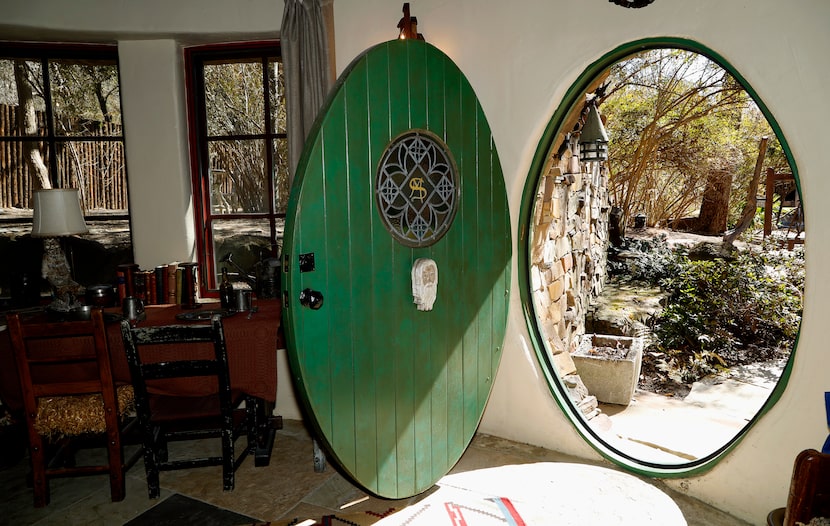
The green front door of the hobbit-styled guest cottage.
Stewart F. House / Special Contributor
The architect Morris Lapidus, designer of Miami’s most flamboyant hotels, lived by the mantra that “too much is never enough.” While that philosophy may not be for everyone, it thankfully is for some people, and Phyllis Glazer is assuredly one of them. Dallas could use more such figures, if not more hobbit houses.
It seems, however, the city is becoming ever more conventional, with cookie-cutter housing developments and overgrown homes that look like they were pulled from an upscale catalog. Earlier this year, the “Mushroom” or “Smurf” house designed by Tom Workman for a prominent corner in Highland Park, was torn down for something that will surely be less inventive.
“Maybe we’ll find a group of wealthy people who say, hey, we should do houses that are interesting and not just like every other house,” says Stocker. “That would be great.”
Glazer’s home, in its commitment to its idiosyncratic spirit, stands as a model for this kind of patronage. Just don’t try to copy it.
Related

Related

Related