

Artificial intelligence is speeding up the search for sustainable magnetic materials, a critical innovation that could reduce the global reliance on rare earth elements. Researchers from the University of New Hampshire have developed an AI tool capable of rapidly identifying new compounds, unlocking a treasure trove of previously unknown magnetic materials. Their findings are set to impact industries ranging from electric vehicles to renewable energy systems.
At the heart of the discovery is a new resource called the Northeast Materials Database (NEMAD), a vast collection of over 67,000 magnetic materials. This database, created using artificial intelligence, includes 25 newly identified compounds that retain their magnetism at high temperatures, an essential feature for many advanced technologies. The significance of this work lies not only in its potential to discover sustainable alternatives to rare earth magnets but also in its promise to drive down costs in industries that depend on these materials.
Reducing Dependence on Rare Earth Elements
Many of today’s most powerful permanent magnets are made using rare earth elements, resources that are costly and difficult to secure. These elements are critical for technologies such as smartphones, medical devices, and electric vehicles, but their limited availability poses a major challenge to industries reliant on them. According to lead author Suman Itani, a doctoral student in physics at the University of New Hampshire, finding sustainable alternatives to these rare earth magnets could significantly lower costs for electric vehicles and renewable energy systems.
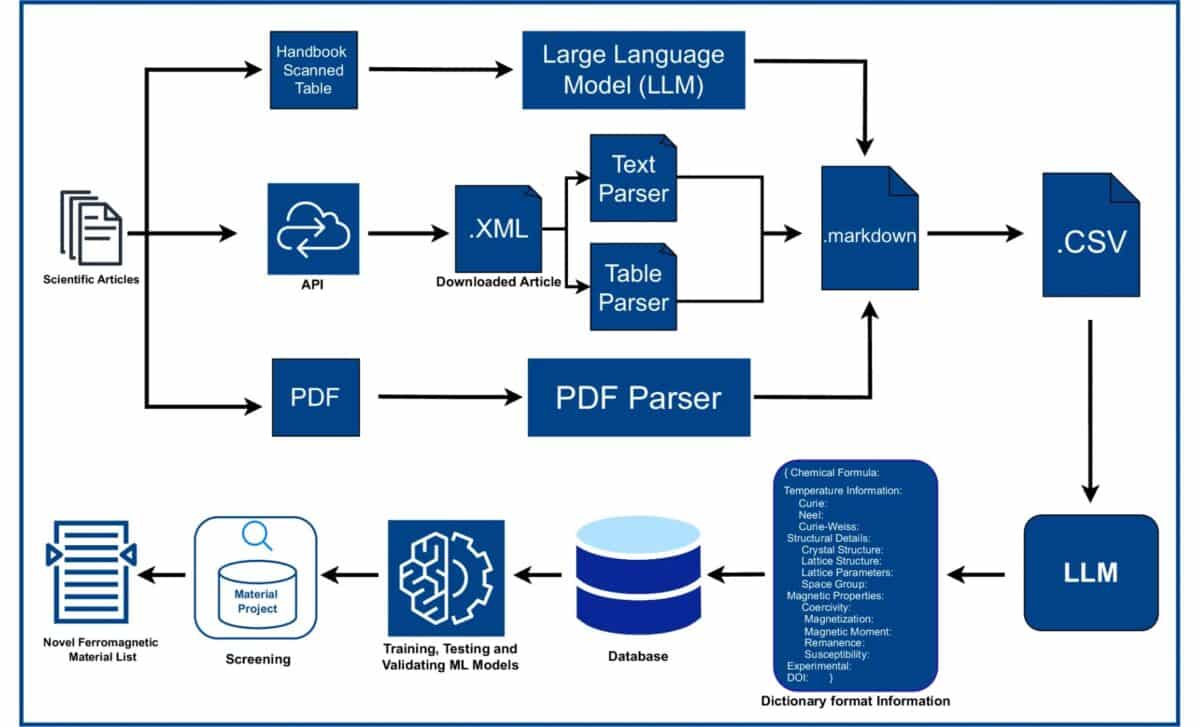 Process for Building and Analyzing a Magnetic Materials Database. ©Nature Communications
However, discovering new magnetic materials is far from simple. The sheer number of possible combinations of elements makes the search incredibly time-consuming. Traditional methods of identifying these materials are expensive and slow. But by using artificial intelligence to sift through decades of scientific literature, researchers have accelerated the discovery process. This new approach allows for the extraction of critical data from past studies, providing a much faster way to identify promising candidates that would have taken years to uncover through laboratory testing.
The Power of AI in Material Science
To speed up the process, the team at the University of New Hampshire trained an AI system to analyze scientific papers and extract key experimental details related to the magnetic properties of materials. The AI’s ability to quickly scan vast amounts of research and distill essential information has resulted in the creation of the NEMAD database, which includes 67,573 entries. This resource is designed to help researchers identify magnetic materials with high Curie and Néel temperatures, thresholds that determine how much heat a material can withstand before losing its magnetism.
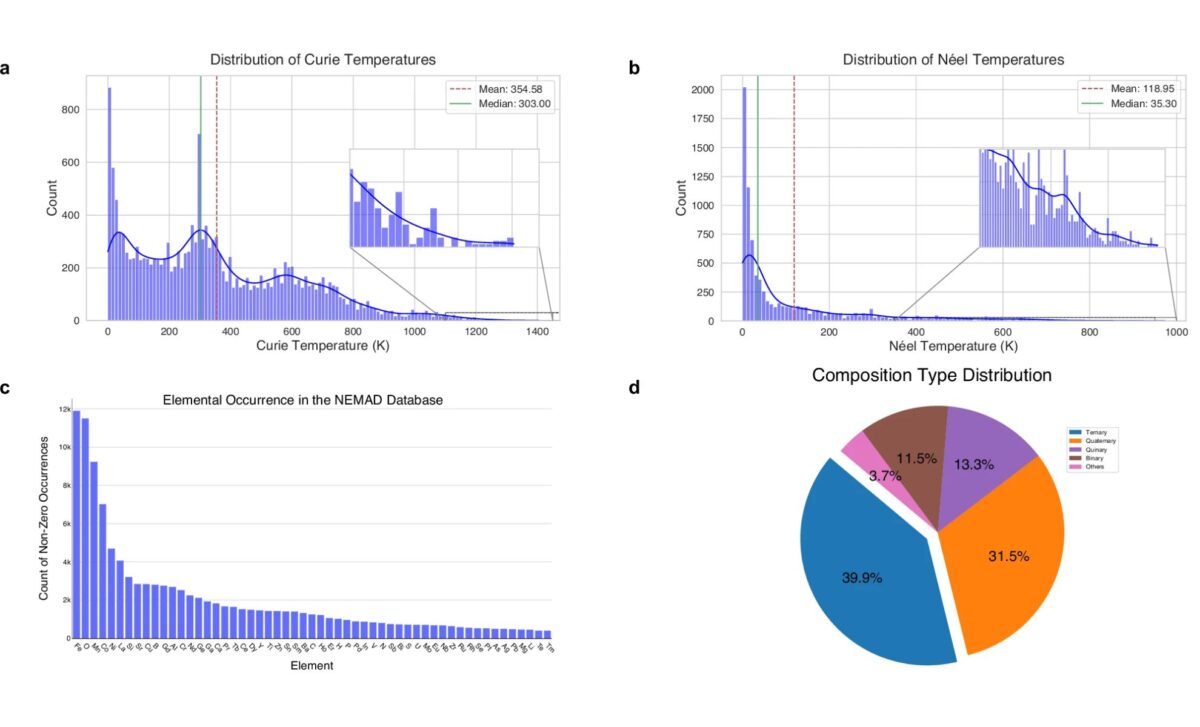 Comprehensive analysis of the NEMAD database. ©Nature Communications
The AI tool extracts experimental data from scientific publications and uses it to predict the behavior of different materials. This allows researchers to determine which compounds have the potential to be developed into permanent magnets without relying on rare earth elements. According to co-author Yibo Zhang, a postdoctoral researcher in both physics and chemistry, the combination of AI and machine learning models offers a powerful tool for accelerating the discovery of sustainable magnetic materials.
Implications for Technology and Industry
The implications of this breakthrough are far-reaching. High-performance magnets are essential in many modern technologies, from the motors in electric vehicles to the turbines in renewable energy generators. The ability to identify materials that can operate at high temperatures (without relying on rare earth elements) could revolutionize these industries. For example, as renewable energy systems become more prevalent, the demand for powerful magnets in wind turbines and power generators is expected to grow. AI’s ability to identify new, more sustainable materials will play a critical role in meeting this demand while lowering costs.
Jiadong Zang, a physics professor and co-author of the study, emphasized that the success of the AI-driven database represents a major step forward in materials science. By enabling quicker and more efficient screening of materials, the research team believes they can contribute to the development of next-generation magnetic materials that are both efficient and environmentally friendly.
As the research progresses, the NEMAD database will continue to grow, potentially uncovering even more compounds that could be used in the development of rare-earth-free magnets. With AI’s power to analyze vast datasets, researchers are poised to make further advances in this field, helping to shape a future where technology relies less on finite and costly resources.