
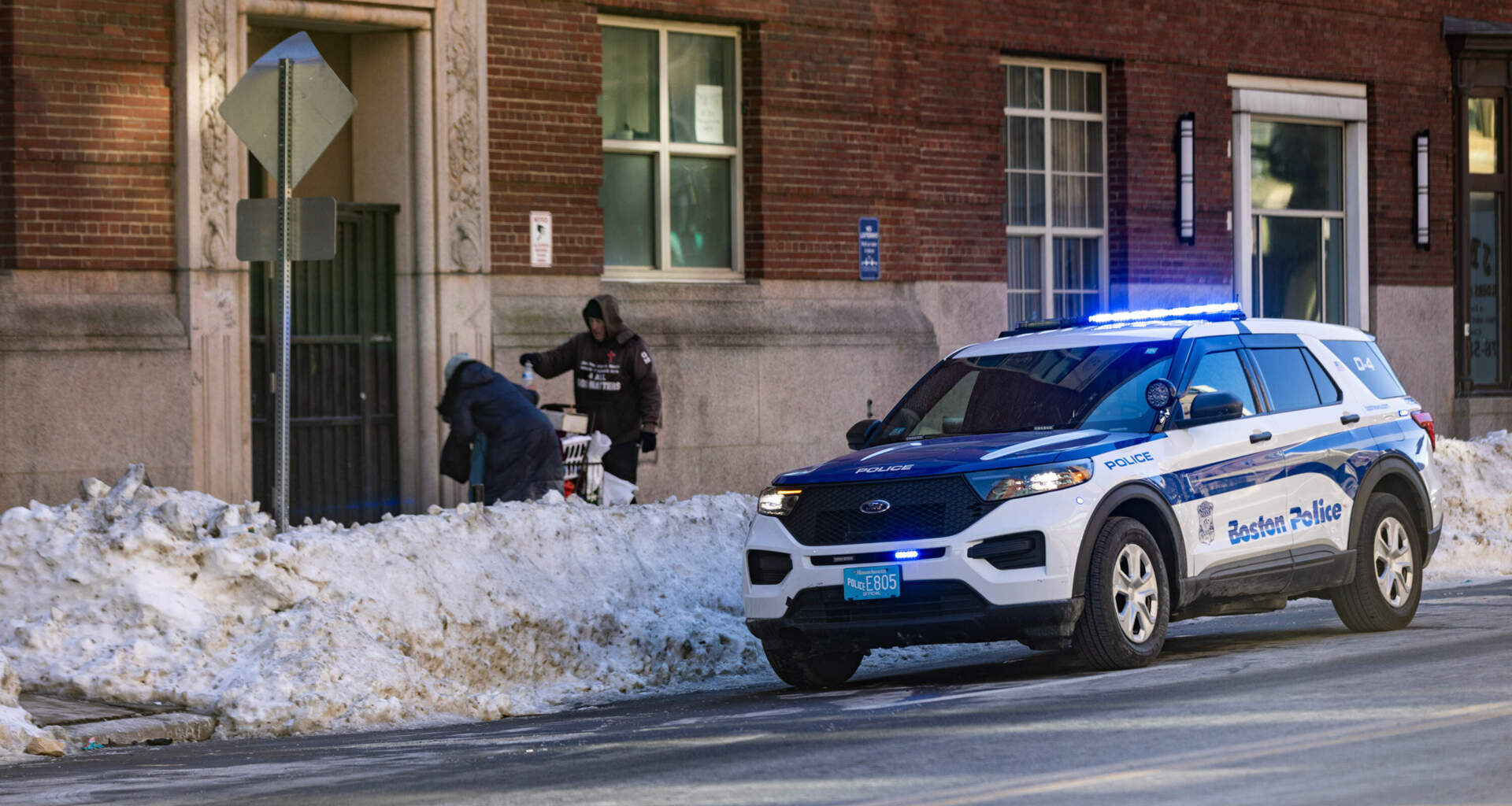
A shift in official strategy at Boston’s beleaguered “Mass. and Cass” neighborhood is pressuring people into addiction treatment, say health experts, who worry the new tactics will lead to more overdose deaths and disease.
Some people who frequent the area around Massachusetts Avenue and Melnea Cass Boulevard told WBUR that Boston police have been approaching those on the streets more often than usual in recent months. Many have been given an ultimatum: Go to jail, or check into detox.
But for many, detox is a revolving door, and they quickly end up back on the streets.
“It’s so disappointing,” said Traci Green, an epidemiologist with the Opioid Policy Research Collaborative at Brandeis University. “It’s a return to a law enforcement based approach, and we’ve been there before.”
The intersection has long been a symbol of the ravages of the opioid epidemic, and is also home to a concentration of addiction, mental health and housing services. For more than a decade, the city has taken various steps to address the problems that at times have included large tent encampments. When Boston Mayor Michelle Wu was elected in 2021, she said she favored an approach that prioritized public health, offering people housing and social services until they were ready for addiction treatment.
But the new strategy, which city officials call an “addiction first” approach, seeks to address drug use before providing other services. The city credits the shift with reducing public drug use and getting more people into treatment. City officials point out that the area is no longer the site of the encampments that, a few years ago, were described as a humanitarian crisis.
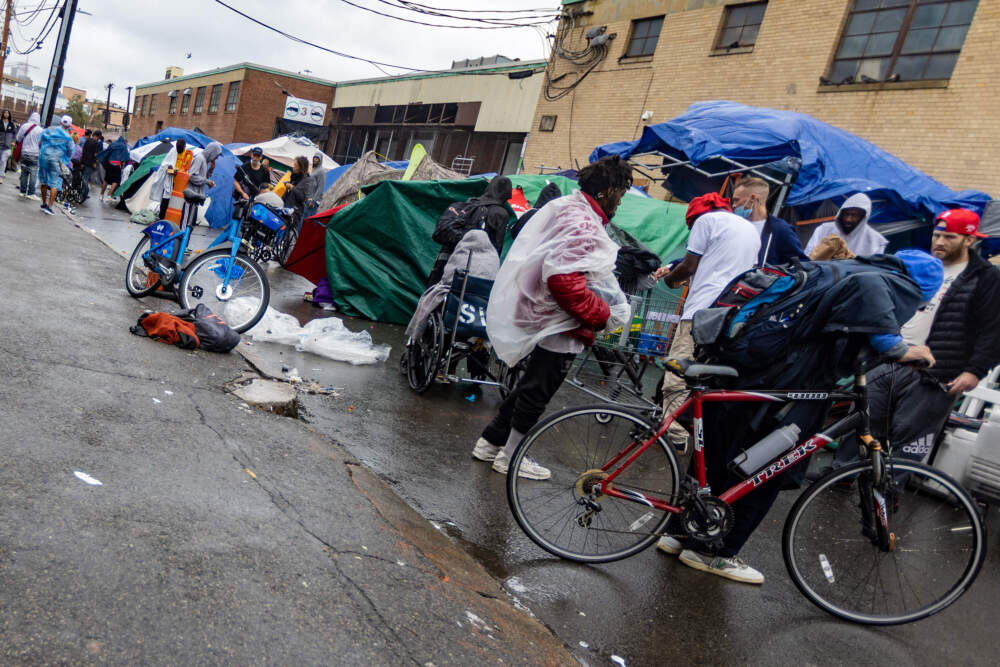 In August 2023, a tent encampment took hold on Atkinson Street in the area of “Mass. and Cass” in the South End. It has since been dismantled. (Jesse Costa/WBUR)
One woman who often spends time near “Mass. and Cass” described being stopped by police twice in the past two months. She said she wasn’t doing anything illegal when she was approached by officers.
“I was just standing on the sidewalk, and they said, ‘Well, you can go to jail or go to detox,’ ” said E. WBUR agreed to identify her only by her first initial because she fears retribution by the police and struggles with substance use.
E., who is 28, said she asked the officers why she would be sent to jail. She had no illegal drugs and said police had no outstanding warrants for her arrest. The officers told her that because she had a syringe, she could be charged with drug possession. E. opted for detox.
The officers took her to a red and white van parked a few blocks away, where she waited for about an hour while workers from the city’s Coordinated Response Team looked for an open detox bed. E. said they ordered an Uber to take her to a facility in Quincy, but when she arrived, she walked across the street to a train station and headed back to “Mass. and Cass.”
“Didn’t even walk in the door,” of the detox, E. said.
E. described a similar encounter with police two weeks later. She was again taken to the van, and an Uber driver brought her to a detox. That facility was farther away, so E. said she checked in, but left before completing the program.
“I slept for a couple days in the detox until I couldn’t sleep anymore, and I discharged myself,” E. said.
After she left, she took the commuter rail back to Boston, and E. said there’s been no follow-up from detox staff.
“I was just standing on the sidewalk, and they said, ‘Well, you can go to jail or go to detox.”
E., a woman who frequents ‘Mass. and Cass’ for services
E.’s story is not unusual, according to Abigail Judge, a clinical psychologist who co-runs the Boston Human Exploitation Advocacy Team, a collaboration between Massachusetts General Hospital and city police. The program works to build trust with women at the intersection of active addiction and the commercial sex trade.
Judge said she’s heard from several clients who opted for detox over potential arrest, but left early or were never admitted. She said the city should not be sending people to detox without knowing their history. And Judge said the strategy is especially ineffective for women who have been trafficked because they may not readily accept treatment.
“We really feel strongly that you need to build a relationship with someone before you can even know where they are with respect to what kind of treatment they’re open to, let alone what will be effective,” Judge said.
She added that forcing women off city sidewalks can put them in danger. Over the past year and half, she said seven women from her program have died — two were murdered. She worries that the city’s crackdown is forcing people to remain in risky situations with abusers or traffickers because they fear being stopped on the street.
“The women we support are not necessarily safer because they’re out of view,” Judge said. “In fact, they might end up having to be with individuals who are less safe because of a lack of options.”
Officials with the city team that works on Mass and Cass denied that the new strategy is a shift away from a public health approach. They described it as a culture shift that reinforces the message that “Mass. and Cass” is not a place to gather or use drugs. They said they meet regularly with nonprofit leaders, health care advocates and addiction service providers to discuss their efforts, which they said are helping those struggling with addiction while protecting the surrounding neighborhoods.
Many aspects of Boston’s latest approach to “Mass. and Cass” were implemented in September, after residents of the nearby South End complained about public drug use. The city took several steps, including increasing law enforcement patrols and cameras, expanding involuntary commitments to mental health and addiction treatment, restricting volunteers from handing out food and supplies, and reducing clean needle distribution.
Boston officials also entered a partnership with the Gavin Foundation, a substance use treatment provider, to reserve treatment beds for people sent by the city.
“The City recognizes that sustained commitment of significant police resources is necessary to address ongoing quality of life and public health concerns,” Boston’s Coordinated Response Team wrote in a memo to the Boston City Council in September.
 In August 2023, Mayor Michelle Wu, with Police Commissioner MIchael Cox to her right, outlined her approach to solving the crisis at Mass and Cass during a press Conference at the Base in Roxbury. (Jesse Costa/WBUR)
Coordinated Response Team officials declined to be quoted for this story but told WBUR the new approach is working. They pointed to a drop in people on the streets near “Mass. and Cass,” although that’s typical in colder months. They also said the city has invested heavily in improving the neighborhood, and since September has placed more than 420 people in treatment, the first step of which is often detox.
But many of those who work with people who are unhoused or experiencing substance use disorders questioned the value of sending hundreds to treatment if there’s little follow-up.
“That number is a huge number,” said Sarah Porter president and CEO of the nonprofit Victory Programs. “It raises questions for me.”
Porter said she has not seen a corresponding increase in people needing post-detox services, which makes her wonder how many people, like E., may be checking themselves out of detox after a few days or never walking in the door.
Boston officials seemed to acknowledge the gap. The city’s working group on addiction, recovery and homelessness, established in 2015, is reviewing the city’s strategy and is expected to release recommendations on improvements later this month. Those are expected to include better tracking and case management of people the city sends to treatment, and the creation of a special “recovery” court to enforce treatment compliance.
“We understand that we have a hole in the system as to when somebody is discharged from detox,” said Stephen Fox, a co-chair of the working group. “We need to manage them into a residential treatment program and we know it’s not working right now.”
Porter and other addiction experts said they are also concerned about people forgoing services because they don’t want to encounter police on the street, which raises the risk of overdoses. Porter said the city’s crackdown, coupled with fear about increased federal immigration efforts, has made people reluctant to seek help.
“People are now sheltering in place because if I know that I run the risk of getting picked up by coordinated response or by the police, or you know, God forbid, by ICE, I’m not going to take the chance and I’m going to stay where I am,’ ” Porter said.
Boston police said while there are more officers and more enforcement in the area since September, officers are not just rounding up people and demanding they go to detox. They said they work with area service providers to try to get people the help they need and keep the nearby neighborhoods safe.
“We’re trying to protect the health of the people out there and the health of the surrounding neighborhoods,” said Boston Police Department spokesperson Mariellen Burns.
Hundreds of health care workers also criticized the city’s restrictions on clean needle distribution. Addiction and primary care physician Dr. Avik Chatterjee was among nearly 400 signers of an op-ed submitted to several media organizations and the mayor’s office saying the policy is “short sighted,” and could result in outbreaks of diseases such as HIV and hepatitis C, which are spread by using dirty needles. Chatterjee said research has linked limited access to sterile syringes with disease outbreaks.
“I think we’re flirting with an HIV outbreak,” Chatterjee said.
Chatterjee added that more clean needles are needed now than a decade ago because fentanyl requires users to inject more frequently. He said he finds it disappointing that Boston is changing its tone after a July order from President Trump which called for defunding harm reduction, a type of services designed to keep people who use drugs alive, often while encouraging — but not requiring — them to seek treatment.
“It’s really sad that the unsupported claims that harm reduction doesn’t work in the Trump executive order are now things that our Massachusetts public health officials are seeming to fall behind on uncritically,” Chatterjee said.
Clarification: The program for women involved in the commercial sex trade and struggling with addiction is now known as the Boston Human Exploitation Advocacy Team.