
During the 2024 campaign Donald Trump repeatedly promised not just to end inflation but to reduce prices. Unfortunately, enough voters believed him to put him back in the White House. Predictably, he has utterly failed to deliver.
Equally predictably, his response to this failure has been an attempt to gaslight the public. Reuters reports:
In five speeches on the economy since December, Trump asserted that inflation had been beaten or was way down almost 20 times and said prices were falling almost 30 times, assertions at odds with economic data and voters’ daily experiences.
It isn’t working: 52 percent of Americans say that Trump’s policies have made the economy worse, while only 28 percent say that he’s made it better.
And plunging approval on the economy isn’t the only way in which stubborn inflation, currently hovering close to 3%, hurts Trump. It also undermines any case for the Federal Reserve to deliver a big cut in short-term interest rates — which Trump constantly and threateningly demands. Granted, the Fed cut rates in 2024 and 2025 in response to a steep decline in inflation from its 2022 peak. But there’s little justification for further cuts, especially big ones, with inflation stubbornly above the Fed’s 2 percent target.
So what can Trump’s yes-men do?
Trump hasn’t made a rational argument for lower interest rates. Instead, he seems to believe that rate cuts should be his reward for overseeing a “hot” economy – like a third-grader given a gold star for acing a quiz. Understanding that this makes no sense, Trump’s economy-policy minions have converged on a different, ostensibly more economically rational reason to cut interest rates: AI.
Recently Scott Bessent, the Treasury secretary, Stephen Miran, who Trump appointed to the Federal Reserve Board, and Kevin Warsh, his choice as Fed chair, have all argued that the coming AI-led boom in productivity justifies slashing interest rates now. The script goes like this: AI will lead to a surge in productivity; higher productivity will reduce production costs and thereby reduce inflation; and the coming fall in inflation justifies much lower interest rates now.
I will admit that this story isn’t completely nonsensical, unlike what Trump has been spouting. Yes, AI could reduce production costs and, other things equal, reduce inflation. However, both theory and historical experience say that the supposed benefits of AI aren’t a reason to cut interest rates now and almost certainly won’t be a reason to cut them in the future.
First, it’s dangerous to base policy on the assumption that AI will sharply raise productivity growth. That would be a serious case of counting your digital chickens before they’re hatched. AI might deliver big productivity gains, or it might not. Nobody knows yet.
Moreover, we know that right now the boom in AI spending is raising many prices. Demand from data centers has been driving soaring electricity prices. And data center demand for memory chips, which are essential for almost every consumer electronics product, has caused an apocalyptic shortage, with prices roughly tripling — a cost that will be reflected in the price of your next laptop or smartphone.
As for promises of a productivity bonanza, it’s instructive to look at the history of productivity as measured by the Bureau of Labor Statistics, which calculates growth rates between business cycle peaks:
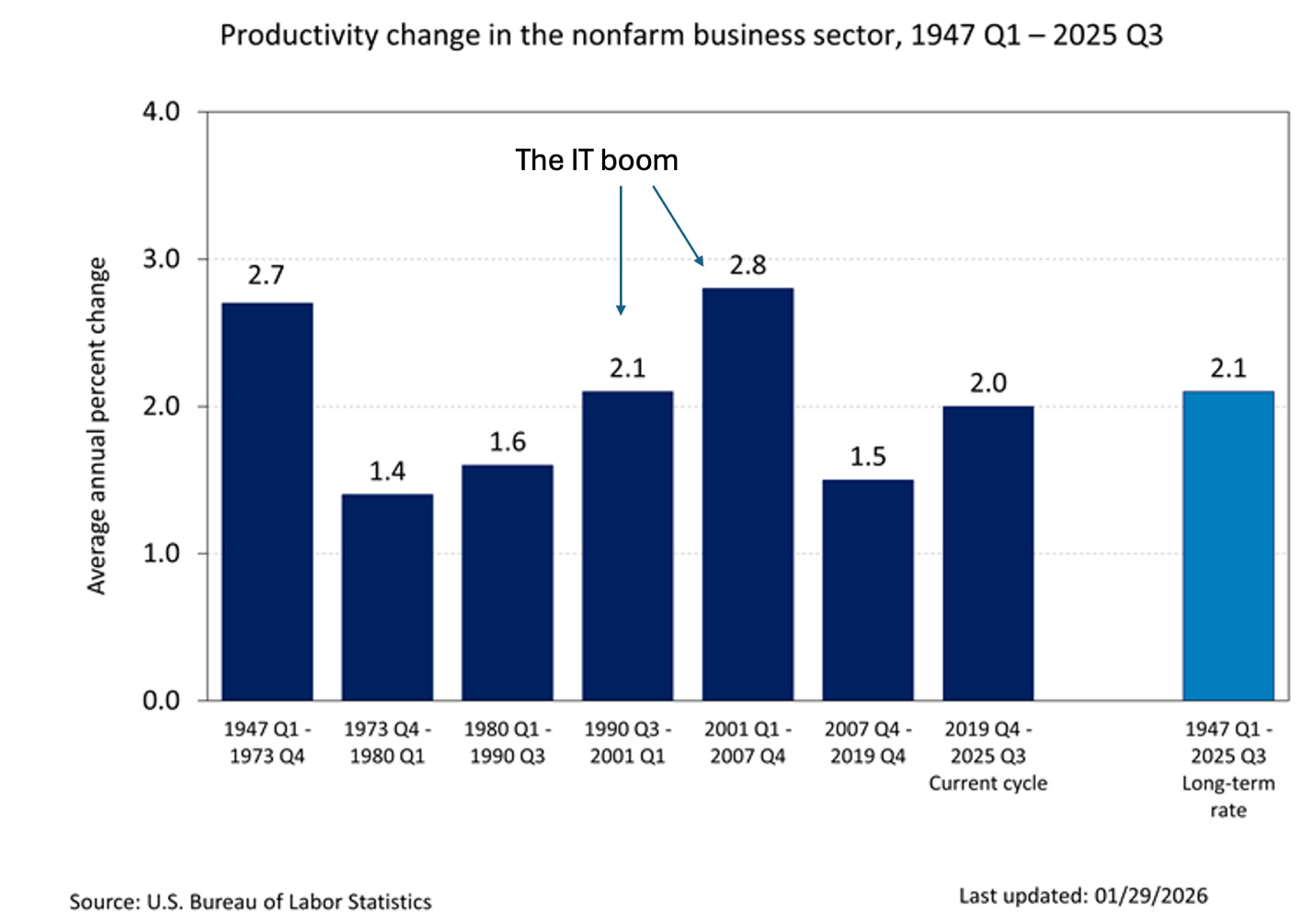
Information technology, including but not limited to the internet, did lead to a burst of productivity growth in the 1990s and 2000s. AI enthusiasts point to that burst as a precedent for what they claim AI will do now.
But look at what happened after 2007. Technological change didn’t stop. Notably, this era was marked by the rise of smartphones — the first iPhone was introduced in 2007 — which changed our lives and society (in many ways for the worse, but still). But the macroeconomic payoff to the mobile internet and other post-2007 innovations is invisible in the data. This is a general observation: The economy is huge and diverse, and flashy, attention-grabbing technologies often don’t matter as much as one might expect. In fact, the productivity boom that began around 1995 largely involved distinctly unglamorous applications like inventory management at Walmart.
Second, even if AI does end up driving a major acceleration in productivity growth, this is likely to require higher, not lower, interest rates.
Why? Accelerated productivity growth would indeed reduce the inflation rate, other things equal. This might allow policymakers to run an economy with low unemployment and tight labor markets, as Alan Greenspan did in the late 1990s. But while it’s possible for new technologies to reduce inflation by reducing production costs, they also raise prices by driving higher investment spending by business, which can lead both to shortages of particular goods like memory chips and overheating in the economy as a whole. The 90s technology boom led to a very large rise in business capital expenditure — mostly carried out by telecoms, not dotcoms — as a share of GDP:
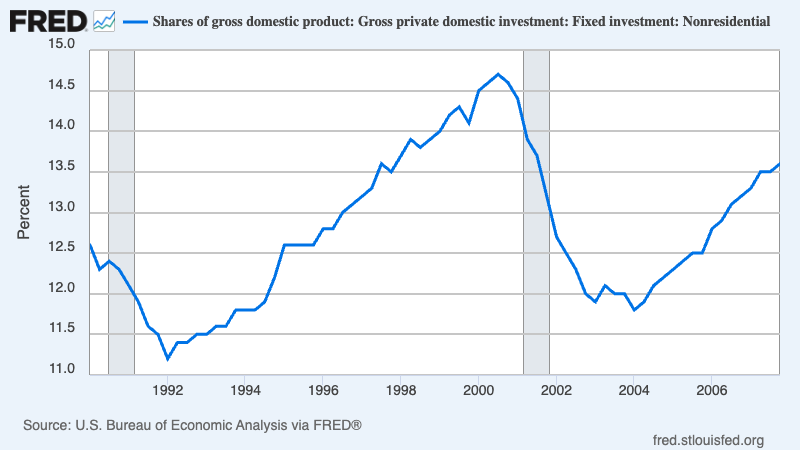
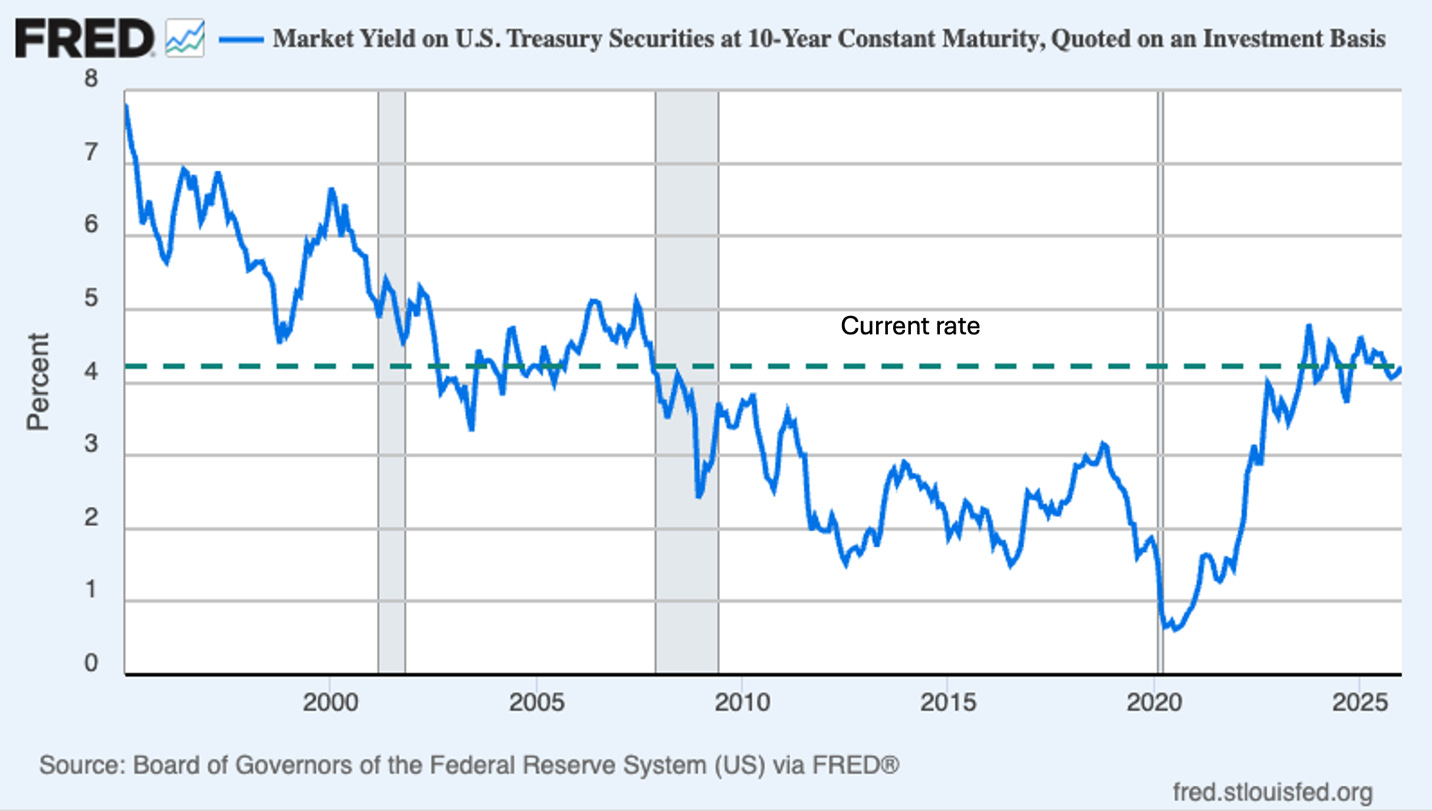
High levels of business investment, in turn, meant that interest rates had to stay relatively high by today’s standards to avoid inflationary overheating. Contrary to what you sometimes read, Greenspan didn’t cut interest rates during the 90s boom, except for an emergency cut during the LTCM crisis. All he did was refrain from raising rates despite historically low unemployment. And long-term interest rates remained high compared with rates now — whereas they slumped during the post-2007 productivity slowdown:
And while the productivity payoff from AI is still speculative, massive capital expenditure driven by AI dreams is already happening, on a scale that raises questions about where the money (not to mention the electricity and the chips) will come from.
So no, AI doesn’t justify interest rate cuts, and certainly not the huge cuts Trump demands.
And the alacrity with which Trump officials have jumped on the argument that the Fed should slash rates because of AI is troubling for reasons that go beyond the fact that they’re wrong. Consider how this argument became popular in Trumpworld. Did Bessent, or Warsh, or Miran carefully consider the evidence, and advocate an interest-rate policy based on what that evidence showed? Of course not. Their boss wants to slash interest rates, so they went looking for plausible-sounding economic arguments that might rationalize his whims.
So am I saying that the argument that AI justifies rate cuts is dishonest, that AI has become the last refuge of scoundrels? Why yes, I am.
MUSICAL CODA