
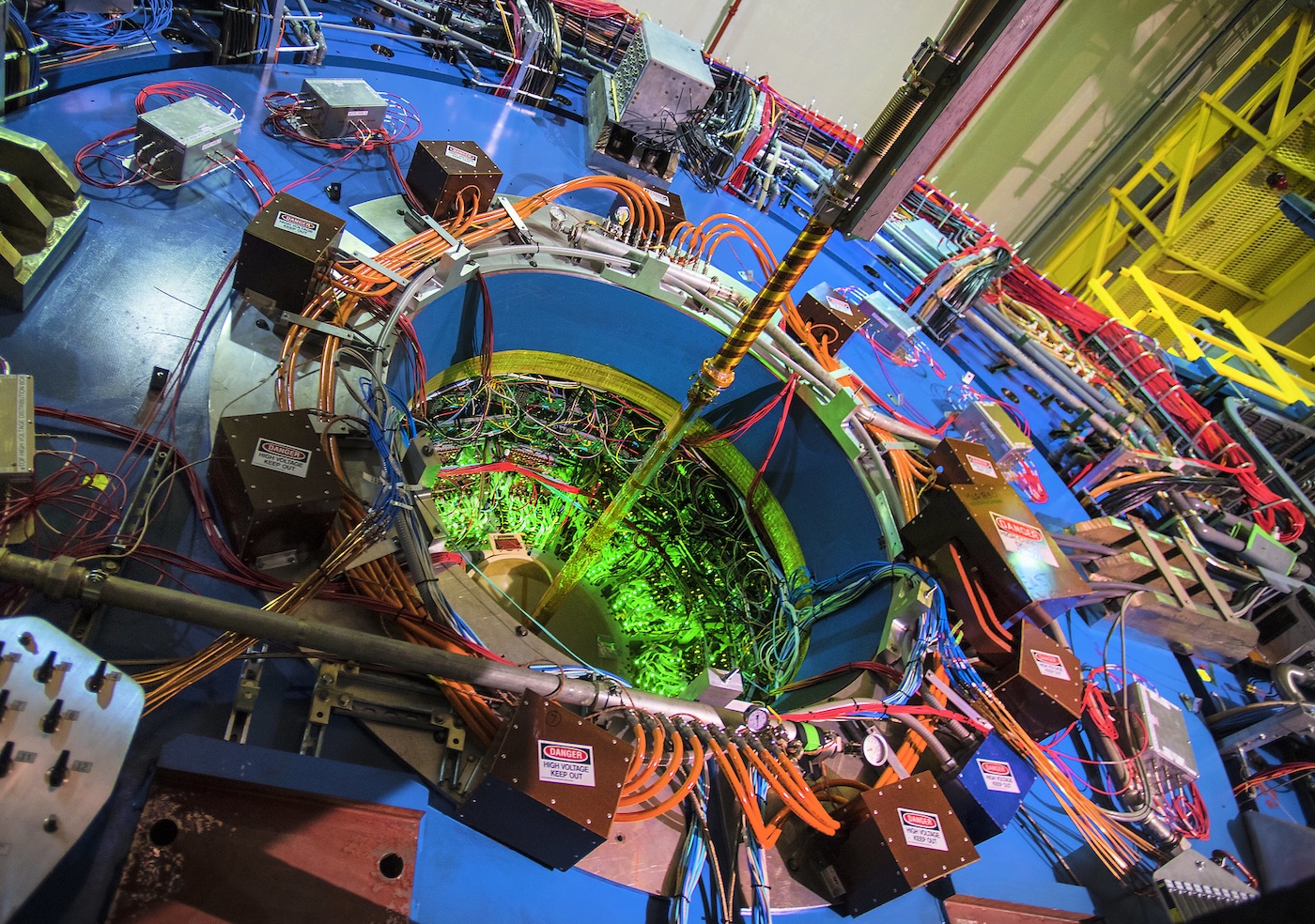
FLORA LICHTMAN: Hey, it’s Flora Lichtman. And you’re listening to Science Friday. RHIC, the only large particle collider in the US collided its last particles last week. RICH is the Relativistic Heavy Ion Collider based at Brookhaven National Lab.
It was the second most powerful accelerator operating on the planet, second only to the LHC at CERN. It started colliding in 2000. And scientists have used it to study the tiniest particles, which gives us insight into some of the universe’s biggest mysteries.
Dr. Gene Van Buren, a nuclear physicist at Brookhaven, is a researcher on a RHIC detector called Star. Hi, Gene.
GENE VAN BUREN: Hi, there.
FLORA LICHTMAN: These last collisions, I mean, were they a celebration or a wake?
GENE VAN BUREN: Oh, I think it’s absolutely a celebration. There has been a fantastic lifetime for this device, this facility, so there’s a lot to celebrate for what it’s done and achieved.
FLORA LICHTMAN: You’ve been working on this project for decades. What was it like to see them pull the plug? And did they actually pull a plug?
[LAUGHTER]
GENE VAN BUREN: Well, I think they made it a bit of a staples easy button moment, where they had a very important person press a button. But behind the scenes, there’s someone else who’s actually really turning off the machine at exactly the same time.
FLORA LICHTMAN: Was it emotional for you?
GENE VAN BUREN: I think, for me, it’s emotional in terms of the people. These are people we’ve been working with for a long, long time. And it’s relationships and time spent together doing things for 25 plus years. And that’s the sad part.
As far as the science goes, there’s nothing sad there. There’s a lot of positives for the results that we’ve gotten and the data that we have stored and ready to analyze in the coming years.
FLORA LICHTMAN: Well, I want to get into it. Let’s go back in time first. I mean, what was RHIC designed to do? Why did we need it?
GENE VAN BUREN: The first goal was to study what we believed was going to be the quark-gluon plasma. This was believed to be a new gaseous state of matter that we had seen hints of at lower collision energies at previous facilities. We had such a facility here at Brookhaven National Laboratory– gave us some tantalizing hints of what might happen when nuclear matter becomes very hot and very dense, and actually changes phase.
A change of phase like that’s very telling for the science. It really tells us a lot about the interaction of the constituents of matter. And so this was going to be our star facility for studying the quark-gluon plasma and the transition from the normal state of matter into that plasma phase that we were hoping to see and study.
FLORA LICHTMAN: Remind us what the quark-gluon plasma is.
GENE VAN BUREN: Certainly. So when you think of something like water, and you get it hot enough, the water molecules begin to get enough energy of motion that they can actually separate from each other.
And they become free of each other. They become liberated. And that’s what steam really is. It’s just water where the molecules no longer are cool enough to stick together.
So when we look at nuclear matter, a nucleus is similarly a liquid droplet of this stuff that makes up nuclei, quarks, and gluons, and what they form as larger structures, all come and stick together into this droplet of stuff that we eventually call a nucleus. And the idea is that when you get this stuff hot enough, they’ve got enough energy of motion that they overcome this stickiness, and they liberate.
They become free of each other and, perhaps, form a gas. So that was the expectation, is that we would be forming this plasma. And the question is then, when you form this plasma state where things are all separated from each other and liberated from each other, whether that’s going to be a gaseous state or whether it’ll be something else.
FLORA LICHTMAN: So this is it, right? And it was supposed that it was going to be gassy. This quark-gluon plasma was going to be gassy, right?
GENE VAN BUREN: I think that’s a good way to put it, a gassy plasma. In the end, it was not exactly that. And that was one of the fascinating findings in the early days of RHIC, was to produce this new plasma state and find that instead of a gaseous state, it was a new liquid plasma.
And over the years, we learned more of the characteristics about this liquid and found it was one of the most ideal, perfect liquids that anyone could ever create.
FLORA LICHTMAN: What is a perfect liquid?
GENE VAN BUREN: Essentially, where you’ve got a liquid has a viscosity, which relates to how when part of a fluid moves, how that movement then carries over into neighboring constituents of the fluid. And in this case, what we’ve seen is the lowest shear viscosity of any fluid that could ever be achieved, getting down to what we believe is the quantum mechanical limit.
So that’s what we call the perfect fluid. And that’s what we were seeing when we looked at the fluid motion of this plasma as it was produced at RHIC.
FLORA LICHTMAN: Break down the name for us, the Relativistic Heavy Ion Collider. I mean, why is smashing heavy ions of interest? And what can you learn from that, that you couldn’t learn with lighter atoms?
GENE VAN BUREN: A very good question. So the word ion just refers to atom that has too few or too many electrons. And you could, for example, have an atom where you’ve stripped off all the electrons, and you would still call that an ion, but you would further call that just the bare nucleus.
And a heavy ion is an ion where the nucleus is very large. If you drop something like a bar of lead or a bar of gold on your foot, it hurts because it’s got a lot of stuff in the nucleus. And the reason that we want a large nucleus, a heavy nucleus, is because we want to bring a lot of this nuclear stuff into the place where we have the collisions.
It’s very similar to the idea of thinking– let’s say you had just two or three molecules of water. And with that, you can’t really describe two or three molecules in a liquid state or in a gaseous state. You really need to have lots of water molecules in order to actually see this kind of bulk behavior when you have a lot of the material. So that’s what we wanted from the nuclei.
We really can’t see liquid, and gaseous, and plasma states with just a few particles, so you need a lot of the stuff. And so that’s one of the reasons why we use large or heavy nuclei, where we bring a lot of the matter there into the collision point.
FLORA LICHTMAN: Why is RHIC shutting down? Have we answered all the questions?
GENE VAN BUREN: We have definitely not answered all the questions. There’s a lot more to learn. And it’s tempting to say that you keep a facility like this open to keep trying to answer more and more questions with more and more precision. But instead of trying to pursue that tactic, it’s better to take a different approach, and try to learn things from a different perspective.
And so the perspective that the community of nuclear physicists around the world has prioritized is that instead of trying to heat matter to high temperatures and create this plasma, that we instead start trying to understand normal, somewhat cold nuclear matter a little bit better. Because what we found when we went to the high temperature matter is that it left us asking some questions about matter even when it’s cold.
So now, the next effort is to try to probe cold nuclear matter. And the method by which we’re doing that is building a new collider, which instead of collaging two large nuclei and producing something hot is to have a very small thing collide with a large nucleus.
So you can have something like a very small electron hitting a large nucleus. That will leave the large nucleus cold, but it allows the electron to get in there, and probe, and try to help us understand the structure and movement of things inside a nucleus, even when it’s cold.
Does that mean you’re not interested in breaking it apart? You want to see what’s going on when it’s stuck together?
Well, as a side effect of probing it, the reality is that we will break it apart. But that is not the goal. That is not what we’re trying to achieve.
What we’re really trying to achieve is, essentially, shining a light onto an object and trying to see what you see back, to see what reflects off of it when you really try to probe it with some intense light, light that can even penetrate the surface and go down deep inside.
FLORA LICHTMAN: What’s the timeline for the new collider?
GENE VAN BUREN: It’s about a decade. The numbers vary by a year, or two, or something like that. But it’s going to take us a decade to build the new collider. We will make use of one of these storage rings that we have in our current collider, the collider that has just shut down. But we only need to keep one of those.
The other ring that accelerated nuclei in the opposite direction can be replaced with an accelerator for electrons. And that’s what’s going to take us about a decade to do, as well as building detectors, devices that can watch the collisions and help us investigate the physics.
FLORA LICHTMAN: What will you do for the next 10 years while you’re waiting for the new one?
GENE VAN BUREN: I’ve got plenty to do. I’ve got a lot of data sitting that we have collected. Particularly in the past few years of running the experiments, we did upgrade our systems to be able to acquire data faster and faster rates. And that allowed us to accumulate enough data to spend, perhaps, maybe 2/3 of the next decade trying to process and analyze that data.
FLORA LICHTMAN: With no big particle accelerator in the US for the moment, are US physicists are at a disadvantage?
GENE VAN BUREN: That’s a tough question.
FLORA LICHTMAN: [LAUGHS]
GENE VAN BUREN: I think the way to see it is that the field in general is a global community of people who learn about the science and who participate in doing the analysis and building the systems. It’s a little too focused on our own country to think that we alone will be impacted by this. The global community will be impacted by not having as many running facilities at the moment.
FLORA LICHTMAN: It puts all physicists at a disadvantage is what I’m hearing.
GENE VAN BUREN: I think that’s a fair way to say it.
FLORA LICHTMAN: Well, before RHIC started operating, there was some concern that it might form black holes on Long Island, or create the strange matter, or some other physics anomaly or calamity. How many black holes did it create?
[LAUGHTER]
GENE VAN BUREN: I think the answer to that is, none that would be detectable. But I think another way to see it is that what we have done at a facility, like the Relativistic Heavy Ion Collider, is take these collisions and put them in a controlled environment. And that is to say that these collisions are actually happening in nature all around us, all the time.
There are high-energy particles moving through space. And they are striking the Earth, or the moon, or other planets. And if they were creating black holes on these other natural collisions, then we could have expected to have seen some kind of impact from that when that happened throughout nature.
What we did at this facility is take those collisions and do them when we want, where we want so that we could study them.
FLORA LICHTMAN: I love the idea that we’re all living on a collider right now.
GENE VAN BUREN: Nature is actually doing this all the time, and it has been for millennia. And it’s not a problem for us.
FLORA LICHTMAN: Gene Van Buren is a nuclear physicist at Brookhaven National Laboratory based in Upton, New York. Thanks so much, Gene. I enjoyed it.
GENE VAN BUREN: Glad to be with you.
FLORA LICHTMAN: This segment was produced by Charles Bergquist. And if this show has smashed some new ideas into your brain, why not rate and review us, wherever you get your podcasts? No heavy ions required. I’m Flora Lichtman. See you tomorrow.
Copyright © 2026 Science Friday Initiative. All rights reserved. Science Friday transcripts are produced on a tight deadline by 3Play Media. Fidelity to the original aired/published audio or video file might vary, and text might be updated or amended in the future. For the authoritative record of Science Friday’s programming, please visit the original aired/published recording. For terms of use and more information, visit our policies pages at http://www.sciencefriday.com/about/policies/
[MUSIC PLAYING]