
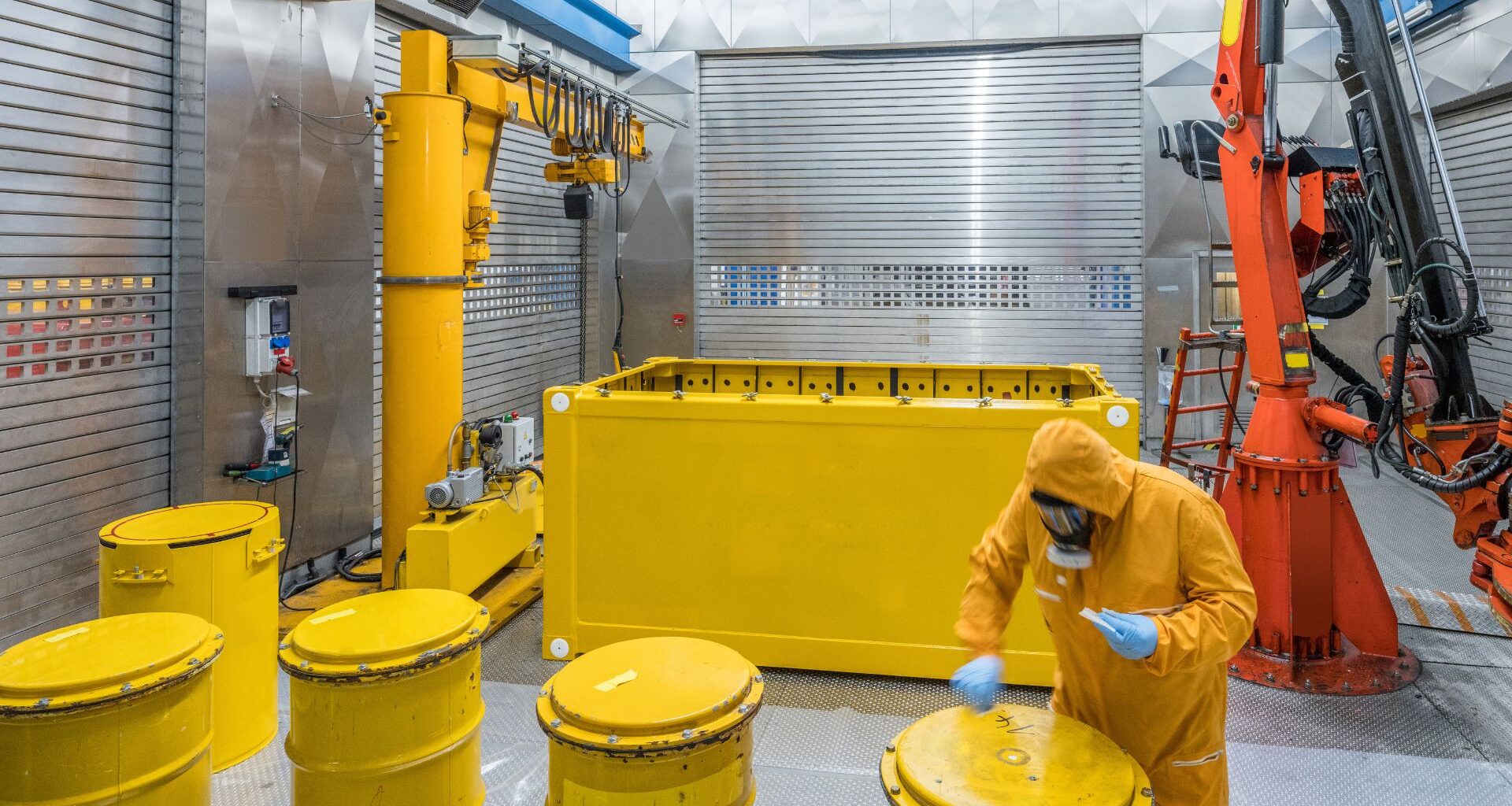
The Office of Nuclear Energy has selected five companies in the US to research and develop technologies to recycle spent nuclear reactor fuel and has awarded them a $19 million purse. The award is designed to help the US address economic and technological challenges in nuclear fuel recycling.
The US is the world’s largest producer of nuclear energy, accounting for nearly 30 percent of global nuclear power. As of 2025, the total power generation capacity of the country’s 94 nuclear reactors was around 97 gigawatts (GW). However, this also comes at a cost of massive nuclear waste generation.
Estimates suggest that the US manages about 90,000 metric tons of nuclear waste, with over 2,000 metric tons added each year. This is largely stored in temporary facilities since the country lacks a permanent disposal facility.
According to the Department of Energy (DOE), less than 5 percent of the potential energy in nuclear fuel is extracted, even after five years of operation in a commercial reactor. So, nuclear waste could be used to extract more energy. This is what fuel recycling can do to reduce nuclear waste by up to 90 percent.
Recycling nuclear fuel in the US
Recycling nuclear fuel from commercial reactors has been prohibited by law in the US since 1977. Instead, all spent fuel from the reactors is treated as high-level waste. In sharp contrast, military programs in the US have been recycling their nuclear waste for many years at government-operated defense plants.
Attempts to recycle nuclear fuel waste from commercial reactors were made in the 1960s and 70s but policy changes meant that the work did not take off. In 2022, the Department of Energy launched the Converting UNF Radioisotopes Into Energy (CURIE) program to address key gaps and barriers in recycling technologies.
The project had a purse of $38 million and included twelve projects. In a recent announcement, the DOE has allocated a $19 million purse and included only five companies to advance technologies for nuclear fuel recycling.
Areas of work
As per the DOE press release, the companies selected for this award meet the strict non-proliferation standards and security goals of the US and will focus on various aspects of nuclear fuel recycling.
For instance, Alpha Nur Inc., an Illinois-based company, will research and validate a process that uses used nuclear fuel to recover highly enriched uranium (HEU). This can then be used to produce high-assay, low-enrichment uranium (HALEU) fuel for small modular reactors (SMRs).
Washington (D.C.)-based Curio Solutions will work to scale up its NuCycle technology that produces uranium hexachloride gas from spent fuel, which can then be used to enrich uranium-235 in the fuel. The approach can reduce the volume of spent fuel waste by up to 96 percent, thereby reducing long-term storage requirements.
Oklo Inc., a Santa Clara, California-based company that builds small modular reactors, will study heavy-element deposition in molten salts to optimize its pyro-processing nuclear plant design, while Flibe Energy, another nuclear reactor company that uses a liquid-cooled design, will work on electrochemical methods for processing spent nuclear fuel.
Another startup, Shine Technologies, will use its grant money to develop a process design that incorporates transport, storage, and disposal of used fuel using hydro-processing technology.
All award projects will last up to three years and involve a 20 percent cost share from each recipient, the press release added.