
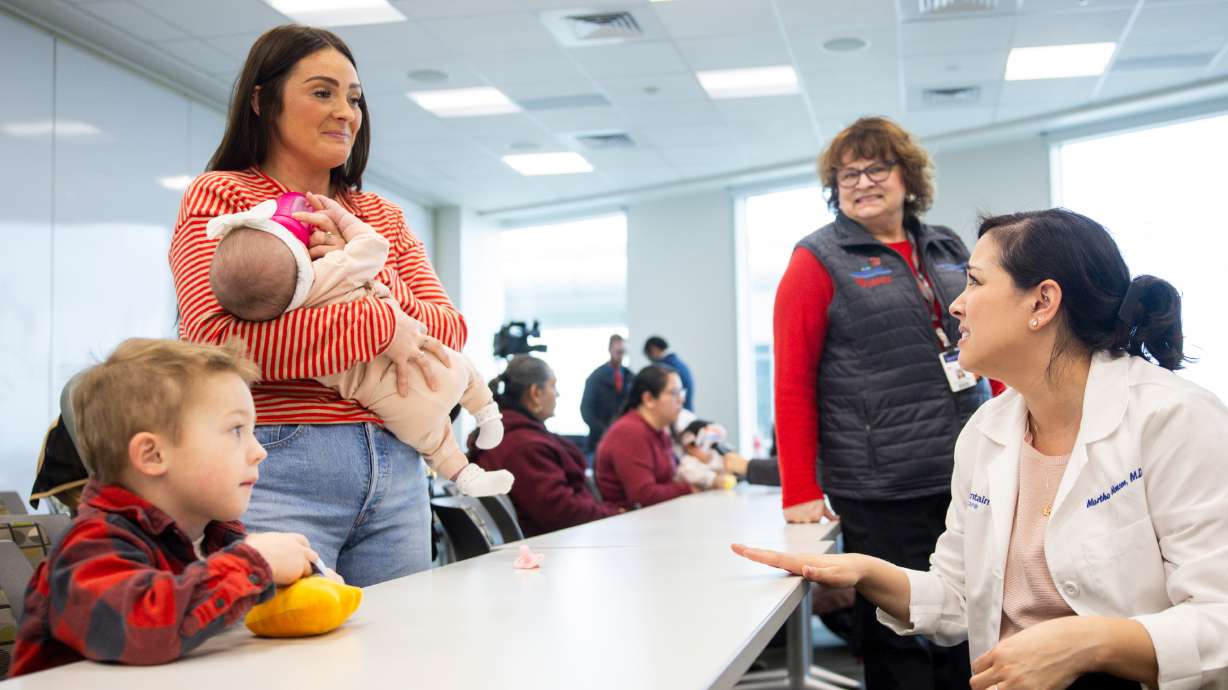
SALT LAKE CITY — Maddison Vance said when her baby was diagnosed with spina bifida shortly after her 20-week ultrasound, there was no question in her and her husband’s minds that they were going to move forward with a surgery before their daughter’s birth.
“It was scary, and it was hard, and probably the hardest thing that we’ll ever go through,” she said.
She had a fetoscopic surgery at 26 weeks pregnant about two months before her daughter Jaycie was born, which she said was a wild journey, especially with their toddler, too. Now, her daughter is 4 months old and “doing amazing.”
Vance said they have no regrets.
“She’s the cutest thing we’ve ever seen. Her brain looks beautiful on all of her scans, which is all you could ever hope for with this, and her legs are doing good, too,” she said.
Vance spoke along with doctors and another patient on Monday at a press event celebrating the success of a fetoscopic surgery method for treating spina bifida, which doctors say only requires three small incisions in the uterus and leads to better outcomes for mothers and babies.
‘Cutting-edge’ care
Spina bifida is a congenital neural tube defect that happens when the spinal column fails to close completely in the first month of pregnancy. It is the most common permanently disabling birth defect in the U.S. This procedure, which uses a small camera and tools to repair a baby’s spine, has helped eight women since it was introduced for the first time in Utah last May, according to Intermountain Health.
Dr. Martha Monson said the new procedure allows moms to carry pregnancies full term and have a vaginal delivery. The previous method makes a larger incision in the uterus and requires mothers to have a preterm cesarean section in that pregnancy and any future pregnancies, she said.
Grem Vance looks at his daughter Jaycie as they wait for the start of a media event highlighting advancements in treatment of spina bifida at Primary Children’s Hospital on Monday. (Photo: Rio Giancarlo, Deseret News)
Janice Byrne, maternal fetal specialist and medical geneticist, said the health system is thrilled to offer such a “cutting-edge procedure” to all families, noting one patient traveled from Alaska. She thanked those patients for putting their trust in the fetal intervention team.
“The procedure offers a marked advancement in the care of children with neural tube defects or spinal bifida by potentially increasing their ability to live independently and ambulate as well as to decrease the need for multiple shunt procedures throughout their lifetime,” she said.
Byrne said each shunt a spina bifida patient gets — a procedure to help drain water from their brains — comes with a risk of infection.
The right foot
Vance said their family still has a lot to learn and a long journey to go through. She thanked the people who helped with her baby’s care, saying she feels like she owes them her life.
“It’s still hard every time we go to an appointment; you just don’t know what the outcomes are going to be or what the conversations are going to be,” Vance said.
She said they still don’t know if her daughter will be able to walk or need a wheelchair. Although they mourned the healthy baby they thought they would have, getting to know their baby — 5-month-old Jaycie — has been “amazing,” she said.
Last week, the family saw her move her foot the first time, and Vance was so excited she took about 10 videos of it.
Dr. Rajiv Iyer, director of the spina bifida program at the Scott Bohnam Fetal Center, said the surgery helps close the skin when babies have the open version of spina bifida. He said it is a chronic disorder and does not have a cure, but doctors can still help and give “the maximum possible potential.”
“Setting them up on the right foot when they start out in life is so critical,” he said.
Iyer said surgeries like this can reduce the rate of hydrocephalus, or water on the brain, and lead to better outcomes when the babies reach school age.
Closer to home
Angela Ibarra Garcia, a West Jordan mom, was the first person to have the minimally invasive surgery at the center. She said they had been planning to go to California to have the surgery, but it was a better option for them when the opportunity came to have it closer to home where family could help.
She has two other daughters and travel would have made it more complicated.
Angela Ibarra Garcia holds her daughter Daniela as they attend a media event highlighting advancements in treatment of spina bifida at Primary Children’s Hospital in Salt Lake City on Monday. (Photo: Rio Giancarlo, Deseret News)
There were risks with doing a surgery before birth, but the benefits were much higher.
“We want to do what is possible for her to give her the best life,” she said about her daughter Deniela.
Garcia’s baby is doing well now. She said Deniela is kicking and lifting her feet and doing well at tummy time. She said her daughter’s brain is also doing well, and they are hearing good news at each appointment.
Dr. Stephen Fenton, director of the fetal center, said this new option is possible through the collaboration the center has with the University of Utah and Primary Children’s Hospital. He also said the donation from Megan and Brad Bonham accelerated their ability to do surgeries like this.
The Key Takeaways for this article were generated with the assistance of large language models and reviewed by our editorial team. The article, itself, is solely human-written.