
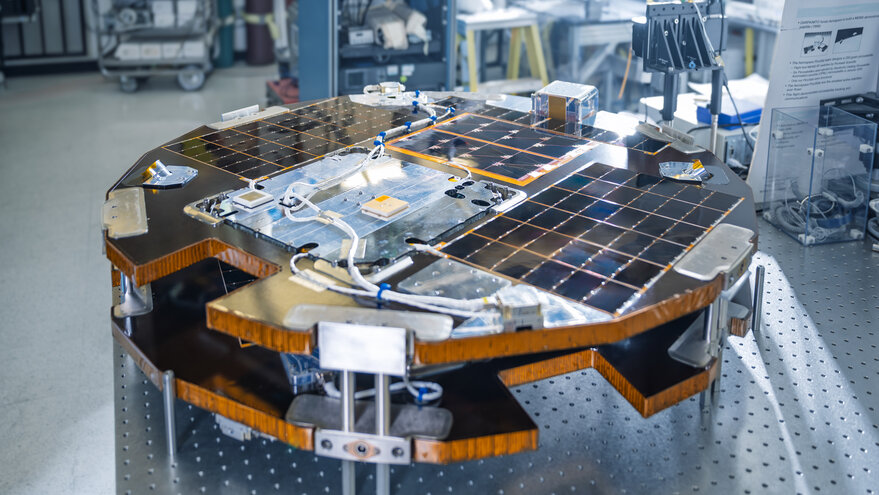
MOUNTAIN VIEW, Calif. – The Aerospace Corp. is sharing DiskSat technology with industry partners as the first four pancake-shaped spacecraft undergo commissioning.
Orbotic Systems, a Southern California startup focused on space debris remediation, and San Francisco-based edge computing startup Satlyt have signed the first DiskSat commercial licensing agreements.
“This is an opportunity for commercial, international, government to work with us to license the design, so that they can take it on themselves and build their own DiskSats,” Catherine Venturini, Aerospace DiskSat principal scientist, told SpaceNews. Organizations also can work with Aerospace “to help advance DiskSat capabilities or technology.”
Orbotic plans to operate DiskSats in very low Earth orbit (VLEO) to gather space weather observations with its Wind Ion Neutral Density (WIND) sensor. “Also working closely with The Aerospace Corporation to manufacture and distribute,” Orbotic CEO Erik Long posted on LinkedIn. “If you need a DiskSat or a ride for your tech, let me know. We will offer DiskSat as a Service (DaaS).”
In-Orbit Compute
Satlyt is working with Aerospace to “explore applications in autonomous operations, in-orbit data processing, and distributed spacecraft coordination, advancing small satellite capabilities for both government and commercial missions,” Rama Afullo, Satlyt founder and CEO, said on LinkedIn.
“This collaboration represents a step toward enabling true autonomy in space,” Afullo said in a Feb. 2 blog. “DiskSat provides the kind of power and scalability that makes real-time computing in orbit possible.”
Aerospace is likely to announce additional partnerships as the DiskSats, launched in December on a Rocket Lab Electron for the U.S. Space Force Space Test Program, complete commissioning and begin operations.
With its initial DiskSat mission, the Space Test Program plans to characterize the performance of the bus, while demonstrating generation and management of 100 watts of peak power. Communications and environmental-sensing payloads aon the first DiskSats will be evaluated as well.
Dispensing DiskSats
After launch, four 2.5-centimeter-thick DiskSats with a one-meter diameter were ejected from a DiskSat dispenser into low-Earth orbit at an altitude of approximately 550 kilometers.
“Any new dispenser system is always high risk, so we put a lot of effort into testing and the design,” Darren Rowen, DiskSat chief engineer, told SpaceNews. “We’re happy that the custom-built dispenser for the DiskSats worked exactly as planned.”
Once the commissioning phase ends, one DiskSat will move into VLEO “to show we can maintain low-altitude flight,” Rowen said. “With the low cross-sectional area, we expect to get lower than possible with traditional vehicles.”
During commissioning, DiskSat program officials have demonstrated they can point and maneuver the flat satellites.
Related