
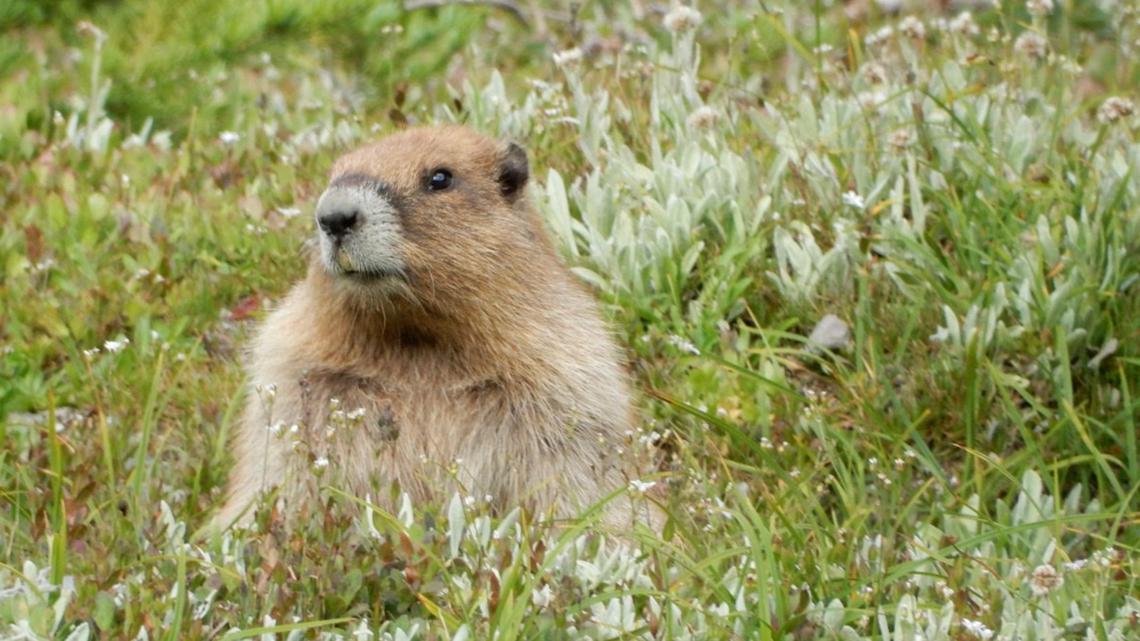
This social, whistling rodent is only found in Washington’s Olympic Mountains. Here’s why Fish and Wildlife is considering this new protection.
SEATTLE —
The U.S. Fish and Wildlife Service has determined that a petition to list the Olympic marmot under the Endangered Species Act warrants further review, marking a crucial step toward potential federal protections for the species only found in Washington’s Olympic Mountains.
Olympic marmots are social animals known for their whistle that are about the size of a house cat and make homes in meadows. Those habitats are facing threats and it’s having a domino effect on the population.
The marmots inhabit alpine meadows above 4,000 feet throughout the Olympic Mountains, with about 90% of their habitat protected within Olympic National Park. As temperatures warm, trees are advancing upslope into these meadows, fragmentally reducing available habitat.
“Since they’re already at the tops of the mountains, there’s really nowhere else to go. If they lose those alpine meadows, then they pretty much lose the only place they can live,” said Aaron Kunkler, senior media specialist at the Center for Biological Diversity, the nonprofit that filed the petition for consideration.
The petition identifies habitat loss and fragmentation, along with predation by nonnative coyotes, as primary threats warranting federal review.
Fish and Wildlife determined there is “substantial” evidence for protections and is now conducting a status review, announced Jan. 26.
The Center for Biological Diversity submitted the petition for consideration in May 2024, citing significant population declines and mounting threats.
The decision should have come 90 days after the petition was filed, originally due in August 2024, but Fish and Wildlife did not respond, prompting the Center for Biological Diversity to file a lawsuit in October 2025.
The announcement of substantial evidence came three months after that.
“Fish and Wildlife has been historically good at meeting those deadlines but with recent federal funding cuts, that has changed,” said Kunkler.
Kunkler said current population estimates range from 2,000 to 4,000 individuals, with approximately 60% of known colonies disappearing over recent decades.
Olympic marmots exhibit an unusually slow life cycle for rodents. They don’t reach reproductive maturity until age 3 or older, with females averaging 4.5 years for first reproduction. Only about 35% of reproductive-age females produce young in an average year, with litters of one to six pups emerging in late July or August.
About half of young marmots die before their first spring. The combination of late maturation, low reproduction rates and high juvenile mortality makes adult females particularly valuable, and difficult to replace when lost to predation or other causes.
The species’ life history makes it especially vulnerable to population declines. Marmots hibernate seven to eight months annually, with body temperatures dropping below 40 degrees Fahrenheit and heart rates slowing to three beats per minute.
Fish and Wildlife will now conduct its own research and studies to determine whether to list the Olympic marmot as threatened or endangered. Under the Endangered Species Act, the agency typically has nine months to complete this review and issue a decision which would be either “warranted but precluded,” “warranted” or “not warranted.”
The species will be assigned a priority ranking according to the agency’s methodology and added to the National Listing Workplan.
Named Washington’s official endemic mammal in 2009, Olympic marmots are highly social rodents that live in family groups and communicate through sharp, piercing whistles. They can weigh 15 pounds or more before hibernation and display widely varying coat colors from dark gray to brownish, yellow or tan.