
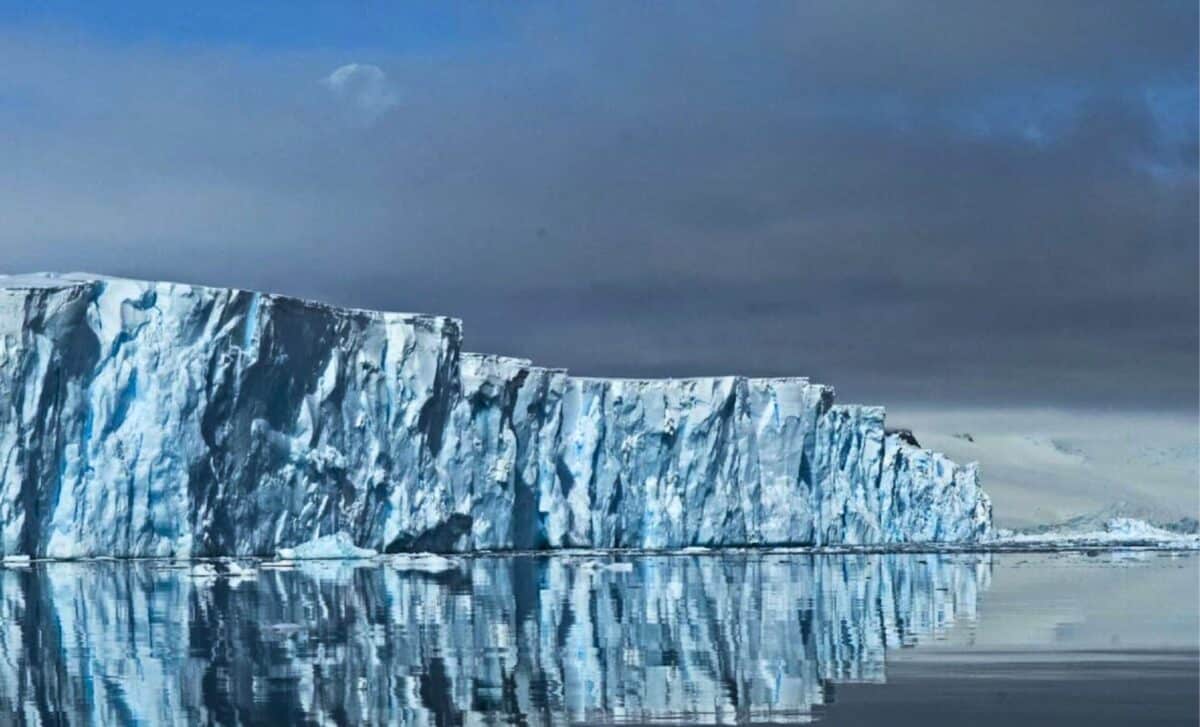
Deep beneath the ice of West Antarctica, a critical boundary is eroding. Warm ocean currents are surging beneath Thwaites Glacier, the so-called “Doomsday Glacier”, accelerating its collapse and bringing global sea levels with it.
In 2025, those currents were measured creeping past a natural underwater ridge that once acted as a partial barrier. Now, an international team of scientists and engineers believes a manmade curtain anchored to the seafloor could restore that function, and delay one of Earth’s most dangerous feedback loops.
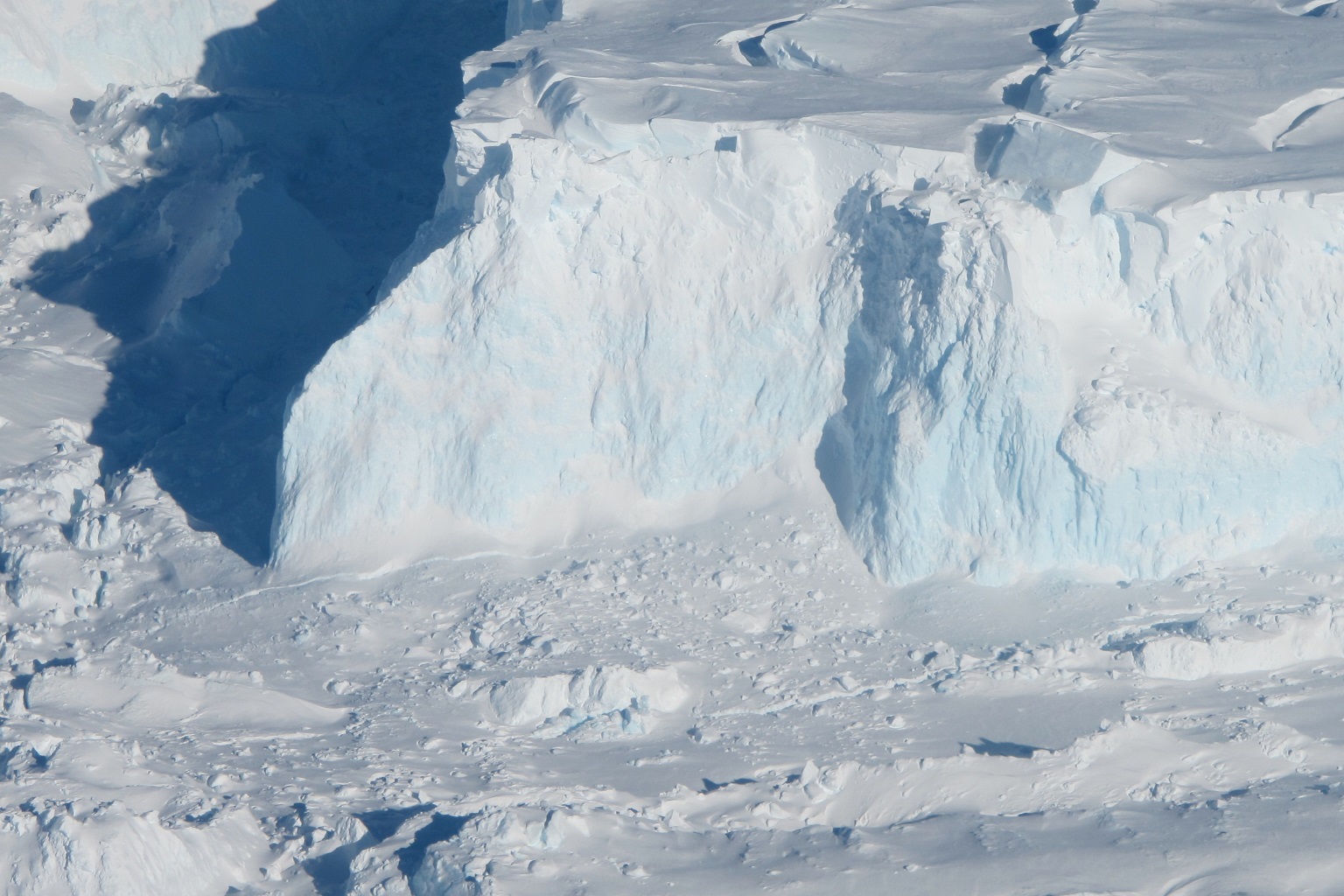 The Thwaites Ice Shelf, photographed from the IceBridge DC-8 in 2012. Image by James Yungel for NASA ICE
The proposal involves a flexible underwater barrier 80 kilometers long and over 150 meters tall, engineered to block warm water from reaching the glacier’s base. Supporters describe it not as a permanent fix, but a last-resort measure to buy time as the world works to slow greenhouse gas emissions.
If Thwaites collapses completely, the ice it holds could raise global sea levels by up to 65 centimeters, according to researchers involved in the project. Each additional centimeter threatens to expose millions of people in coastal regions to tidal flooding and saltwater intrusion.
A Technical Stopgap with Global Stakes
The project, known as the Seabed Anchored Curtain, has entered a three-year research phase. The curtain would sit just offshore from Thwaites, anchored to the seabed, with its upper edge trailing below the ocean surface to avoid interference with icebergs. Its purpose is to interrupt the flow of Circumpolar Deep Water—a relatively warm, salty current that accelerates melting from below.
The research consortium includes teams from Cambridge University, University of Chicago, NYU, the Alfred Wegener Institute, NIVA, Aker Solutions, and the University of Lapland. Prototype testing is scheduled to begin in a Norwegian fjord, with fundraising efforts targeting $10 million for the early development phase, as reported by Interesting Engineering.
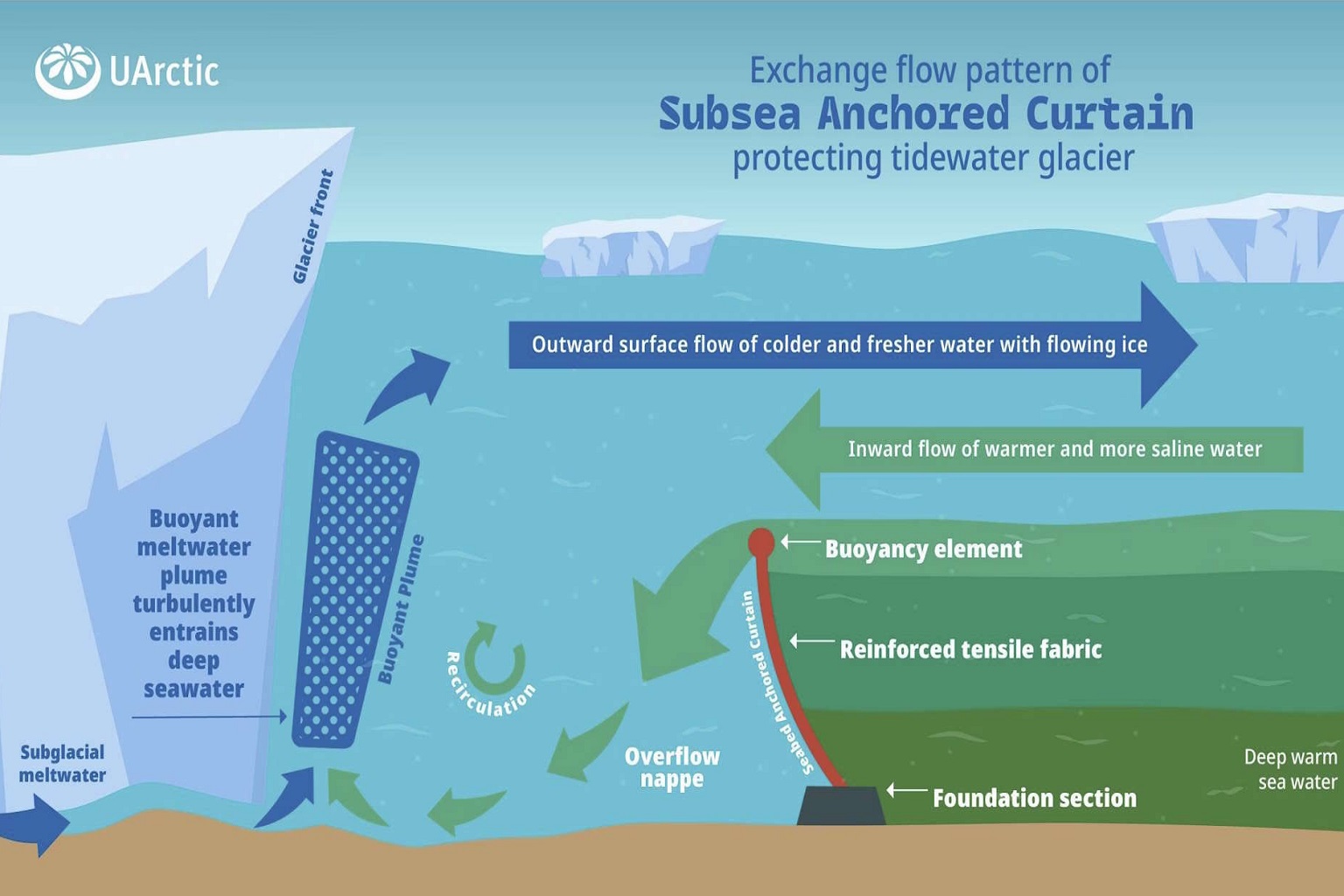 Exchange flow pattern of Subsea Anchored Curtain protecting tidewater glacier. Image by UArctic.
In parallel, field teams have deployed moored sensors and fiber-optic cables at multiple locations around the glacier’s grounding line. These instruments, installed via hot-water drilling, now provide daily satellite data on ocean temperatures and melt dynamics over 1,000 meters below the surface.
“This is one of the most important and unstable glaciers on the planet, and we are finally able to see what is happening where it matters most,” said Dr. Peter Davis, a physical oceanographer at the British Antarctic Survey. “We’ll be watching, in near real time, what warm ocean water is doing to the ice 1,000 metres below the surface. This has only recently become possible and it’s critical for understanding how fast sea levels could rise.”
From Concept to Feasibility in Extreme Conditions
The curtain concept relies on previous experience in offshore marine engineering, but its application in the dynamic, icy conditions of West Antarctica presents unprecedented challenges. The structure would need to endure seasonal iceberg activity, deep ocean pressure, sediment shifting, and corrosion over years or decades.
The curtain’s planned anchor points align with a submarine moraine—a natural ridge beneath the Amundsen Sea. During fieldwork in January 2026, researchers aboard the South Korean vessel RV Araon surveyed the ridge to determine whether it could serve as a stable foundation. Reporting by The Atlantic describes how the curtain would rise from this feature to block warm currents entering the seabed canyon.
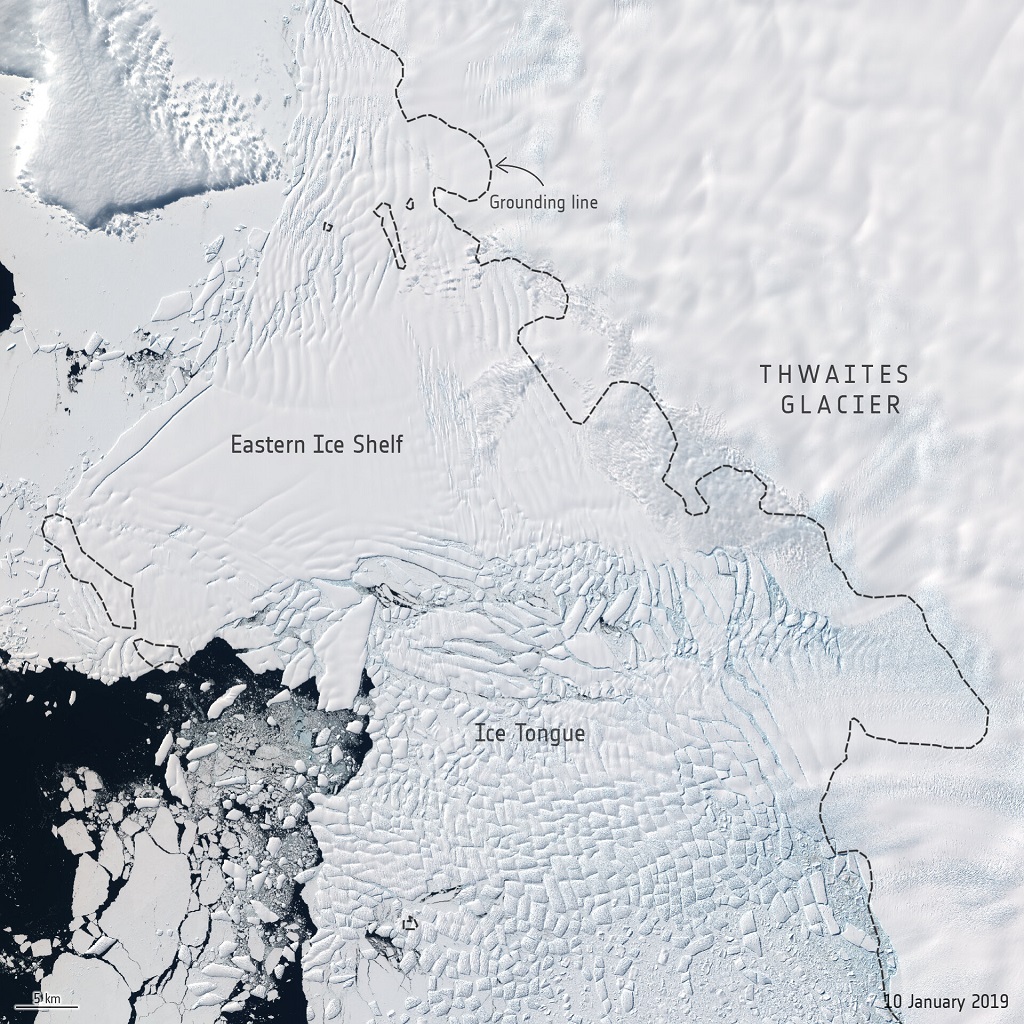 The Thwaites Glacier, Ice Tongue and Eastern Ice Shelf, photographed in 2019 from the Sentinel-2 satellite. Image by the European Space Agency
No permanent structure of this kind has ever been installed in the Southern Ocean. Project leaders emphasize that full deployment would require not only additional testing, but also extensive regulatory review under the Antarctic Treaty System, which governs human activity on the continent.
Governance Gaps and Open Technical Questions
There is currently no international precedent for implementing large-scale climate adaptation infrastructure in polar marine environments. Legal scholars note that the Antarctic Treaty restricts permanent structures unless they support scientific research. Whether the curtain qualifies remains untested.
The proposal has raised internal debate within the scientific community. Some researchers are concerned that projects like this could detract from mitigation efforts. Supporters argue the reverse: that with ocean warming underway, adaptation measures may now be essential alongside emissions reductions.
Critically, the curtain would not reverse Thwaites’ destabilization. Its function is to reduce the rate of melting and extend the glacier’s stability window, potentially by decades. The timeline for any full-scale installation remains undefined.
The next major data releases from the project’s sensors are expected in mid-2026, providing new insights into the pace of ice loss and the mechanical feasibility of seabed-based interventions. Whether a curtain can meaningfully delay a tipping point remains uncertain—but as The Atlantic notes, researchers suggest the window for experimentation is narrowing.