
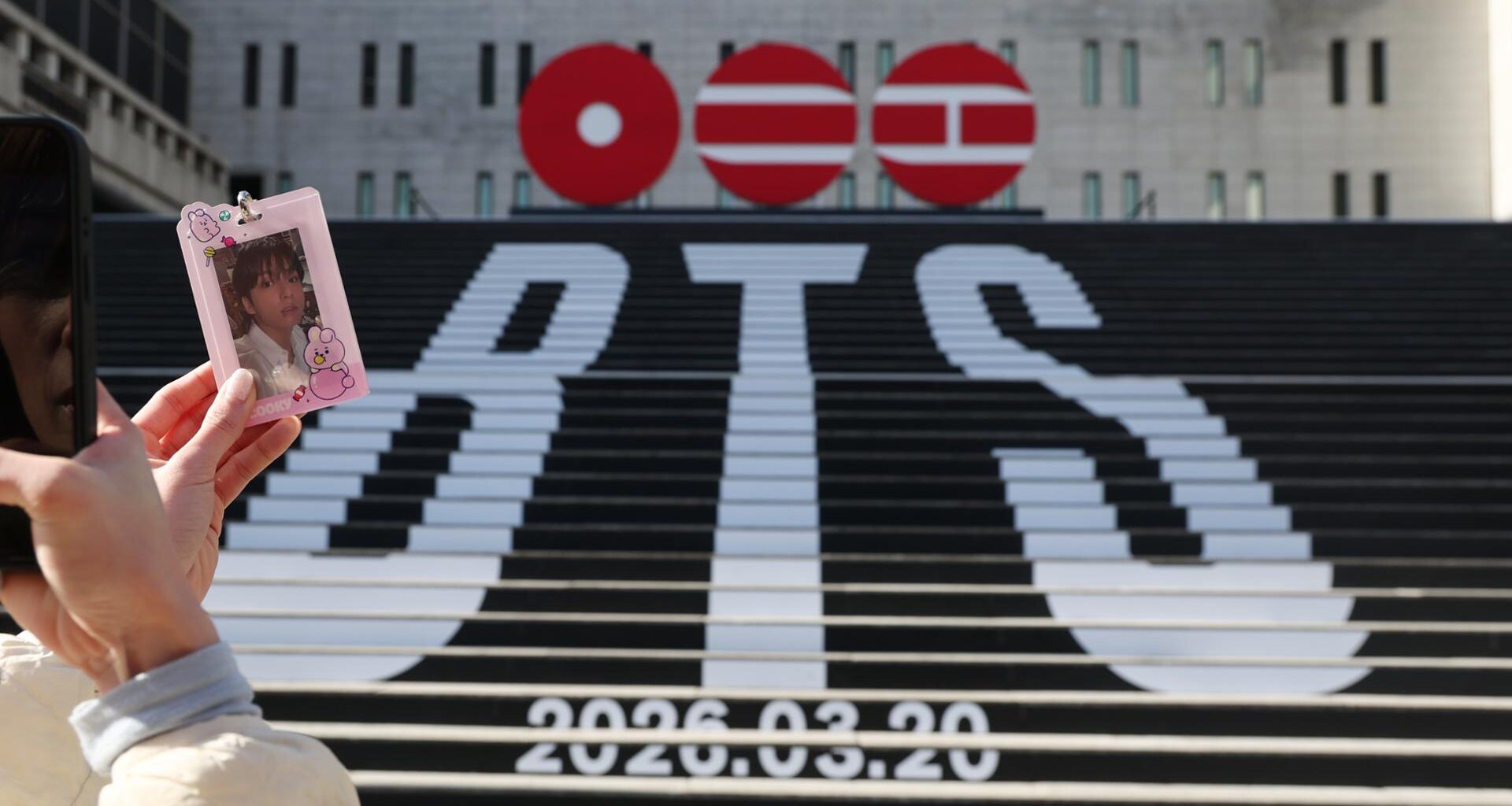
A visitor takes a picture of a photocard in front of a street installation promoting K-pop boy band BTS’ comeback at Gwanghwamun Square in central Seoul, Jan. 22. Yonhap
Editor’s note
This is the first of two articles diving into the meaning and spectacle of K-pop act BTS’ comeback show, slated for March 21 at the historic and symbolic Gwanghwamun Square in the center of Seoul. — ED.
When BTS, one of K-pop’s most globally recognized groups, returns as a full seven-member act in March, it will mark more than just the end of a hiatus. The comeback has been interpreted as a deliberate statement about identity and belonging, at a time when fans and observers are debating whether K-pop is evolving into something more culturally neutral, often described by its biggest producers as “global pop.”
Scheduled for March 20, BTS’ return is defined by two closely linked choices: a new album titled “Arirang,” named after one of Korea’s most enduring folk songs, and a large-scale free outdoor performance the following day at Gwanghwamun Square in central Seoul. Thus, the K-pop juggernaut is positioning its comeback as a return home, centering the members’ Korean heritage rather than displacing it.
“Centering an album on ‘Arirang’ reflects BTS’ confidence in placing Korean heritage at the core of their global identity,” Kim Hee-yon, an assistant professor of strategy at Cornell University, told The Korea Times in a written interview.
Adding that the move aligns with BTS’ long-standing emphasis on authenticity, Kim pointed to how the group has consistently framed narratives of selfhood, struggle and belonging throughout its career.
“Their trajectory suggests that global reach does not require erasing cultural specificity,” Kim said. “Rootedness and authenticity themselves can become a source of global resonance.”
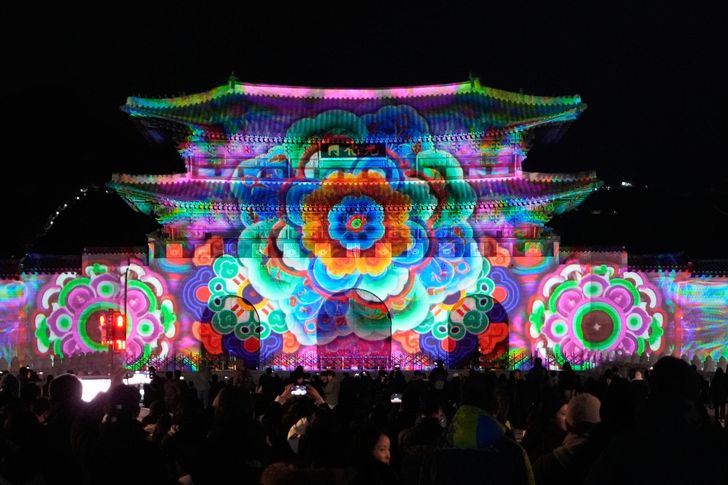
Media art illuminates the facade of Gwanghwamun, the main gate of Gyeongbok Palace, during Seoul Winter Festa in central Seoul, Dec. 12, 2025. AP-Yonhap
Cultural specificity
That message lands at a moment when the industry’s global strategy looks different than it did even a few years ago. More acts are experimenting with English-language singles, “international” visual codes that flatten cultural markers and market-tailored groups designed for localization outside Korea.
Against that backdrop, experts note that BTS’ approach is a “conscious recalibration” of what K-pop’s global success can look like.
“The move contrasts with industry trends that often detach global pop acts from specific national contexts,” Kim said. “It positions BTS not just as entertainers but as cultural figures embedded in Korea’s historical and symbolic landscape, consistent with how they have repeatedly anchored their global narrative in personal experiences.”
Grace Kao, IBM professor of sociology at Yale University, agreed with this assessment, stating that BTS is “reasserting their identity as Korean artists.”
“BTS seems intent on reminding global audiences that they are Korean artists,” she said. “While the industry may be moving in different directions, this return highlights the importance of Korea to their identity and their music.”
That message stands in contrast to a recent industry trend where some K-pop producers and executives have argued that the goal is no longer to export K-pop as a Korean genre but to create a broader category of “global pop” built on the K-pop system.
Kao noted that BTS’ framing sits perpendicular to that rhetoric.
“It’s interesting because this is in contrast to Bang Si-hyuk’s assertion that HYBE is creating the genre of global pop rather than K-pop. Maybe they are, but BTS wants to remind us that they are proud to be Korean,” she said. Bang is the chairman of BTS’ agency, HYBE, and the executive behind the group’s creation.
“Of course, an event like this does much more for hallyu since everyone watching on Netflix will know they are witnessing an event in Korea by Korean artists.”

K-pop act BTS / Courtesy of BigHit Music
When heritage meets scale
The symbolism of BTS’ comeback is reinforced by the choice of venue for its comeback stage. Gwanghwamun, the main gate of Gyeongbok Palace, historically served as the central axis of Hanyang, capital of the 1392-1910 Joseon Dynasty, with major government offices lining the avenue in front. The site has long been associated with governance, authority and national identity.
“Gwanghwamun is one of Korea’s most symbolically charged public spaces, associated with history, statehood and civic life,” Kim said. “For BTS to perform there reframes global success as something that returns home rather than transcends it.”
Some experts broadly welcome the idea of infusing one of K-pop’s biggest moments with Korean heritage — an approach likely to draw unprecedented attention to both the site and the symbolism. Others caution that, without careful planning and execution, the gesture could invite controversy rather than deepen cultural appreciation.
Seo Jae-kweon, a professor at the Korea National University of Heritage, emphasized that both the song and the space demand careful handling.
“‘Arirang’ is a song that contains the joys, sorrows and aspirations of Koreans across generations,” Seo said. “It is a national intangible cultural asset and a UNESCO-listed heritage. Using it as a title is meaningful, and the performance itself must also interpret that identity in a contemporary and thoughtful way.”
Seo also pointed to the layered meaning of Gwanghwamun, which has evolved from a royal space into a civic one, with rallies against government corruption and for democratic values being held there in recent years.
“What was once the king’s space has become the people’s space,” he said, praising the choice of venue while also stressing the responsibility that comes with performing there.
The upcoming show will mark the first time a K-pop act has staged a standalone concert at Gwanghwamun Square. Local media outlets have reported that the performance may also include a choreographed procession, with BTS members emerging from Gyeongbok Palace.
According to HYBE’s proposal submitted to the Korea Heritage Agency, the route under consideration would pass through some of the palace’s most important areas, including Geunjeong Gate, Heungnye Gate and the recently restored platform used for royal ceremonies, known as “woldae” in Korean. Given the scale of the event, experts warn that even minor physical alterations or heavy foot traffic could put fragile cultural assets at risk.
Crowd management has also emerged as a key concern, as tickets for the concert are set to be free and the performance will be accompanied by multiple installations integrated into the cityscape.
“Using cultural heritage in films, dramas or performances is welcome,” Seo said. “But interpretation belongs to the artist, and if the spirit of that heritage is damaged, controversy can follow. The same applies to the space itself. With large crowds expected, safety and preservation must be ensured.”