
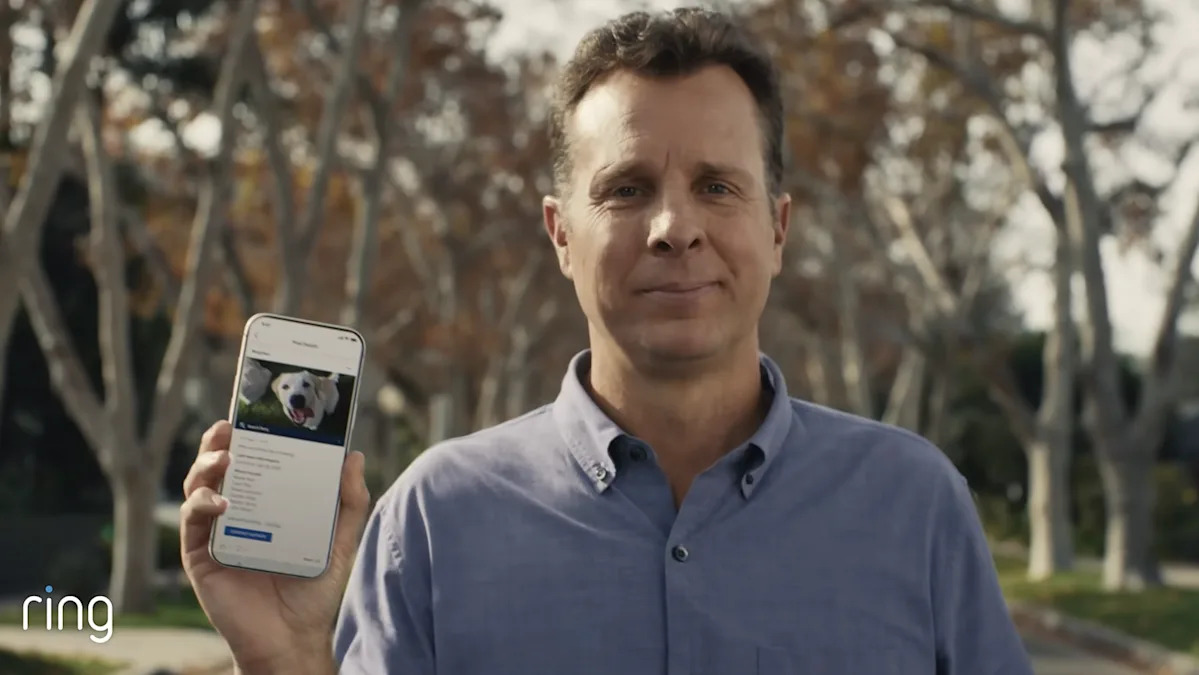
Super Bowl ads come and go, but this year one spot seems to be sparking conversation, controversy and confusion days after the big game: Ring’s 30-second pitch for “Search Party,” a new feature of the Amazon-owned company’s doorbell cameras that “uses AI to help families find lost dogs.”
“Pets are family, but every year 10 million go missing,” says Ring founder Jamie Siminoff as shots of cute pups, sad children and lost-dog posters stapled to telephone poles flash on screen. “And the way we look for them hasn’t changed in years — until now.”
While few would object to the idea of reuniting a canine with their human companion, some critics are concerned that Ring and Amazon are exploiting that worthy goal. As Chris Gilliard, a privacy expert and author of the upcoming book Luxury Surveillance, told 404 Media earlier this week, Amazon is putting “a cuddly face on a rather dystopian reality: widespread networked surveillance by a company that has cozy relationships with law enforcement and other equally invasive surveillance companies,” .
So what’s really happening? Is Jeff Bezos using your doorbell camera to create a nationwide AI-fueled surveillance network? Here’s what we know — and what we don’t.

“Lost Dog” posting.
(Ring via YouTube)How does Ring’s Search Party feature work?
The ad makes it seem simple.
“One post of a dog’s photo in the Ring app starts outdoor cameras looking for a match,” Siminoff says. A distraught puppy parent is then seen uploading an image of a grinning Labrador retriever. He fills in two fields below the photo: pet name (“Milo”) and description (“Milo our yellow lab is missing”).

The Search Party mobile interface.
A single Ring camera, positioned above a garage, is suddenly activated; a birds-eye view reveals that all the automated cameras in the neighborhood are also switched on and searching. Finally, video from one doorbell camera shows a yellow lab sniffing around. A white box tracks the dog on the screen, then glows green. “Milo match,” it says.

An image from a Search Party demonstration.
(Ring via YouTube)
“Since launch, more than a dog a day has been reunited with their family,” Siminoff claims as Milo bounds happily towards his home. “Be a hero in your neighborhood with Search Party.”
The reality, however, is a little more complicated. When someone reports a lost dog in the app, Ring scans cloud footage from every nearby, outdoor, Search Party-enabled Ring camera for a potential match. If the scan is successful, the camera’s owner gets a notification — not the owner of the lost dog. The camera’s owner can then decide to share the clip with the dog’s owner.
According to Ring, “nothing is shared automatically” and “the search is temporary, expiring after a few hours unless renewed,” as GeekWire recently reported.
But the problem, critics say, is less about what Search Party is doing than how it’s doing it: with facial recognition technology powered by artificial intelligence.
“If the Search Party function built into the doorbell camera’s app can be used to find a lost dog,” warned Hayes Brown of MSNow, “there’s little to stop it from being used to track people.”
Why is Search Party controversial?
Given Amazon’s record and Ring’s recent moves, privacy experts have speculated that Search Party, which was introduced late last year, could be a Trojan horse for AI-driven human surveillance at a time when federal law enforcement is using similar tools to find individuals for deportation and scan protesters’ faces for rapid identification.
Here are a few points of concern:
Amazon acquired Ring in 2018. Soon after, the company launched Neighbors, an app that provides “real-time crime and safety alerts” in partnership with local law enforcement. In 2022, The Verge reported that police departments could request and receive emergency access to Ring footage without owners’ permission or even a warrant. Facing backlash, Ring later announced it would end this feature.
Last fall, however, Ring inked deals with two security companies: Flock Safety (which makes law enforcement devices like security cameras and automated license plate readers) and its competitor Axon Enterprises (whose product line includes Tasers and body cameras). It then relaunched its law-enforcement partnerships with a feature called Community Requests, which again allows local law enforcement to request access to users’ footage — this time through Flock or Axon.
A Ring spokesperson recently told The Verge that “the reason we [partnered with Flock and Axon] is these third-party evidence management systems offer a much more secure chain of custody.” But as 404 Media reported last year, local police departments have already been searching Flock’s camera network on behalf of U.S. Immigration and Customs Enforcement (ICE) and Customs and Border Protection (CBP), giving federal law enforcement “side-door access to a tool that it currently does not have a formal contract for.”
Despite saying for years that Ring doesn’t do facial recognition, Amazon has also recently launched an AI-powered beta product called “Familiar Faces” that allows you to “easily tag your family and friends in the Ring app so your 2K and 4K cameras can notify you when someone [you know] is spotted” at your door.
The nexus between local police, federal immigration agents and AI facial recognition analysis has some worried about what could come next.
“This definitely isn’t about dogs — it’s about mass surveillance,” Democratic Sen. Ed Markey of Massachusetts posted on X.
How has Ring responded?
A Ring spokesperson told the Verge that Search Party is “not capable of processing human biometrics”; that Familiar Faces is separate from Search Party, with zero communal sharing; that Community Requests is “built for the use of local public safety agencies only”; that all requests for footage can be seen on its Neighbors app; and that Ring has no partnerships with ICE or any other federal agency.
For its part, Flock says it “does not work with” or “partner with ICE,” and police departments can only access footage by requesting it from the camera’s owners.
“These are not tools for mass surveillance,” the Ring spokesperson insisted. “We build the right guardrails, and we’re super transparent about them.”
But while users have to opt-in to Familiar Faces, Search Party is enabled by default on any outdoor camera enrolled in Ring’s subscription plan. Few choose to opt-out.
For some Ring customers, the idea that their camera can connect with neighbors — or even police — might provide a sense of safety. But others will blanch.
After two years away, Siminoff returned to Ring (and Amazon) in April 2025 to oversee its home security business. He said he came back because of AI.
“With this technology, [Siminoff] believes neighborhood cameras could be used to virtually “zero out crime” within a year,” the Verge reported. “Eliminating crime is an admirable goal, but history has shown that tools capable of large-scale surveillance are rarely limited to their original purpose.”