
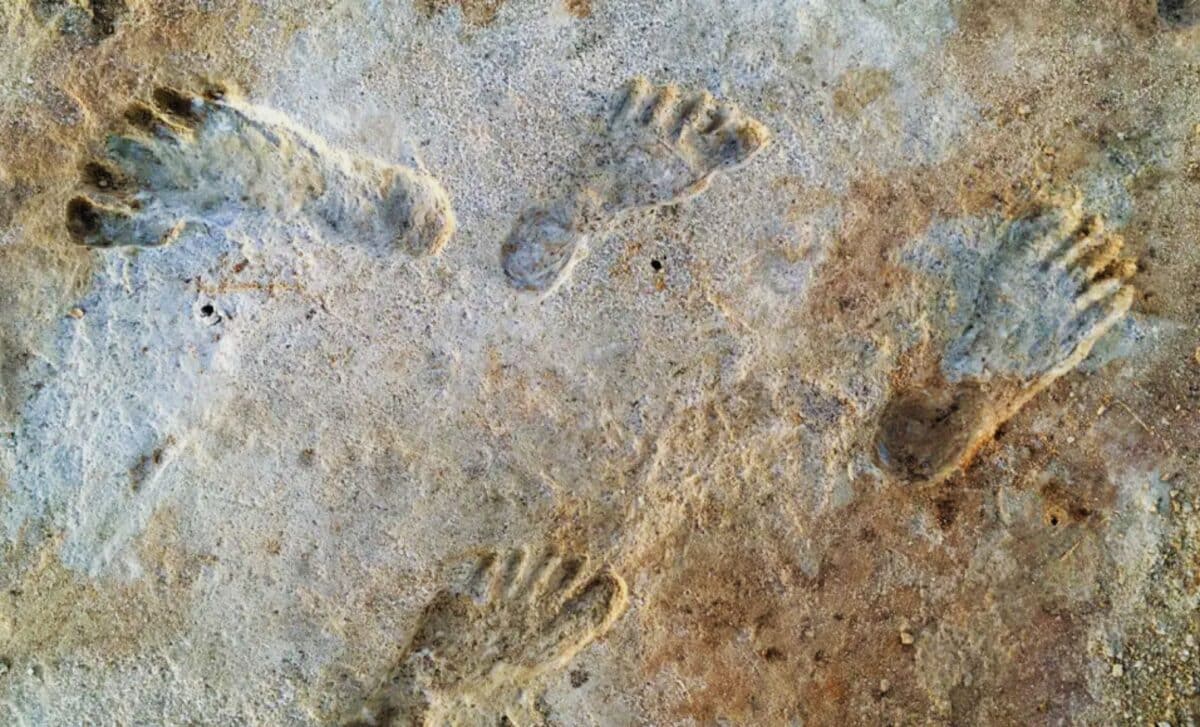
Footprints found in White Sands, New Mexico, are challenging everything we thought we knew about the first humans in North America. These prints, preserved in ancient mud, date back over 20,000 years, suggesting that humans were walking across the continent far earlier than scientists had believed, during the last Ice Age, no less.
For a long time, the Clovis-first theory was the dominant explanation for human migration to the Americas. According to this idea, humans crossed the Bering Land Bridge into Alaska around 13,000 years ago. But the discovery of these footprints in White Sands is pushing back that timeline, showing that humans were likely here much earlier than we thought.
A Snapshot from the Ice Age
The White Sands footprints were preserved in mud from an ancient lakebed, dating back to the period of the Last Glacial Maximum about 23,000 years ago, when the Ice Age was at its peak. Back then, the area wasn’t a desert but a much wetter landscape with lakes, making it a possible refuge for early humans.
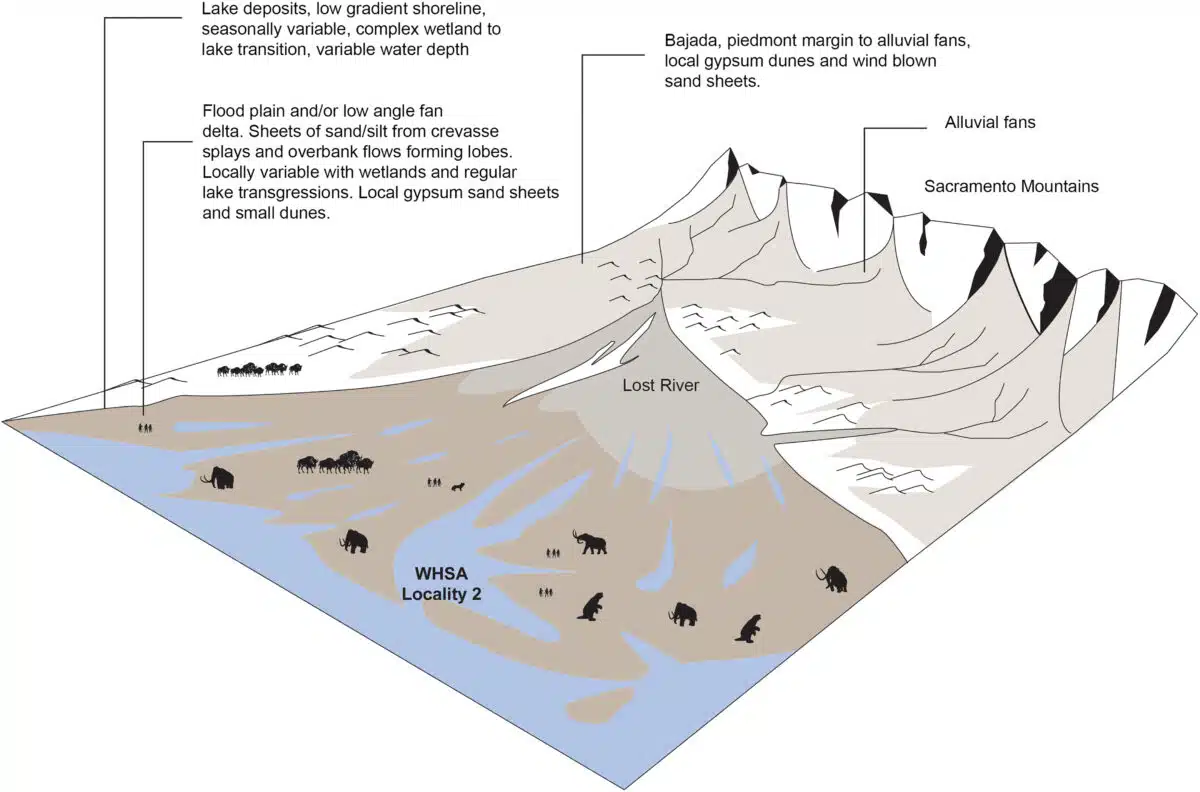 Illustrated map of White Sands with human and mammoth tracks, revising human arrival in the Americas. Credit: Science Advances.
Originally, scientists used plant seeds and pollen found with the footprints to estimate their age. However, doubts about the accuracy of these methods led to further investigations. By radiocarbon dating the mud itself, the team confirmed that the footprints indeed date back to the same period, providing solid evidence that humans lived in North America long before the Clovis culture.
Rock-Solid Proof: A Story That Stays Consistent
Vance Holliday, a lead researcher from the University of Arizona, pointed out how consistent the findings are. Multiple labs analyzed the footprints using different materials, seeds, pollen, and mud, all came back with the same age range: 20,700 to 22,400 years ago.
“It’s a remarkably consistent record,” Holliday said, “You get to the point where it’s really hard to explain all this away. As I say in the paper, it would be serendipity in the extreme to have all these dates giving you a consistent picture that’s in error.”
One question that still lingers is why there aren’t any other artifacts, like tools or shelters, left behind by these ancient people. As explained by the study, avaliable on Science Advances, because the footprints were likely created quickly, it’s not surprising that other materials didn’t survive. In such a remote area, it would be unlikely for people to leave much else behind.
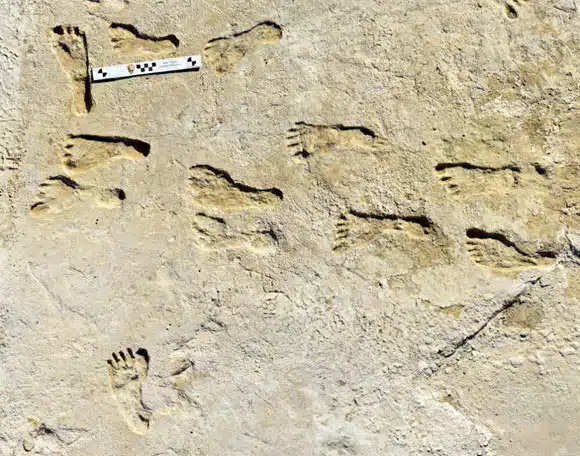 Ancient human footprints found at White Sands National Park. Credit: Science
The Truth About Human Migration Is Finally Out!
The discovery of these ancient footprints is making scientists rethink everything they knew about when and how people first arrived in the Americas. The Clovis-first theory, which claimed humans arrived around 13,000 years ago, is now in question. If humans were already in North America 23,000 years ago, that means their migration could have followed different paths or taken place under completely different conditions than we thought.
“I really had no doubt from the outset because the dating we had was already consistent,” Holliday said. “We have direct data from the field – and a lot of it now.”
The find sparks fresh questions about how early humans navigated the Ice Age. What did their world look like, and how did they adapt to such a challenging environment? As more evidence surfaces, researchers are beginning to piece together a more ancient and complicated story of the first Americans.
“It’s a fair question. Some of the footprints uncovered for the 2021 study were part of trackways that would have taken just a few seconds to walk,” said the authors.