
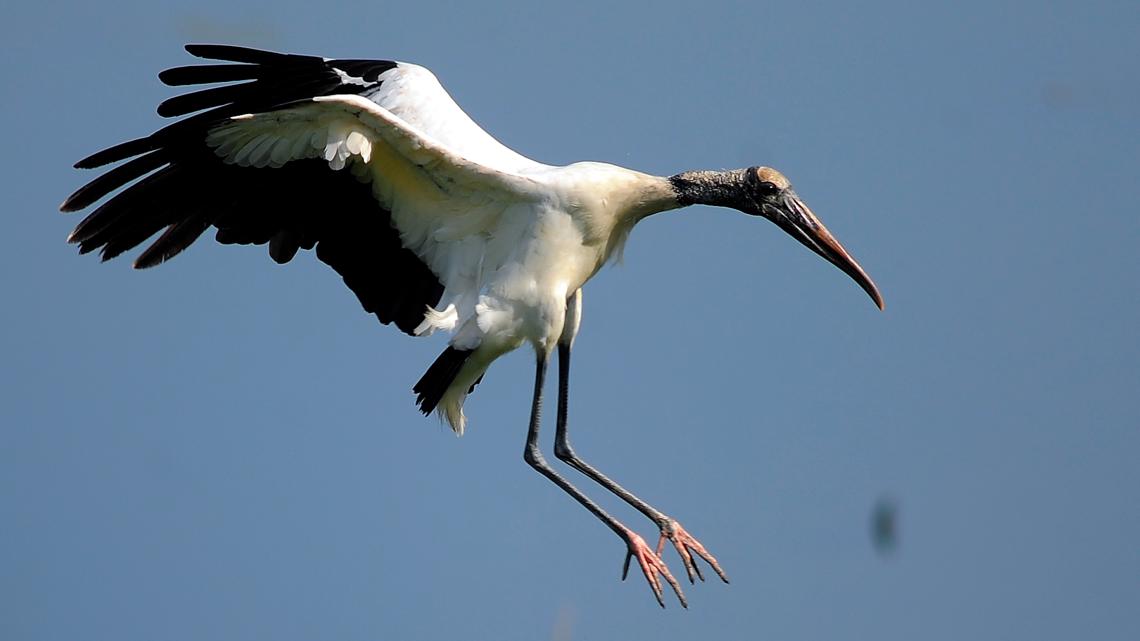
The wood stork, which live and breeds in parts of southeast Georgia as well as other southeastern states, was first listed in 1984.
ATLANTA — A Georgia bird will be delisted from the endangered and threatened species list, the U.S. Fish and Wildlife Service announced this week.
The wood stork, which live and breeds in parts of southeast Georgia as well as other southeastern states, was first listed in 1984 but now has an estimated breeding population of 10,000-14,000 nesting pairs across 100 colony sites, the service said in a release.
In 2022, according to federal documents on the delisting, there were 22 such colonies in Georgia — up from two when the bird was first listed.
The Georgia Department of Natural Resources says wood stork colonies have been documented in 13 counties in coastal and southern Georgia.
The bird’s depopulation by as much as 75% between the 1930s and 1984 was, U.S. Fish and Wildlife said, “largely due to habitat loss, especially in South Florida, where vital wetland areas for breeding and foraging had been severely diminished.”
But thanks in part to conservation efforts, wood storks have “adapted to new nesting areas, moving north into coastal salt marshes, flooded rice fields, floodplain forest wetlands and human-created wetlands,” such as those in southeast Georgia.
At least one advocacy group, the Southern Environmental Law Center, said delisting will put the wood stork colonies in the southeast at risk due to reversals in wetland habitat gains.
“This is a short-sighted and premature move,” the Wildlife Program leader for the group, Ramon McGee, said in a statement. “Wood storks need wetlands to survive, and that habitat is facing overwhelming pressure. It is disappointing that Fish and Wildlife Service largely brushed away serious concerns about how losses to wetlands protections and climate change’s consequences for our coast increase threats to our U.S. population of wood stork.”
There is a 10-year post-delisting monitoring program “to ensure the species’ recovery is maintained,” U.S. Fish and Wildlife said.
The delisting will take full effect on March 12.
“The wood stork’s recovery is a real conservation success thanks to a lot of hard work from our partners,” said U.S. Fish and Wildlife Service Director Brian Nesvik in a statement. “The Trump administration is working quickly to remove federal protections from species that no longer need them, and I’m proud that the wood stork is another example of that.”
The wood stork is additionally important in Georgia as an “indicator species” that can broadly serve as a sign of an ecosystem’s health, according to Georgia DNR.
“There is a direct relationship between the quality of environment and the number/well-being of the indicator species in question,” the state DNR website notes. “By closely observing the wood stork, we can gather crucial information about the surrounding environment and analyze trends overtime.”