
By Richard H. Weiss
Special to the Post-Dispatch

Kevin and Juanita Logan pose in front of their home in the McKinley Heights area of St. Louis.
J.B. Forbes
This story was commissioned by the River City Journalism Fund.
Kevin Logan still recalls the moment an older student in the University of Kansas architecture program pulled him aside. Darren was an upperclassman who had already experienced being a Black student in a sea of white faces. He was schooling Logan and his fraternity brother Cal on how things worked at the campus in Lawrence.
“I’m telling you,” Darren said, “they’re not going to let both of you guys graduate. They’re only gonna let one African American finish the program.” Cal, a model student , seemed destined to be the one who would make it through. Logan, who had already endured what he called a “challenging” experience at St. Louis University High School, heard the warning differently. His “radar” went up.
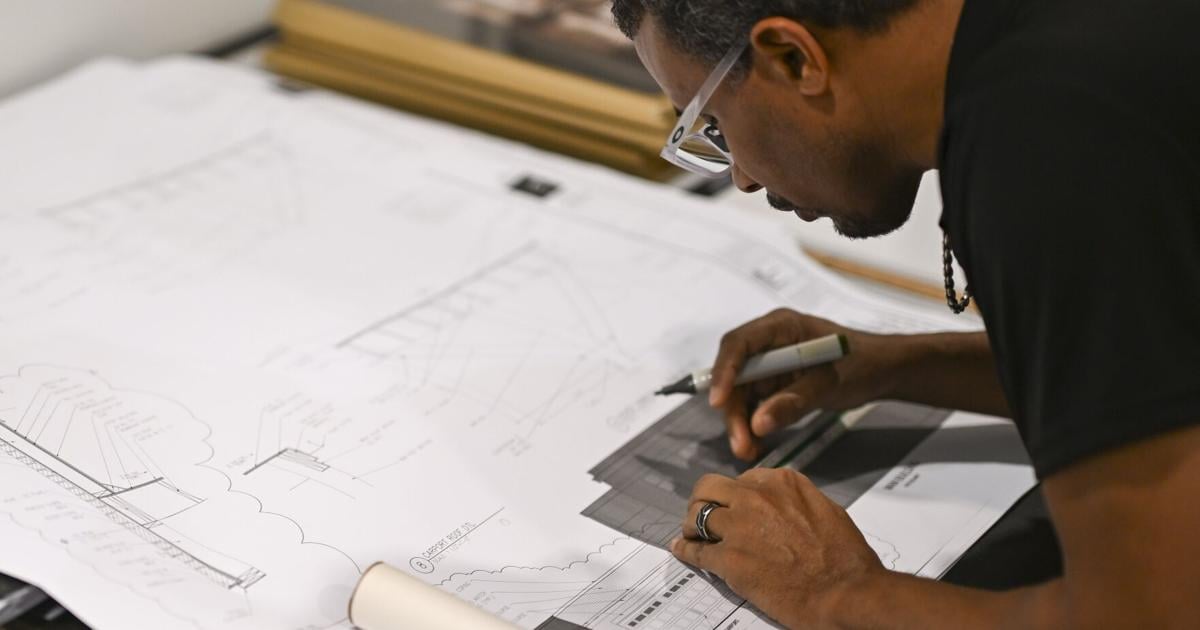
Kevin Logan at work in his basement office.
J.B. Forbes
Then, like clockwork, at the end of a term, a studio professor told Logan he was getting a failing grade — the kind of F that would set him back a full year and effectively end his path into architecture. Convinced he had done solid “B work or better,” Logan marched to the assistant dean’s office, laid out his record, and warned that if he was failed without cause, he would not accept it quietly.
People are also reading…
Victim shot in Starbucks drive-thru in St. Louis was Sado’s GM, figure skating coach
Worthy: Brendan Donovan was the cost the Cardinals paid for falling behind rest of MLB
Woman shot, killed at Starbucks on South Grand in St. Louis
The Rams cash was supposed to transform St. Louis. It’s being used to fill holes.
Missouri Gov. Mike Kehoe ponies up $1 million for new home
Starbucks killing in Tower Grove East was a robbery, charges say
Kratom addiction wiped man’s savings, closed St. Louis County ice cream shop, suit says
Hundreds of St. Louis area high school students continue anti-ICE walkouts
St. Louis-area students plan more walkouts to protest immigration crackdown
A Florissant renter knew her $12,000 water bill was wrong. She’s being evicted for it.
McClellan: The country’s coming apart, and now the vegetable peeler is gone
Mizzou to sell naming rights to football stadium, likely to drop ‘Memorial’ name
Lions Club farmers market is leaving St. Charles, fed up with city taking its cash
Cardinals farm system jumps to No. 2 in Baseball America rankings, highest in 13 years
Woman angry over sushi order fired shot in Kirkwood restaurant, charges say
Weeks later, when his grades arrived at home, the F had become a B.
“I was unhappy that I had to go through that,” Logan recalls, but he went on to have a great experience with the architecture program and graduated proudly with the class of ’95.
As he’s being interviewed, he wears a KU ball cap. He talks about Lawrence as a beautiful town with some of “the nicest people on the planet,” and KU’s architecture program as an elite place that helped launch his career. He sent his son there, who is now majoring in mechanical engineering. He returns to campus twice a year for games and events, and, along with Cal, donated a seat in the architecture school auditorium with both their names on it.
Logan sits inside the house in the McKinley Heights neighborhood he designed for his family — his wife, Juanita; their four children, Kaleb, Kai, Kadence and Kalise; and his mother-in-law, Ida Cothrine. It’s not just a home; it’s a statement — an “I have a dream home” in the spirit of Dr. Martin Luther King.
He built it using minority contractors, including Barry Cosey, a plumber whom he had known for decades; Kane Epperson, a painter and serial entrepreneur; and DeJuan Bateman, a carpenter known for mentoring other young craftsmen.
Logan’s dream home is a measure of their abilities, a rebuke to the institutions that underestimated him and a testament to the persistence that carried him through.
The very private downstairs area outside of the Logans’ family room basement is open on both sides to let in air and light.
J.B. Forbes
Making of a builder
On summer weekends, before he ever learned to draft, Logan worked beside his father, Lloyd — a pharmacist and self-taught craftsman. He took pleasure in teaching Kevin and neighborhood kids about electronics.
Lloyd had become the family breadwinner at a young age after his father died. When he came of age, Lloyd enlisted in the Air Force. He worked on aircraft electronics at Scott Air Force Base and attended St. Louis College of Pharmacy at night.
Lloyd’s multi-tasking continued as he would go on to open two neighborhood pharmacies while also serving many years as a vice president for the Daughters of Charity hospital network, negotiating equipment purchases.
Kevin applied his father’s lessons in resilience, entrepreneurship and craftsmanship into architecture. When he designed his own home, he started with what he had: a modest lot, trusted tradespeople and a habit of seeing how pieces fit together.
A view of the Logan family kitchen. The wall divides the kitchen from the living room.
J.B. Forbes
A view from the third floor of the Logans’ home with windows facing the southside neighborhood.
J.B. Forbes
The lot itself was uneven but high enough to capture a skyline view. Logan studied how light would move through the house, placing windows and rooms deliberately. He reused materials wherever possible. He bought scrap sticks and had them made into a feature wall near the dining area. After digging the foundation, Logan found a lot of stone, which he used for steps and decorative elements. He also found several soda bottles from the 1800s, which are now displayed in their kitchen.
The layout followed real life: open gathering spaces, quiet corners for work, and a first-floor bedroom for his mother-in-law, balancing privacy with connection. “We built it to fit us,” Logan says.
A blueprint for inclusion
With only a few exceptions, Logan hired minority tradespeople for each phase of construction. He worked alongside them when he could, hauling materials and checking levels.
“There’s enough skill in our community,” he says. “People just need to see it.”
For Logan, design begins with listening — sketching, asking questions, paying attention to how people live. Clients sometimes hesitate when he pushes inclusive crews. He lets the work speak.
Evenings in the Logan home still feel like an extension of the build: music from the kitchen, kids at the table, someone sanding a board in the garage.
Logan began his career in the mid-1990s at KAI Design & Build, one of the region’s few large Black-owned firms. Fresh out of school, he found himself cleaning warehouses and running blueprints before teaching himself AutoCAD — computer-aided design software used by architects and engineers to produce precise two- and three-dimensional drawings — and earning real drafting work. He also saw how minority contractors were often included to satisfy Minority Business Enterprise requirements. But in reality, few firms were receiving meaningful opportunities.
After stints at Team Four and co-founding X3 LLC, a tradesmen staffing company, Logan launched Kaelo Architecture in 2012 to build not only projects, but also capacity. “Once you get that opportunity,” he says, “you’ve got to set people up for success.”
Contractor Barry Cosey of Barry’s Sewer and Drain poses for a portrait at on a job site on January 20, 2026 in St. Louis.
Michael Thomas
Craft, character and a chance to build
On his own home, that philosophy became tangible.
Logan met Barry Cosey, the plumber on this project, more than 20 years ago while he was rehabbing one of the family’s earlier homes on Withnell Street, near Benton Park. After a hard freeze, the building was riddled with burst pipes and hidden leaks. Logan had spent days chasing damage that kept multiplying. Cosey walked in, assessed the system, told him the walls needed to be opened so the plumbing could be traced properly — and fixed the problem in a matter of hours. From that point forward, Cosey became Logan’s go-to tradesman.
Much of that steadiness traces back to Cosey’s mother, Lee Affie Brown, who raised 10 children with a discipline that was neither ornamental nor optional. When the family left Mississippi for St. Louis what Brown brought with her was structure — rules that governed money, time and responsibility with the same clarity that plumbing diagrams later governed Cosey’s work.
Cosey remembers a house run on schedules and expectations. Everyone had chores. Everyone contributed. When children grew old enough to earn money, the arrangement was simple: You got a check, the house got a check. It wasn’t punishment; it was preparation. Brown worked nights cleaning a medical building and days in a school cafeteria, but she still managed the household with precision. “Everybody knew their place,” Cosey says. “My mom ruled the house.”
When younger tradesmen ask how he built a business without ever taking out a bank loan or taking shortcuts, Cosey doesn’t talk first about skill. He talks about accountability. “You don’t outgrow what your mother taught you,” he says. “You just apply it somewhere else.”
Through a friend he was able to get that truck, once used by a local television station, for a song, a benefit of building strong relationships with a neighbor who managed the station’s fleet. His truck operates like a rolling workshop, fittings arranged by size, tools cleaned and returned to place each day.
Kane Epperson was hired by Kevin Logan to do custom painting on his house project.
Provided by Kane Epperson
He talks less about hustle than consistency: show up when you say you will, do the job fully the first time and leave people confident enough to call you back. Reputation, he says, travels faster than advertising.
Kane Epperson, the painter on the project, came to construction by a far less direct route. He arrived in St. Louis during the Ferguson unrest after rebuilding his life from a turbulent youth. Painting paid his bills while he also pursued work in music promotion. Over time, the trades proved the more dependable engine of independence.
Epperson approaches painting with an entrepreneurial instinct that goes beyond surface finish. He studies neighborhoods the way promoters study markets — where reinvestment is happening, which streets signal momentum, which small rehabs foreshadow larger change. He reinvested early profits into equipment, vehicles and crews, expanding gradually rather than chasing fast growth.
He talks openly about second chances — not as redemption, but as discipline. Painting gave him structure: early mornings, visible results, accountability to customers. In St. Louis he built his life without inherited networks, relying on word of mouth and visible results. “The paint business bought our house,” Epperson says.
Dujuan Bateman
Dick Weiss
What Epperson values most, though, is control — not over others, but over outcomes. Having spent years navigating industries where gatekeepers dictated opportunity, he takes pride in owning his time and his standards.
Carpenter DuJuan Bateman followed a steadier path: family discipline, technical training and professionalism shaped on job sites. Raised in St. Louis by a family that prized responsibility and routine, he learned carpentry early through sweat equity and technical schooling.
In person, Bateman carries that steadiness easily. He dresses simply — work jeans, a soft-brim cap, a neatly buttoned shirt. He learned how to navigate competition and quiet racism without letting either harden him. Reliability, he believes, becomes its own leverage: when people know you will finish what you start, doors open that arguments never could.
Bateman approaches carpentry the way some people approach caregiving — attentively, anticipatorily, steadily under pressure. He mentors younger workers by explaining not just what to do, but why, translating classroom precision into field judgment. The physical toll of the work is real, he acknowledges, but so is the dignity: skilled workmanship still offers a viable path toward stability, ownership and pride when contractors are treated as full partners rather than placeholders.
Together, Cosey, Epperson and Bateman represent not exception stories but a working ecosystem — one rarely visible to policymakers or developers, yet deeply present on neighborhood job sites.
The fenced northside of the Logan house that the family uses as a patio with a fire pit.
J.B. Forbes
Rebuilding after the tornado
The May 16 tornado damaged or destroyed more than 5,000 homes across St. Louis, many in historically Black neighborhoods.
“There’s so much work out there,” Logan says. “But a lot of big companies are gouging.”
He cites cases of emergency roofing costing tens of thousands of dollars. At the same time, he had already secured several repair projects himself — evidence that minority contractors are ready when opportunity reaches them.
The question now is whether reconstruction will treat minority contractors as true partners or continue old patterns of exclusion. Policy alone won’t solve it, Logan says. Practice will.
Rebuilding, he argues, is not just about structures — it’s about building opportunity, ownership and trust. When the next crane rises in St. Louis, it should lift more than steel, Logan believes. It should lift the people who have long been ready to lead.
Post-Dispatch photographers capture hundreds of images each week; here’s a glimpse at the week of Feb. 1, 2026. Video edited by Jenna Jones.
Post-Dispatch photographers
Richard H. Weiss, a former reporter and editor at the St. Louis Post-Dispatch, is chair of the River City Journalism Fund, a nonprofit organization that addresses the need for stories about marginalized communities in these times and in this town.
Make your house a home
For the holidays: Get inspiring home and gift ideas – sign up now!