
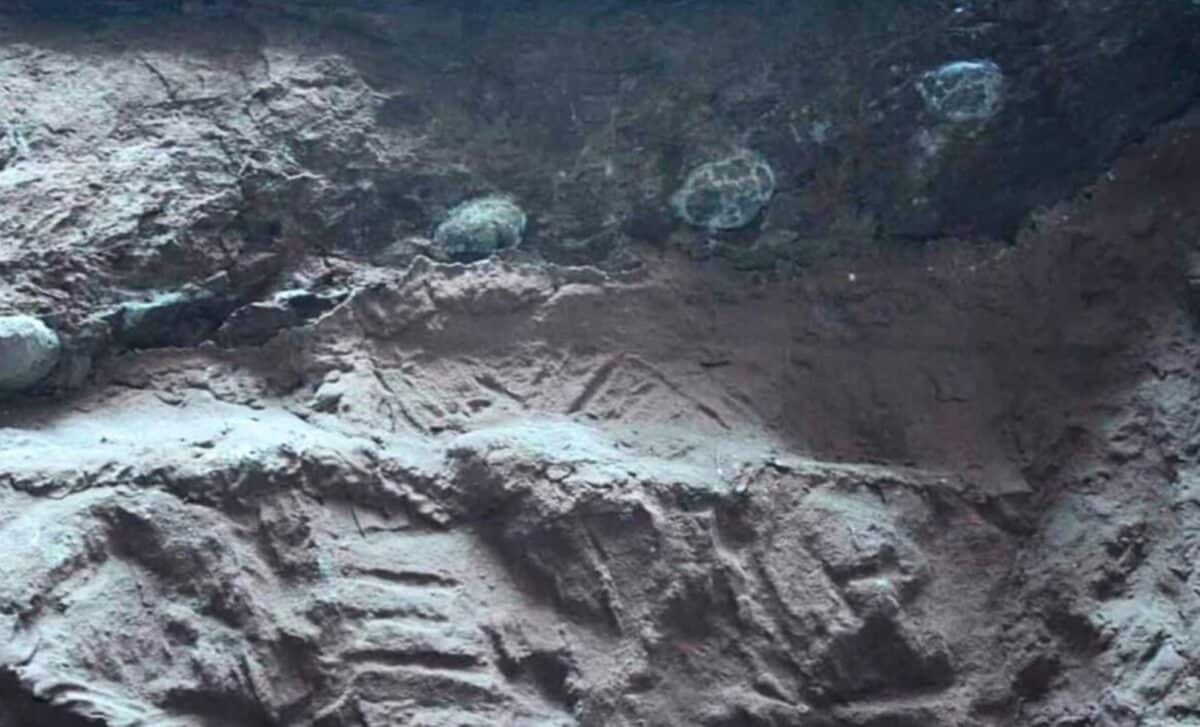
Two nearly spherical dinosaur eggs recovered from eastern China have drawn international attention not because of what they preserved, but because of what they did not. When researchers sectioned the 13-centimeter specimens from Anhui Province, they discovered that their interiors were completely filled with calcite crystals, not embryonic remains.
The eggs were excavated from the Chishan Formation in the Qianshan Basin, a region that had not previously yielded confirmed dinosaur fossils. Their external morphology appeared typical of Late Cretaceous eggs. Internally, however, the shells contained transparent crystalline structures growing from the inner wall toward the center.
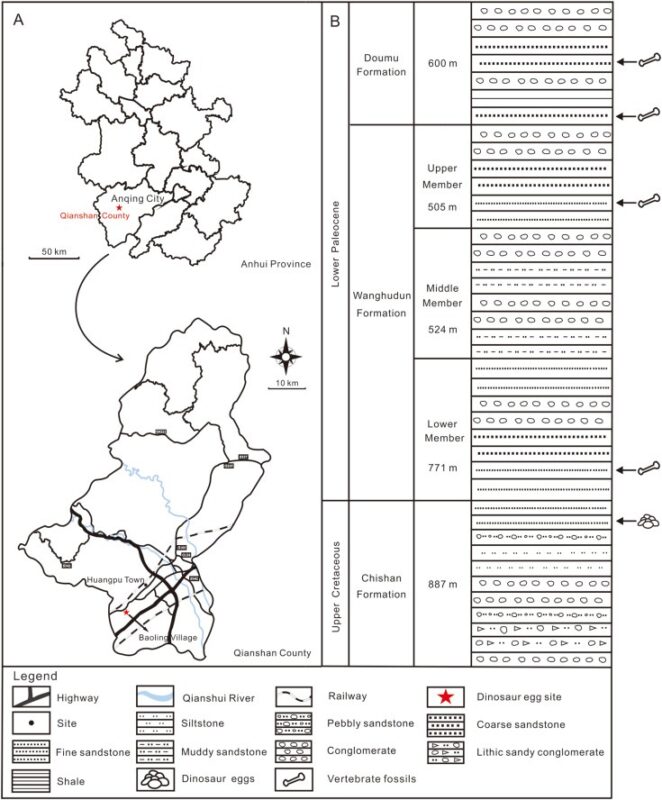 Map showing the location of the newly discovered dinosaur eggs in the Qianshan Basin, Anhui Province, East China. Credit: Journal of Palaeogeography
The findings were formally described in the Journal of Palaeogeography. The peer-reviewed study, available via ScienceDirect, documents the eggs’ microstructure and establishes a new oospecies, Shixingoolithus qianshanensis.
Crystal-Filled Interiors Confirmed in Peer-Reviewed Study
The scientific paper describes the specimens as “nearly spherical in shape,” each measuring approximately 13 centimeters in diameter. The eggs are classified within the oofamily Stalicoolithidae, based on shell thickness and microstructural characteristics.
The defining observation appears clearly in the study:
“The inner space of the egg is completely filled with transparent calcite crystals.”
Researchers further describe “coarse sparry crystal grains growing from the inner wall to the center of the egg.” No embryonic bones, organic residue, or soft tissue were reported. The authors do not claim that embryos were present prior to mineralization, nor do they speculate on whether biological material dissolved before crystallization.
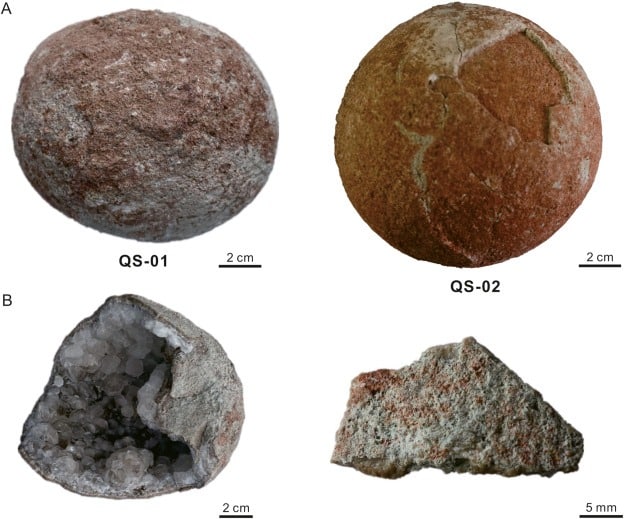 Holotype of Shixingoolithus qianshanensis oosp.nov. from the Qianshan Basin, Anhui Province, East China. A) Two single dinosaur eggs (QS-01 and QS-02); B) The inner and outer surface of QS-01. Credit: Journal of Palaeogeography
Instead, the internal condition is consistent with diagenetic mineralization. After burial, the contents likely decayed or dissolved, leaving a cavity that later filled with mineral-rich groundwater. Over time, calcium carbonate precipitated and crystallized.
The eggs are formally designated as Shixingoolithus qianshanensis. Additional background on the naming and classification process is summarized through institutional reporting by the Nanjing Institute of Geology and Palaeontology, Chinese Academy of Sciences, which outlines the regional geological framework and fossil context.
First Confirmed Dinosaur Fossils from the Qianshan Basin
The study states:
“The discovery of the dinosaur eggs from the Chishan Formation in the Qianshan Basin represents the first report of dinosaur fossils in this basin.”
The authors add:
“This discovery is of great significance for the biostratigraphic division and correlation of the Upper Cretaceous, Paleocene strata in the Qianshan Basin and even in the eastern China.”
This means the fossils serve not only as biological specimens but also as stratigraphic markers. The eggshell microstructure allows researchers to correlate sediment layers across eastern China, anchoring them within the Late Cretaceous geological timeline.
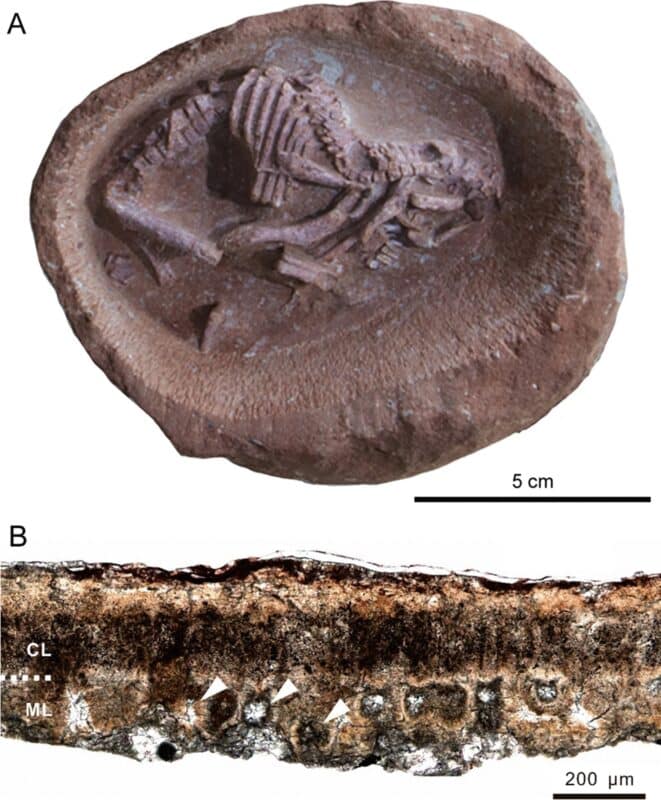 Hadrosauroid eggs and embryos from the Upper Cretaceous (Maastrichtian) from Ganzhou Basin of Jiangxi Province, China. Credit: BMC Ecology and Evolution
Although the strata are broadly dated to around 70 million years ago, no direct radiometric age is provided in the study. The fossils instead rely on lithological and biostratigraphic comparisons within regional formations.
Geological Timing: Close to the K–Pg Boundary
The fossil horizon lies within the closing chapter of the Cretaceous Period, several million years before the Cretaceous–Paleogene boundary, which is widely dated to 66 million years ago.
That boundary is globally associated with the Chicxulub impact event, a massive asteroid collision in present-day Mexico. The environmental consequences of that impact are documented in detail by NASA’s Earth Science Division. The agency explains that the collision triggered:
“A sudden and massive environmental disruption, blocking sunlight and halting photosynthesis across the globe.”
There is no evidence linking the Qianshan eggs directly to that extinction event. The calcite crystallization described in the study is treated as a localized geochemical process rather than a product of global catastrophe. Still, the geological timing places these eggs among the final reproductive traces of non-avian dinosaurs in eastern Asia.
What the Crystal Infill Reveals About Fossil Preservation
The eggshells exhibit three structural layers: an outer ornamented surface, a radial middle layer with columnar units, and an inner prismatic layer. These features justify classification within Stalicoolithidae.
The authors note:
“This new oospecies is more similar to Shixingoolithus erbeni… in eggshell microstructure, but differs in having a more spherical shape and larger eggshell units.”
Without embryonic material, taxonomic assignment is based entirely on eggshell morphology. That limitation underscores a broader preservation bias in paleontology: fossil survival depends not only on biology, but on post-burial chemistry.
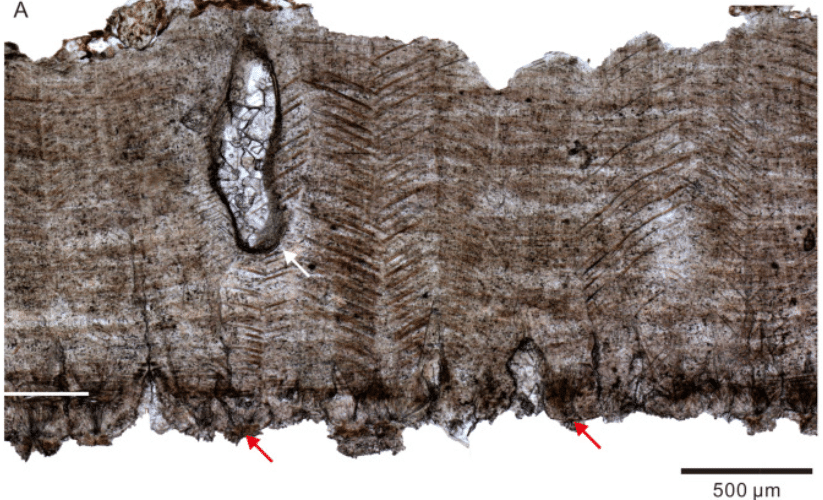 Radial section under polarized light microscope, showing closely arranged eggshell units and the erect or irregular pore canals between eggshell units. White arrow points to pore canal and red arrows point to radial microstructures at the inner end of the eggshell unit. Credit: Journal of Palaeogeography
The Qianshan specimens illustrate how groundwater activity, mineral saturation, and sediment permeability can completely replace biological interiors while leaving external form intact. In other Chinese fossil sites, embryos have been preserved under exceptional conditions. Here, mineralization erased internal biological evidence.
The two described specimens are catalogued as AGM-DU701 and AGM-DU702. They are housed at the Anhui Geological Museum and serve as the holotype and paratype of Shixingoolithus qianshanensis.