

“By the time he reached AIIMS, the financial damage was already done,” added Balhara, who is in charge of the Behavioural Addictions Clinic (BAC), a weekly outpatient service within the Department of Psychiatry and National Drug Dependence Treatment Centre (NDDTC).
 AIIMS, New Delhi | Sneha Richhariya/ThePrint
Balhara told ThePrint that the man was diagnosed with gambling disorder and gaming disorder, formally recognised by the World Health Organization (WHO) as mental health conditions. “For six months after starting treatment, he has not lost more money, but relapse is always a risk,” he said.
The patient is not an outlier.
Since it began operations in 2016, the Behavioural Addictions Clinic (BAC) has been attending to a growing number of patients with non-substance addictions such as excessive internet use, gaming, smartphone and social media dependence. As India’s digital footprint expands, doctors say they are seeing more and more people grappling with problems tied to cellphones, online games, online platforms, and simulated or real gambling.
Many incidents, including the Ghaziabad case involving three minor sisters who jumped to their deaths from the ninth-floor balcony of their apartment, reportedly after their parents restricted their access to cell phones, have drawn attention to heavy exposure to immersive online content.
The Economic Survey 2025-26, tabled in Parliament last month, also flagged digital addiction as a growing risk for India’s youth.
It said that with the number of internet connections growing from 25.15 crore in 2014 to 96.96 crore in 2024, digital dependency had increased among people, severely impacting the mental health of young Indians, particularly those between the ages of 15 and 24.
According to a 2017 research article published in the Annals of the National Academy of Medical Sciences (India), the AIIMS clinic saw a steady rise in consultations.
The clinic received six to seven patients a day when it started in 2016, clinical psychologist Dr Rachna Bhargava, who ran the clinic along with Balhara, told The Times of India. By 2018, the number of people seeking help for internet addiction had doubled, Bhargava told news agency PTI.
Balhara told ThePrint that as people became aware of the clinic, a growing number were seeking help. “We have done some research over the past years, which has shown that there is an increase in prevalence,” he said.
He added that footfall in the clinic doesn’t determine whether there is an increase in digital addiction. “It may simply be because more people are aware. There are many more factors. Maybe there is more phone use in general,” he said.
Also Read: Smartphones are causing a mental health pandemic. Anxious generation needs weekly digital detox
Depression, anxiety & digital addiction
At the AIIMS Behavioural Addictions Clinic, most patients are between the ages of 13 and 18. But patients from other age groups also seek help. “We get people in their 20s and 30s. At times, even elderly people come because their family members think that they are always on the phone and they are just passively looking at the content,” said Balhara.
The clinic has also handled cases linked to online phenomena such as the ‘Blue Whale Challenge,’ the 2017 AIIMS research article had noted.
Dr Rajiv Mehta, senior consultant psychiatrist at Sir Gangaram Hospital, described three broad groups: adolescents whose studies suffer, middle-aged women dealing with loneliness or midlife stress, and older adults who are single or living alone.
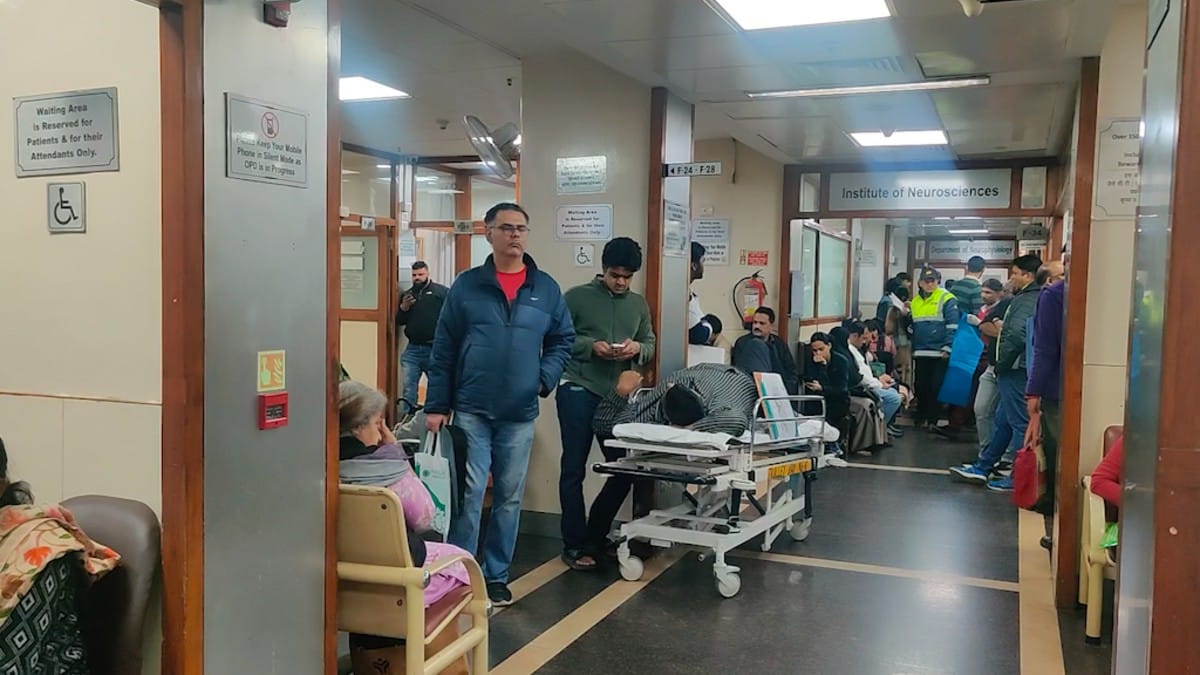 Institute of Neurosciences at Sir Gangaram Hospital in New Delhi | Sneha Richhariya/ThePrint
Dr Rajesh Goyal, vice chairperson of psychiatry at Sir Gangaram Hospital, recalled a 17-year-old student whose marks dropped sharply in Class 12 after scoring 97 percent in Class 10. “He was spending hours on Instagram and Facebook. The ability to focus and execute was affected,” Goyal said. “Teachers said he knew the syllabus but could not perform.”
Dr Samir Parikh, chairperson of the Fortis National Mental Health Program, described another teenager whose excessive online gaming extended into both day and night, disrupting his sleep and daily functioning.
“The adolescent developed irregular sleep-wake patterns, persistent fatigue, irritability, reduced physical activity, and a gradual decline in overall health and psychosocial well-being,” said Parikh, who leads Adayu, a centre focusing on providing residential treatment for acute psychiatric crises.
Mehta said that many fighting couples also come in because they think their partners are always on their mobile phones. “I remember a case where a lawyer brought his 12-year-old daughter for screen dependence. The problem had developed at home—when the child asked for time and attention, the mother, who was herself deeply involved in online gaming, would hand her a second phone instead,” Mehta told ThePrint.
He added that the numbers had risen since the pandemic: “Before COVID, we might have seen one case a month. Now we see two to three such cases every day, especially teenagers.” However, doctors said that high screen time doesn’t always mean addiction.
“Screen time by itself does not mean much,” Balhara said. “It depends on the purpose. A coder or a content creator may spend many hours on screens without addiction.”
The doctor explained that clinically, addiction is about loss of control. “Patients struggle to decide when to start and stop, and continue despite clear harm. Other parts of life—including sleep, meals, studies, work and relationships—are pushed aside,” Balhara said.
“When someone prioritises a screen over sleep, meals, relationships and responsibilities—and still cannot stop despite knowing the damage—that is when we call it addiction.”
Balhara explained that the diagnosis for screen-related addictions is not based only on screen time.
Doctors also look at whether the behaviour causes significant impairment in personal, social, educational, or occupational functioning and persists over a sustained period — typically around 12 months.
This is based on structured assessments and screening tools developed on ICD-11 criteria, the global standard for tracking and comparing health data, injuries, and causes of death.
Doctors say that digital addiction and other mental health issues rarely exist independently.
So, for instance, a teenager who spends nights gaming may develop depression after academic failure and family conflict. At the same time, someone with social anxiety may turn to online spaces because they feel safer there, and gradually lose control.
Mehta described it as a cycle. “Depression and anxiety can lead to digital addiction, and digital addiction can worsen depression and anxiety.”
WHO classification of gaming disorder
In 2019, the World Health Organization (WHO) formally recognised gaming disorder in its International Classification of Diseases (ICD-11), its global standard for diagnosing, recording and tracking diseases and health conditions. Similarly, gambling was also included in ICD-11.
WHO classified gambling disorder under “disorders due to addictive behaviours”. It describes the condition as a pattern of persistent or recurrent gambling where a person loses control, prioritises gambling over daily life, and continues despite harmful consequences.
Several countries have adopted different approaches to curb harmful digital use among young people. Australia has prohibited social media access for children below 16, while China restricts minors’ online gaming time through real-name verification systems.
Singapore emphasises media literacy and cyber-wellness education to promote healthier digital habits, while the UK has introduced a Digital Resilience Framework aimed at schools and online platforms. In addition, many countries have begun limiting or banning smartphone use in classrooms.
Prevention, early detection
The magnitude of the problem led the Indian Council of Medical Research (ICMR) to approve the establishment of the Centre for Advanced Research on Addictive Behaviours (CAR-AB), the first-of-its-kind centre in the country, in February 2025.
The CAR-AB is meant to develop evidence-based interventions targeted at problematic and excessive use of technology, especially among children and youth.
At AIIMS, treatment is now being paired with research. The ICMR-funded Centre for Advanced Research on Addictive Behaviours is undertaking multiple studies to address the growing public health concerns about internet and technology-related addictions among children and adolescents.
“One focuses on developing an AI-based vulnerability prediction model to identify children and adolescents who may be at risk of developing addictive behaviours later in life,” Balhara said.
Researchers are collecting data from schools and colleges to train a machine-learning model that can predict the likelihood of addiction emerging over the next two, five or 10 years.
Another study aims to develop a prevention-focused intervention targeted at students, teachers and parents. “This will be among the first evidence-based prevention programmes in the Indian context. The intervention is expected to begin around April-May this year and will be validated among school and college students,” Balhara said.
In addition, the team is developing screening tools to enable early detection of problematic or addictive internet use, along with a structured counselling module, which is expected to be rolled out next year.
Data collection for the first study on an AI-based vulnerability prediction model has already begun and is scheduled to be completed by April 2026. The research is being conducted across six sites—Delhi, Rishikesh, Shillong, Patna, Bhopal and Puducherry—and will include at least 2,000 students, with a target of 3,000-4,000 participants.
“Analysis is expected to be completed in May, with results likely by the end of the month,” Balhara said. “We don’t tell people to say no to the internet. The internet is not the enemy. Our focus is to stop problematic use and promote safe, healthy use. The goal is control, not complete removal.”
(Edited by Sugita Katyal)
Also Read: #GenerationNowhere: India’s young are fighting an invisible epidemic, smartphone addiction